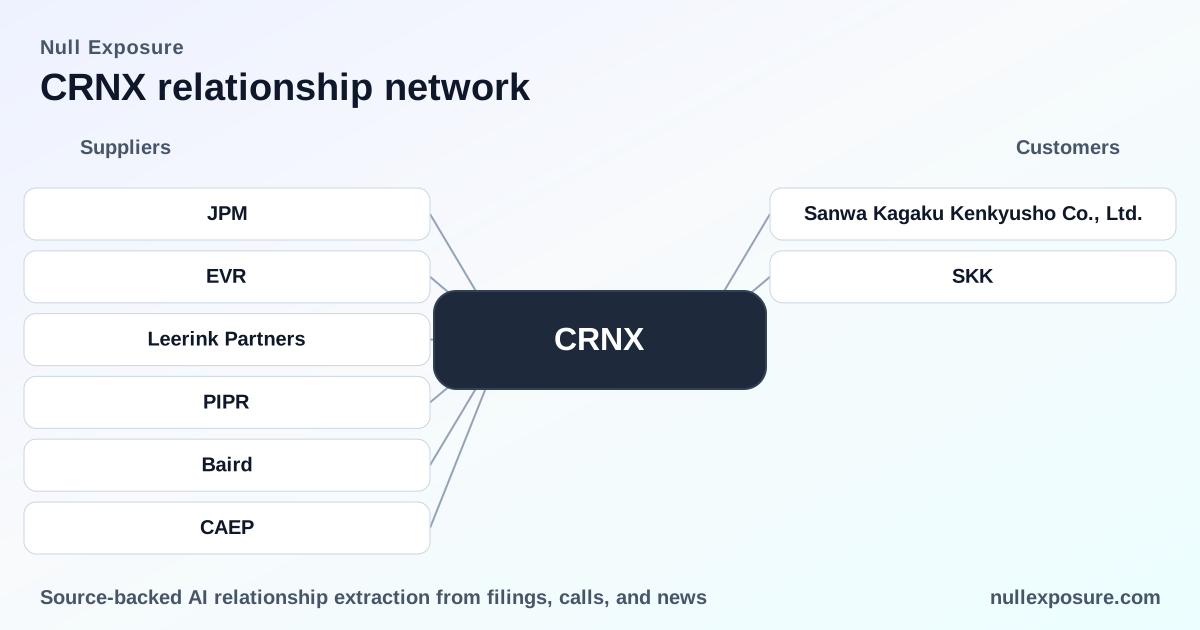
Crinetics Pharmaceuticals (CRNX): supplier relationships that underwrite clinical programs and capital markets activity
Crinetics Pharmaceuticals operates as a clinical-stage drug developer focused on rare endocrine diseases and endocrine-related tumors; it generates value through advancing small-molecule and peptide candidates toward regulatory approval and ultimately commercial sales, funding operations primarily through equity markets, partnerships, and third-party manufacturing and services. Revenue today is negligible relative to market capitalization, while the business model is highly dependent on outsourced manufacturing, CROs, and capital markets to sustain clinical development. For deeper supplier and counterparty intelligence, visit https://nullexposure.com/.
Why suppliers matter for an R&D-heavy biotech
Crinetics’ economics depend on three linked threads: clinical progress to unlock licensing or commercial revenues; reliable third-party manufacturing to supply trials and future launch stock; and access to capital markets to fund multi-year programs. Operational continuity is heavily supplier-dependent — production shortfalls or service interruptions in any of the manufacturing/CRO stack will directly delay clinical milestones and force additional financing. The company’s balance sheet and market valuation reflect high optionality but also high execution risk: revenue TTM is listed at $7.7 million versus a market cap of roughly $3.9 billion, indicating valuation driven by developmental pipeline rather than current cashflow.
Capital markets counterparties tied to a recent equity raise
Crinetics accessed public markets in early March 2026 to raise equity capital, and the news releases consistently name the syndicate of bookrunners. This syndicate constitutes the most visible set of supplier-counterparty relationships in the dataset and is relevant for investors assessing underwriting terms, ongoing access to liquidity, and investor relations.
-
Leerink Partners — Investment bank acting as a joint bookrunning manager on the offering announced in March 2026; the firm is cited in trading coverage announcing the public offering (TradingView, March 9, 2026). Source: https://www.tradingview.com/news/tradingview:d33e0279b115b:0-crinetics-pharmaceuticals-announces-public-offering-of-common-stock/
-
J.P. Morgan — Named as a joint bookrunning manager on the March 2026 public offering, J.P. Morgan participated in syndicate responsibilities tied to pricing and distribution of the deal (TradingView and StockTitan coverage, March 9, 2026). Source: https://www.tradingview.com/news/tradingview:d33e0279b115b:0-crinetics-pharmaceuticals-announces-public-offering-of-common-stock/ and https://www.stocktitan.net/news/CRNX/crinetics-pharmaceuticals-announces-pricing-of-public-offering-of-u8wnihxwo102.html
-
Evercore ISI — Identified among the joint bookrunning managers in the March 2026 offering, supporting deal execution and placement with institutional investors (StockTitan, March 9, 2026). Source: https://www.stocktitan.net/news/CRNX/crinetics-pharmaceuticals-announces-pricing-of-public-offering-of-u8wnihxwo102.html
-
Piper Sandler — Listed as a joint bookrunning manager for the public offering, contributing distribution and syndicate support for the equity issuance (StockTitan, March 9, 2026). Source: https://www.stocktitan.net/news/CRNX/crinetics-pharmaceuticals-announces-pricing-of-public-offering-of-u8wnihxwo102.html
-
Cantor — Included in the syndicate of joint bookrunning managers for the March 2026 offering, aiding capital raise execution and placement (StockTitan, March 9, 2026). Source: https://www.stocktitan.net/news/CRNX/crinetics-pharmaceuticals-announces-pricing-of-public-offering-of-u8wnihxwo102.html
-
Baird — Identified as the lead manager for the offering, Baird’s role implies primary responsibility for coordination and distribution of the deal to its client base (StockTitan, March 9, 2026). Source: https://www.stocktitan.net/news/CRNX/crinetics-pharmaceuticals-announces-pricing-of-public-offering-of-u8wnihxwo102.html
What these relationships mean for operations and liquidity
The composition of the syndicate — a mix of bulge-bracket and specialty healthcare underwriters — signals ready institutional access and an active syndicate willing to underwrite further liquidity events. For operators and procurement teams, that underwriting depth translates to buffer capacity for future financings tied to clinical stage progression. For investors, continued access to these firms reduces the probability of funding-induced program suspensions, assuming normal market conditions.
If you want a structured view of these supplier ties and how they feed into counterparty risk models, explore detailed supplier mappings at https://nullexposure.com/.
Company-level constraints and operating posture (what the filings say)
The public filings and disclosures give a clear picture of Crinetics’ supplier posture and cost structure:
-
Long-term leasing posture: The company reports long-dated real estate commitments (leases with terms that extend into the 2030s and weighted average remaining terms around 10 years), signaling stable facilities commitments and predictable occupancy costs. This is a structural fixed-cost element of the operating model.
-
Outsourced manufacturing and services: Crinetics does not own manufacturing facilities and relies on third-party contract manufacturers and distributors for nonclinical, clinical, and potential commercial supply. The filings list contract manufacturing expense lines (reported as $25,835 in the R&D expense schedule) and operating lease costs ($8.5 million in 2024), indicating meaningful external spend concentrated in manufacturing and logistics.
-
Global footprint for trials and security: Trials are conducted globally, and the company operates a 24/7 cybersecurity threat function to protect distributed systems and third-party integrations — an acknowledgment that supplier risk is geographic as well as functional.
-
Criticality and spend scale: Filings mark third-party manufacturing and CRO relationships as critical to program timelines; contract manufacturing spend places primary external supplier spend in the $10m–$100m band with other line items (leases, services) in the $1m–$10m band, creating medium-to-high supplier concentration in manufacturing.
-
Counterparty type ambiguity: Filings list a broad range of external counterparty types (CROs, trial sites, consultants), reflecting a diverse supplier ecosystem rather than a single dominant vendor.
These constraints shape a company-level profile of outsourced execution, material concentration in manufacturing spend, long-term fixed occupancy costs, and global operational exposure.
Investment implications and short-term watch points
-
Execution risk is supplier risk: Given the reliance on third-party manufacturing and CROs, clinical timelines and eventual commercial readiness will track the strength and redundancy of those supplier relationships. Delays in contract manufacturing will meaningfully shift cash burn and financing needs.
-
Capital markets access matters: The March 2026 syndicate composition demonstrates current market access; continued engagement with these underwriters materially reduces near-term liquidity risk versus a scenario without active syndicate support. Monitor follow-on issuance, lock-up expiries, and syndicate activity as signals of funding runway.
-
Cost structure is set: Long-term leases and high outsourced spend create fixed and semi-fixed cost baselines that compress optionality if clinical programs slow. The company’s current revenue base does not absorb those costs; equity or partner agreements will fund development until approval and commercialization.
For a practitioner-focused breakdown of counterparty roles and to track changes over time, check https://nullexposure.com/.
Final takeaways for investors and operators
Crinetics is a classic clinical-stage biotech: high optionality balanced by supplier-dependent execution risk. The March 2026 underwriting syndicate provides immediate liquidity support, while filings show sustained, material reliance on external manufacturers and service providers under long-term facilities commitments. Investors should underwrite supplier continuity into valuation scenarios; operators should prioritize supplier diversification and contractual protections around capacity and quality. For continuous tracking of these supplier relationships and supplier risk signals, visit https://nullexposure.com/.