Cronos Group (CRON) — supplier relationships and what they mean for investors
Cronos Group operates as a vertically oriented cannabinoid company that cultivates, manufactures and distributes cannabis products, monetizing through wholesale supply agreements, proprietary branded products and third‑party distribution channels. The company’s revenue base is driven by its internal production capabilities (notably Cronos GrowCo), selective use of third‑party manufacturers and distributors, and brand-driven retail sales; margins and cash flow depend on production ramp timing and the cost of raw material procurement. Investors should evaluate Cronos less as a pure consumer brand and more as a hybrid grower-manufacturer whose supplier and intra-group contracts materially influence near-term supply, costs and capacity utilization. Learn more about supplier risk on the homepage: https://nullexposure.com/
Executive snapshot: how supplier relationships shape the story
Cronos’ go-to-market model layers internal production capacity with outsourced services and market intelligence partners. The company’s internal manufacturing arm — Cronos GrowCo (also referenced as Cronos Growing Company Inc.) — functions as both a supplier to Cronos’ other controlled entities and as the primary source of biomass supply under explicit purchase rights. Third parties provide testing, distribution and market-share data used in investor communications. The net effect is a concentrated supply posture where internal capacity ramps and a handful of external relationships determine operational flexibility and cost exposure.
What the contracts and constraints reveal about operating posture
Cronos’ contractual stance includes a mix of rights to purchase production and relatively flexible external supplier agreements. Company-level signals indicate short-term externally cancellable contracts, while the internal GrowCo arrangements give Cronos preferential access to production.
- Contracting posture: Cronos documents state that many external supply agreements do not obligate minimum purchases and allow order cancellation or termination on notice, which signals a short-term, flexible external procurement approach rather than long-term lock-ins (company filings, FY2024).
- Concentration and criticality: Cronos discloses a vendor concentration where a single vendor accounted for at least 10% of trade payables as of Dec 31, 2024, which is material for a company of this size and operational model (Form 10‑K, FY2024). This is an important working-capital and counterparty risk.
- Role and maturity: Cronos both manufactures and buys product through Cronos GrowCo — GrowCo is licensed for production and the supply agreement grants Cronos the right to purchase a large share of GrowCo output, indicating mature internal supply integration (Form 10‑K excerpts and company press materials).
- Geography: The company’s supply footprint includes a significant Canadian component tied to Cronos GrowCo (internal disclosures list Canada at 50% in production allocations).
These characteristics set a supplier risk profile where internal capacity execution is critical and external supplier flexibility limits long-term cost certainty.
Counterparty relationships you need to know
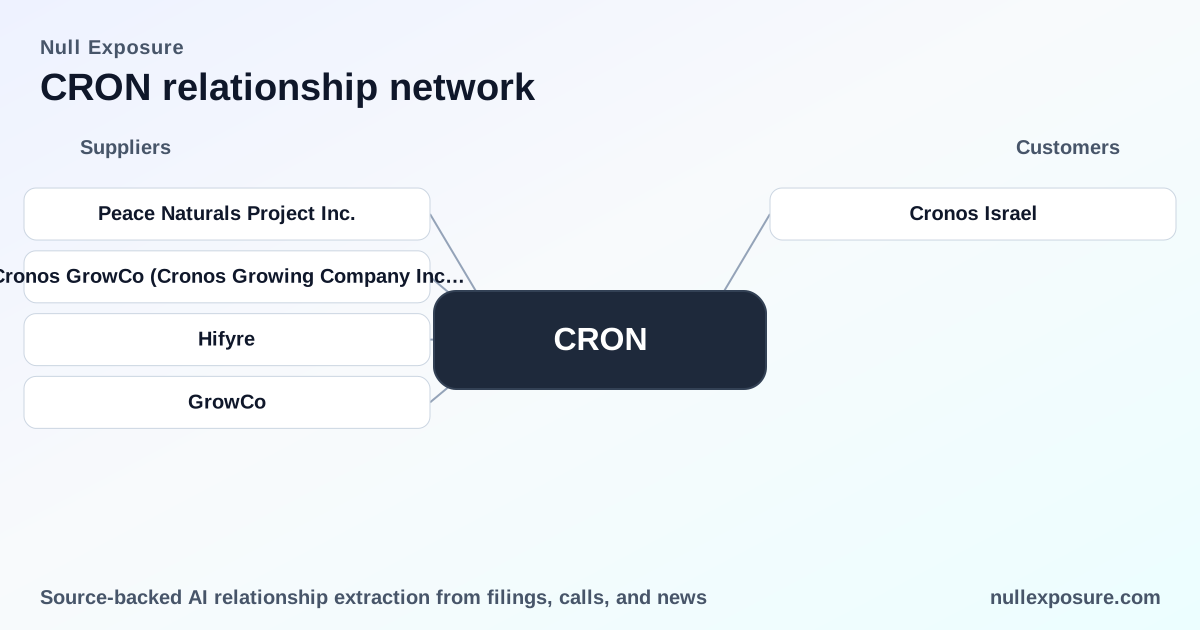
Cronos GrowCo (Cronos Growing Company Inc.)
Cronos GrowCo is the company’s licensed production and manufacturing entity; Cronos retains purchase rights to a majority share of GrowCo’s production (80% before Phase 2 sales ramp, then 70% of forecasted capacity and actual monthly production), making GrowCo central to Cronos’ biomass supply strategy. According to Cronos’ Form 10‑K and subsequent company disclosures, GrowCo is licensed to sell wholesale and export certain products and its facility is authorized for production and manufacturing (Form 10‑K, FY2024; GlobeNewswire press release, Feb 2026).
Peace Naturals Project Inc.
Cronos amended and restated a supply agreement with Peace Naturals Project Inc. on June 20, 2024, establishing an explicit contractual supplier relationship between Cronos Growing Company Inc. and Peace Naturals (Form 10‑K, FY2024). This agreement signals Cronos’ continued reliance on partner suppliers to supplement internal production capacity.
Hifyre
Hifyre is cited as the source for market-share data used in Cronos’ investor communications; during the Q4 2025 earnings call transcript Cronos indicated that market share information referenced on the call was provided by Hifyre, meaning the company relies on external market analytics to validate competitive positioning (InsiderMonkey transcript, Q4 2025 earnings call, published Mar 2026).
GrowCo (as referenced in media coverage)
Independent market commentary references GrowCo capacity as a primary near-term catalyst for earnings and product availability, underlining the company-level dependence on internal production ramps for the success of new product rollouts like vape lines (SimplyWallSt analysis, March 2026). Media coverage highlights how product launches alone do not substitute for the structural dependence on GrowCo’s capacity ramp.
What these relationships mean for financial risk and upside
Cronos’ supplier map creates a leverage point: successful GrowCo execution reduces procurement risk, lowers cost of goods sold and supports brand expansion; conversely, delays or underperformance materially compress margins because external supplier agreements are generally short-term and cancellable. The vendor concentration disclosure (10% of payables tied to a single vendor) indicates working capital and counterparty exposure that investors must monitor in quarterly payables and vendor roll‑forward disclosures.
- Upside driver: Effective utilization of GrowCo capacity to support branded SKUs and margin recovery.
- Key risk: Supplier concentration and the flexible nature of external contracts provide limited downside protection if internal production underdelivers.
Explore deeper supplier analytics and monitoring on the homepage: https://nullexposure.com/
Tactical takeaways for investors and operators
- Prioritize monitoring the operational cadence of Cronos GrowCo: reported production volumes, Phase 2 expansion milestones and month-to-month fulfillment stats will move the valuation faster than product marketing announcements.
- Watch trade payables and vendor concentration in the quarterly filings for signs of stressed counterparties or shifting payment terms; a vendor representing ≥10% of payables is a material operational risk.
- Treat third‑party data partners and testing labs as operational enablers rather than primary value drivers; their role is supportive but necessary for compliance, market intelligence and distribution.
Final assessment and action items
Cronos has structured a supplier ecosystem that privileges internal production while keeping external supply contracts short and flexible. That architecture delivers optionality if GrowCo scales on schedule, but it also concentrates operational risk into a small number of supplier and internal-production relationships. For investors and operators focused on execution and downside protection, the next twelve months of production reporting and vendor-payable disclosures are the most actionable indicators.
For a structured review of how supplier relationships affect portfolio exposure, visit our main page: https://nullexposure.com/ — and subscribe for alerts on counterparty shifts and filing-driven risk signals.