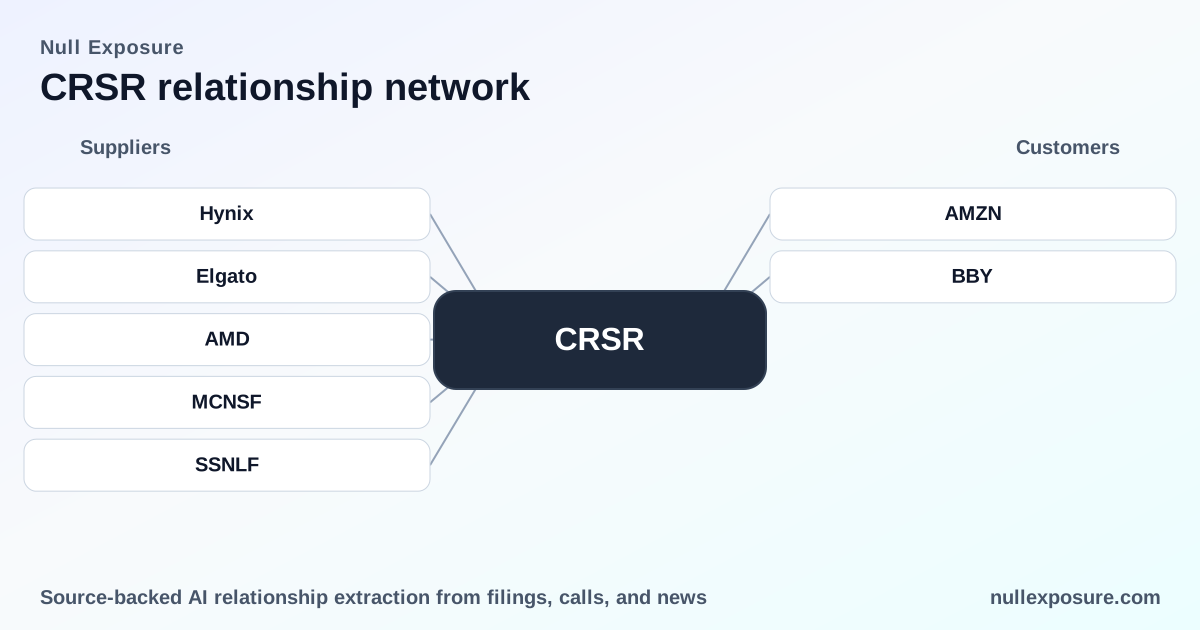
Corsair Gaming (CRSR): supplier map and what it means for investors and operators
Corsair Gaming monetizes by designing, marketing and distributing gaming peripherals, components and systems worldwide, capturing margins across branded hardware, bundled software and channel distribution. Revenue is driven by hardware sales (keyboards, mice, memory modules and small form-factor systems) sold through wholesale distributors and direct channels; gross profit depends on control of component supply and third‑party manufacturing. For investors evaluating supplier risk, Corsair’s operating profile is a mix of inventory intensity, geographic supply concentration in APAC, and reliance on a small set of component partners. Explore a consolidated supplier view at https://nullexposure.com/.
Quick take: the business model you’re buying into
Corsair’s business converts component procurement into branded products sold through distribution and direct retail. The company’s FY‑2025 topline of roughly $1.47 billion, with gross profit of about $426.6 million, signals a low price‑to‑sales valuation (P/S ~0.38) and an operating model where component sourcing and manufacturing execution materially drive margin outcomes. Institutional ownership is high, and near‑term guidance and product cadence (new systems and peripherals) make supplier continuity a core investment risk.
Supplier relationships — the partners you need to track
Below I cover every supplier relationship disclosed in the available results, with plain-English summaries and source notes.
Hynix — DRAM supplier for memory modules
Corsair uses DRAM ICs produced by Hynix in its DRAM modules, making Hynix a direct component supplier for a core product line. According to Corsair’s FY2024 10‑K, the company lists Hynix alongside other major DRAM producers as sources for memory chips.
Source: FY2024 10‑K filing (Corsair).
Micron — another primary DRAM source
Corsair lists Micron as a producer of DRAM ICs used in its DRAM modules, indicating multi‑vendor sourcing for memory components that feed Corsair’s channel and retail memory products. This disclosure is in the same FY2024 10‑K that catalogs DRAM suppliers.
Source: FY2024 10‑K filing (Corsair).
Samsung — DRAM supplier in the component stack
Corsair explicitly uses Samsung‑produced DRAM ICs in its modules, placing Samsung among the trio of memory suppliers integral to Corsair’s module manufacturing and inventory planning, per the FY2024 10‑K.
Source: FY2024 10‑K filing (Corsair).
Elgato — software/hardware integration for streamer products
Corsair’s Elgato brand provides the Stream Deck experience and marketplace that integrates with Corsair’s streaming and broadcast peripherals, with configuration handled by Elgato’s Stream Deck software that supports plugins and profiles. A product review referring to a Corsair keyboard with integrated Stream Deck functionality highlights Elgato’s software role in the product ecosystem.
Source: product coverage on basic‑tutorials.com (March 2026 news post).
AMD — CPU/GPU partner for systems business
Corsair’s systems division leverages AMD Ryzen AI Max processors in at least some AI‑ready ORIGIN PC systems, demonstrating a supplier relationship for CPUs and platform compatibility in Corsair’s compact workstation offerings. A TechPowerUp report covering Q2 2025 product announcements references Corsair’s AI Workstation 300 powered by AMD Ryzen AI Max 300 Series.
Source: TechPowerUp coverage of Corsair’s Q2 2025 product release.
What the supplier map implies about operational constraints
Corsair’s public disclosures and the relationship set above highlight several company‑level operating constraints that investors and operators must weigh:
- Contracting posture — long‑term real estate and distribution commitments. Corsair reports property leases and distribution center arrangements that extend into the 2030s, and about 327,000 square feet of third‑party distribution space under contract, indicating multi‑year fixed commitments that reduce short‑term flexibility on warehousing and logistics costs (FY2024 10‑K).
- Geographic concentration — high APAC exposure. Manufacturing and component production are concentrated in China, Taiwan and Southeast Asia, which centralizes supply risk in regions known for seismic activity and other natural hazards (company filing).
- Materiality and criticality — supply continuity is strategic. DRAM and CPU suppliers are critical to Corsair’s ability to ship core memory products and systems; the 10‑K warns that natural disasters affecting third‑party manufacturers could severely disrupt operations, highlighting high dependency on a handful of component sources.
- Relationship roles and maturity — distributors and contract manufacturers are core. Corsair uses third‑party manufacturing facilities and large distribution contracts, signaling mature, operationally embedded supplier relationships rather than ad hoc sourcing.
- Relationship stage — active oversight. The company is actively developing processes to oversee third‑party service providers and suppliers with access to critical systems, indicating an ongoing governance and risk‑management posture.
These constraints translate into two practical investor implications: supply shocks have direct margin consequences, and operational leverage from fixed lease and distribution commitments amplifies both upside and downside.
Explore more supplier risk mapping and use cases at https://nullexposure.com/ — the full supplier context is central to scenario analysis.
Risk and opportunity — how suppliers affect valuation
- Risk: Concentration in APAC manufacturing and dependence on three DRAM vendors (Samsung, Micron, Hynix) create a correlated risk profile for memory‑related revenue and margin. A regional disruption in APAC would directly pressure gross margins and fulfillment, and long‑term lease obligations limit short‑run cost mitigation options.
- Opportunity: Multi‑vendor sourcing across Samsung, Micron and Hynix gives procurement optionality that can be leveraged for competitive pricing when renegotiating supply contracts; partnerships with AMD and Elgato support product differentiation (AI‑ready systems, integrated streaming tools) that can sustain higher ASPs for premium SKUs.
Actionable signals for investors and operators
- Monitor DRAM market pricing and APAC logistics indicators; sharp DRAM cost moves will have a direct and measurable impact on Corsair’s gross margin profile given the disclosed supplier set.
- Track lease and distribution capacity utilization: fixed warehousing exposure increases operating leverage, so inventory turns and channel fill rates will be early indicators of margin pressure or relief.
- For product roadmaps, watch AMD platform adoption in Corsair systems and Elgato software integration as revenue diversification levers that can offset cyclical hardware demand.
For a deeper, interactive view of supplier ties and constraints, visit https://nullexposure.com/ and review the supplier intelligence tools that map these relationships.
Bottom line
Corsair’s supplier footprint is straightforward but consequential: memory chip relationships with Samsung, Micron and Hynix are material to product continuity and margins, while Elgato and AMD relationships support product differentiation in streaming and AI‑ready systems. The operating model combines long‑term distribution and real‑estate commitments with APAC production concentration, creating both leverage and vulnerability. Investors and operators should treat supplier dynamics as a first‑order variable when modeling Corsair’s near‑term earnings sensitivity and longer‑term competitive positioning.