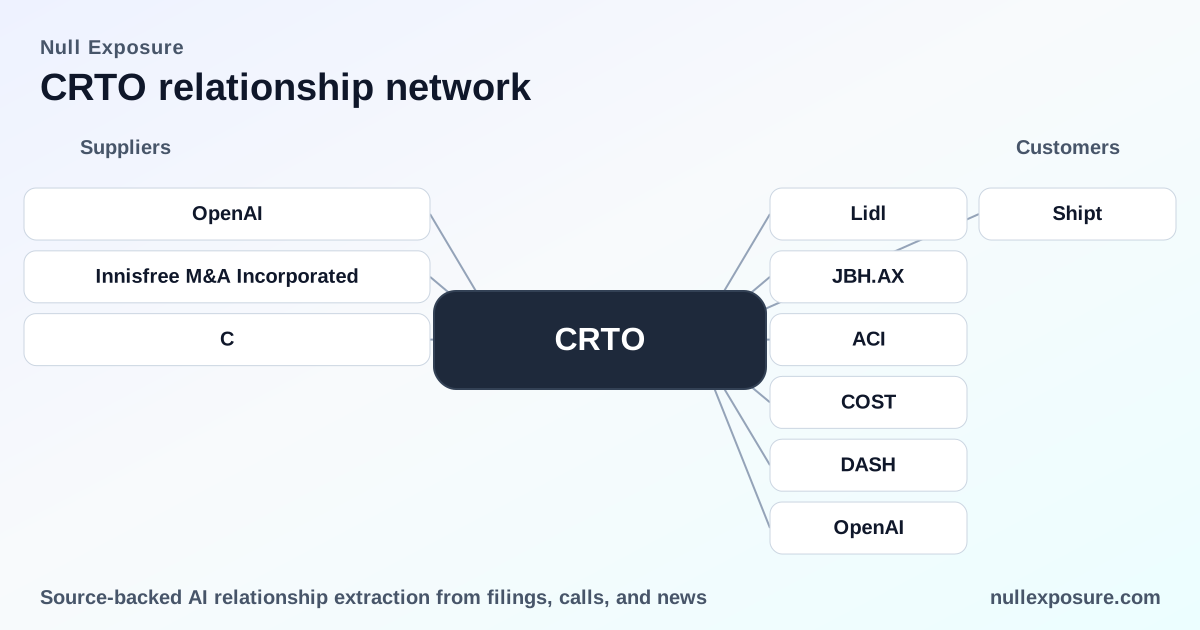
Criteo (CRTO): Supplier relationships that drive the economics of an ad-tech marketplace
Criteo monetizes by buying and selling attention at scale: it purchases impressions and traffic from publishers and exchanges on a usage (CPM) basis, applies its targeting and bidding technology across retail and performance media, and charges advertisers for outcomes. The company’s revenue mix has shifted away from pure retargeting toward retail media, and its cost base is dominated by traffic acquisition, making supplier contracts a core driver of margins and cash flow. For a fast, structured briefing of third‑party exposure across suppliers and partners, visit https://nullexposure.com/.
How Criteo’s supplier posture determines valuation outcomes
Criteo operates as a high‑volume, variable‑cost merchant of digital advertising inventory. Traffic acquisition costs (TAC) represent a large and volatile portion of cost of revenue, implying that gross margins and operating leverage hinge directly on procurement terms with publishers, exchanges and cloud/data center providers. The company splits its infrastructure across Americas, EMEA and APAC regions and leases data center space while also using major public cloud services, which creates a hybrid supplier stack that is both geographically distributed and layered between usage‑based ad buys and contracted hosting services.
- Contracting posture: Predominantly usage‑based for media buys (CPM) with a mix of leased and cloud hosting engagements for operations.
- Concentration and criticality: Procurement of impressions is material to revenue generation; hosting and cloud services are critical for platform uptime and latency.
- Maturity and negotiability: Media buy relationships are transactional and price‑sensitive; hosting contracts trend toward multi‑year leases and cloud agreements with service SLAs.
What the public relationship signals are — OpenAI, Innisfree, Citigroup
Below I cover every supplier/partner mention surfaced in the review. Each entry is a concise, plain‑English takeaway followed by a source note.
OpenAI
Criteo became the first ad‑tech partner in OpenAI’s ChatGPT advertising pilot (announced March 2, 2026), reflecting a strategic push into contextual and conversational advertising as retail/first‑party channels grow; Criteo has also shifted revenue mix with retargeting down from roughly 90% in 2020 to about 40% by end‑2024. Source: reporting referencing Criteo’s involvement in OpenAI’s pilot (ppc.land, March 2026).
Innisfree M&A Incorporated
Innisfree is acting as Criteo’s proxy solicitation firm for shareholder communications around FY2026 corporate actions, providing contact details for investors and proxy matters — a standard governance/service relationship rather than an operational supplier. Source: investor/proxy notice referencing Innisfree contact details (Yahoo Finance, FY2026).
Citigroup Global Markets Inc
Citigroup is listed among ordinary shareholders/market intermediaries in Criteo’s SEC filing materials, indicating Citigroup’s role as a capital markets counterparty or custodian/broker dealer in CRTO equity transactions. Source: SEC filing excerpt presented on a filings aggregator (StockTitan, FY2026).
Why these relationships matter to investors and operators
The three named relationships are diverse: strategic product partnership (OpenAI), governance/proxy services (Innisfree), and capital markets/intermediary role (Citigroup). None singlehandedly determines Criteo’s operating performance, but together they illuminate the company’s commercial orientation:
- Product diversification and revenue mix: The OpenAI partnership signals deliberate movement into new ad placements and formats that reduce dependence on pure retargeting and contestable inventory pools.
- Corporate governance readiness: Innisfree’s involvement shows standard institutional preparation for shareholder engagement and M&A processes.
- Capital markets access: Citigroup’s appearance in filings underscores normal broker/dealer relationships necessary for liquidity, ADR/sponsor activity, or block trading.
Commercial constraints that shape supplier risk (company‑level signals)
Criteo’s supplier exposure can be summarized through the following company‑level constraints derived from filings and disclosures:
- Usage‑based media procurement is dominant. Traffic acquisition costs are primarily CPM purchases from publishers and exchanges, making the firm a large buyer of third‑party impressions (confidence strong). This creates direct revenue sensitivity to CPM pricing and inventory availability.
- Global operations across three regions. Infrastructure is organized into Americas, EMEA and APAC, with data center footprint in the U.S., France, the Netherlands, Singapore and Japan, which distributes operational risk but demands multi‑jurisdictional supplier management.
- Traffic acquisition is material to margin. TAC represents a significant share of cost of revenue (evidence shows TAC roughly at the high 40s percent of revenue in cited figures), establishing supplier terms as materially determinative of gross margin volatility.
- Dual role with third parties. Criteo functions as both a buyer of media inventory (transactional buys) and a service consumer for hosting/cloud providers, producing mixed bargaining dynamics across supplier classes.
These constraints translate into key operational characteristics: high variable cost exposure, need for diversified inventory supply, and dependence on resilient hosting infrastructure to maintain yield and platform performance.
Practical implications for investors and operators
- For investors: Monitor TAC trends and CPM dynamics as leading indicators of margin trajectory; product partnerships (like OpenAI) are positive for diversification but will only improve margins if they command better yield or lower procurement cost per conversion. Institutional ownership is high, and valuation multiples imply the market prices in operating leverage opportunities.
- For operators: Focus negotiation and analytics on inventory sources that produce higher yield versus cost, and maintain multi‑region hosting redundancy to safeguard program performance and advertiser SLAs.
- Governance and capital markets relationships are standard but confirm that Criteo is prepared for investor engagement and block trading activity.
If you want a deeper supplier risk map or a tailored briefing for underwriting or vendor negotiations, start here: https://nullexposure.com/.
Bottom line and actions
Criteo’s economics are defined by volume‑driven, usage‑based media buys and a geographically distributed hosting model. Product moves into retail media and conversational formats (OpenAI) are strategically important but require measurement against procurement cost trends to deliver durable margin expansion. For investors, the key monitoring signals are TAC percentage, CPM and yield per placement, and the pace of revenue diversification away from retargeting.
For operational teams and dealmakers, prioritize contracting that reduces TAC volatility and secures multi‑region capacity. Learn more or request a supplier exposure analysis at https://nullexposure.com/.
Bold decisions on procurement strategy and partnership monetization will determine whether Criteo converts its distribution scale into sustained margin improvement.