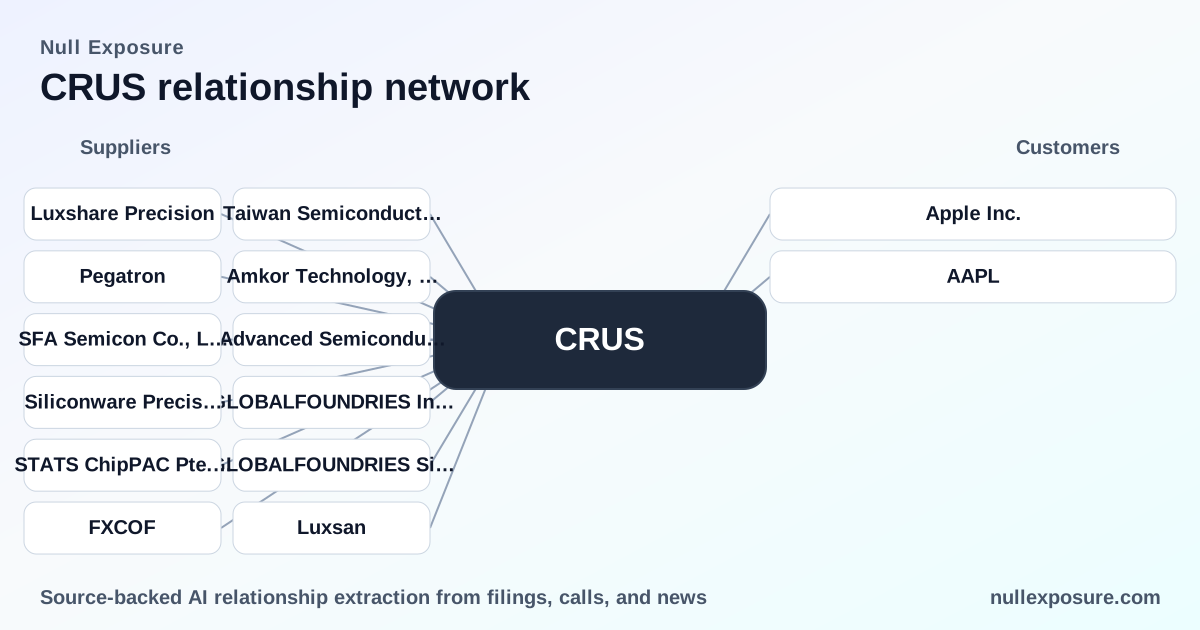
Cirrus Logic (CRUS): a concentrated, foundry-dependent supplier footprint investors must price in
Cirrus Logic is a fabless semiconductor company that designs high‑precision, low‑power mixed‑signal audio and voice integrated circuits and monetizes by selling finished ICs to consumer electronics OEMs and contract manufacturers; manufacturing and packaging are outsourced to third‑party foundries and assembly/test houses while the company recognizes product sales and associated margins. With roughly $1.97 billion in trailing revenue and a market cap near $6.9 billion, Cirrus’s economics are driven by design/IP margins but entirely dependent on external wafer capacity and packaging partners—a structural fact that shapes cash flow volatility, supply risk, and capital commitments. For a concise supplier-risk snapshot and comparative supplier intelligence, visit https://nullexposure.com/.
Supplier strategy in one line: Cirrus outsources wafer fabrication to multiple foundries (primarily GLOBALFOUNDRIES and TSMC) and uses several global assembly/test houses while maintaining material long‑term capacity commitments and concentrated trade receivable exposure to a small set of contract manufacturers.
What the supplier map tells investors about CRUS’s operating leverage
Cirrus operates with a classic fabless contracting posture: it owns product and design but no fabrication capacity, so third‑party manufacturers and packagers are critical to revenue delivery. The FY2025 filings show a mix of dual‑sourcing (TSMC and GlobalFoundries) for wafers and a roster of established assembly/test vendors (ASE, Amkor, SPIL, STATS ChipPAC, SFA). At the same time, Cirrus has entered long‑term wafer capacity and pricing commitments: a Capacity Reservation and Wafer Supply Commitment Agreement with GLOBALFOUNDRIES Singapore that covers calendar years 2022–2026, and an amendment in February 2025 that allocated the remaining wafer quantities by quarter. According to the FY2025 10‑K, total future unconditional purchase commitments stood at roughly $617 million, concentrated in 2026–2027—evidence of meaningful forward spend and fixed obligations that investors must capitalize into forecasts.
Key operating constraints and what they mean:
- Long‑term commitments reduce short‑term price/supply volatility but create forward fixed spend that impacts flexibility and downside protection if end‑market demand softens.
- Supplier concentration creates single‑point exposure: several contract manufacturers account for a large share of consolidated gross trade receivable, which transfers counterparty and collection risk onto a few entities.
- Active contractual management is in place: the February 2025 amendment to the GF agreement signals operational coordination over delivery pacing rather than passive procurement.
For a deeper supplier‑risk monitor and tailored alerts, see https://nullexposure.com/.
The relationships investors must track (entity‑by‑entity)
Below I cover every supplier relationship disclosed in the FY2025 10‑K with a concise, investor‑focused takeaway and the source.
-
Taiwan Semiconductor Manufacturing Company (TSMC)
Cirrus reports that it uses a variety of foundries and is primarily supplied by TSMC and GLOBALFOUNDRIES for wafer production; TSMC is therefore a primary source of advanced wafer capability for Cirrus products. According to Cirrus Logic’s FY2025 Form 10‑K, TSMC is named alongside GLOBALFOUNDRIES as a principal foundry supplier. -
GLOBALFOUNDRIES Inc.
GLOBALFOUNDRIES is identified as a primary foundry supplier and is the counterparty to Cirrus’s multi‑year capacity reservation and wafer supply commitments, making it a strategic production partner. The relationship and contractual commitments are described in the company’s FY2025 10‑K. -
GLOBALFOUNDRIES Singapore Pte. Ltd.
Cirrus entered a Capacity Reservation and Wafer Supply Commitment Agreement with GLOBALFOUNDRIES Singapore on July 28, 2021 that covers wafer capacity and pricing for calendar years 2022–2026; an amendment dated February 18, 2025 defined the quarterly spread of remaining wafer quantities. This is explicitly documented in the FY2025 10‑K and cited as the basis for the long‑term capacity posture. -
Advanced Semiconductor Engineering, Inc. (ASE)
ASE is listed among Cirrus’s primary assembly and test houses, responsible for packaging and final test that turn wafers into ship‑ready devices, as stated in the FY2025 10‑K. -
Amkor Technology, Inc.
Amkor is likewise identified as a primary assembly and test provider, forming part of the outsourced packaging network Cirrus uses to deliver finished product to customers (FY2025 10‑K). -
STATS ChipPAC Pte. Ltd.
STATS ChipPAC is included in the list of primary assembly and test houses used by Cirrus to complete device packaging and testing before shipment, per the FY2025 10‑K. -
Siliconware Precision Industries Co., Ltd. (SPIL)
SPIL is named among the principal assembly/test vendors, confirming Cirrus’s reliance on a diversified—but industry‑standard—set of packagers (FY2025 10‑K). -
SFA Semicon Co., Ltd.
SFA Semicon is cited as a primary assembly and test house used in Cirrus’s outsourced manufacturing chain (FY2025 10‑K). -
Foxconn (aggregated parent for contract manufacturing)
Foxconn, aggregated at the parent level, represented 41% of consolidated gross trade accounts receivable as of the end of FY2025, indicating substantial working capital exposure and distribution reliance routed through that contract manufacturer (FY2025 10‑K). -
Luxsan (contract manufacturer)
Luxsan, aggregated at parent level, represented 21% of consolidated gross trade accounts receivable at the end of FY2025, underscoring another concentration of receivable exposure (FY2025 10‑K). -
Luxshare Precision
For FY2024, Luxshare Precision appeared as one of three contract manufacturers (with Foxconn and Pegatron) and was reported to represent about 11% of consolidated gross trade accounts receivable, highlighting multi‑year counterparty concentration in contract manufacturing (FY2025 10‑K). -
Pegatron
Pegatron was reported in FY2024 as accounting for roughly 10% of consolidated gross trade accounts receivable, completing a triad of contract manufacturers that together drove a large share of receivable concentration (FY2025 10‑K).
What investors should price into models now
- Supply‑side outsized importance: foundry and assembly partners are not interchangeable in the near term; long‑lead wafer capacity commitments and packaging certifications create operational lock‑in that increases recovery time from shocks. The GF Singapore agreement through 2026 is a tangible example.
- Concentration of credit and logistics exposure: receivable concentration with Foxconn, Luxsan, Luxshare and Pegatron creates counterparty credit risk and distribution single‑points that can amplify revenue volatility if one partner delays shipments or collection.
- Material forward commitments: the company disclosed roughly $617 million in future unconditional purchase commitments, implying non‑trivial fixed spend that should be amortized into scenario financials for demand downturns.
- Active supplier management is in place: the February 2025 amendment to the GF agreement indicates Cirrus is actively pacing wafer deliveries, which is a positive operational control signal.
Monitor the following closely: quarterly updates on wafer allocation and delivery schedules, receivable aging tied to the named contract manufacturers, any re‑pricing or extension of the GLOBALFOUNDRIES Singapore agreement beyond 2026, and incremental disclosure around TSMC volumes.
For ongoing supplier alerts and to integrate these supplier signals into your investment process, go to https://nullexposure.com/.
Bottom line and next steps for the investor
Cirrus Logic’s business model delivers attractive design margins but transfers manufacturing, capacity, and credit risk to a small set of foundries, assembly houses, and contract manufacturers. The GF Singapore long‑term commitment and the FY2025 receivable concentration are the two supplier facts that should move your valuation assumptions—they both reduce some forms of spot risk while introducing fixed‑cost and counterparty concentration risks that affect downside scenarios.
If you run scenario models, explicitly stress the $617 million of future purchase commitments and simulate 90‑day and 180‑day disruptions to the largest contract manufacturers. For continuous updates and supplier‑risk dashboards relevant to CRUS and peers, visit https://nullexposure.com/.