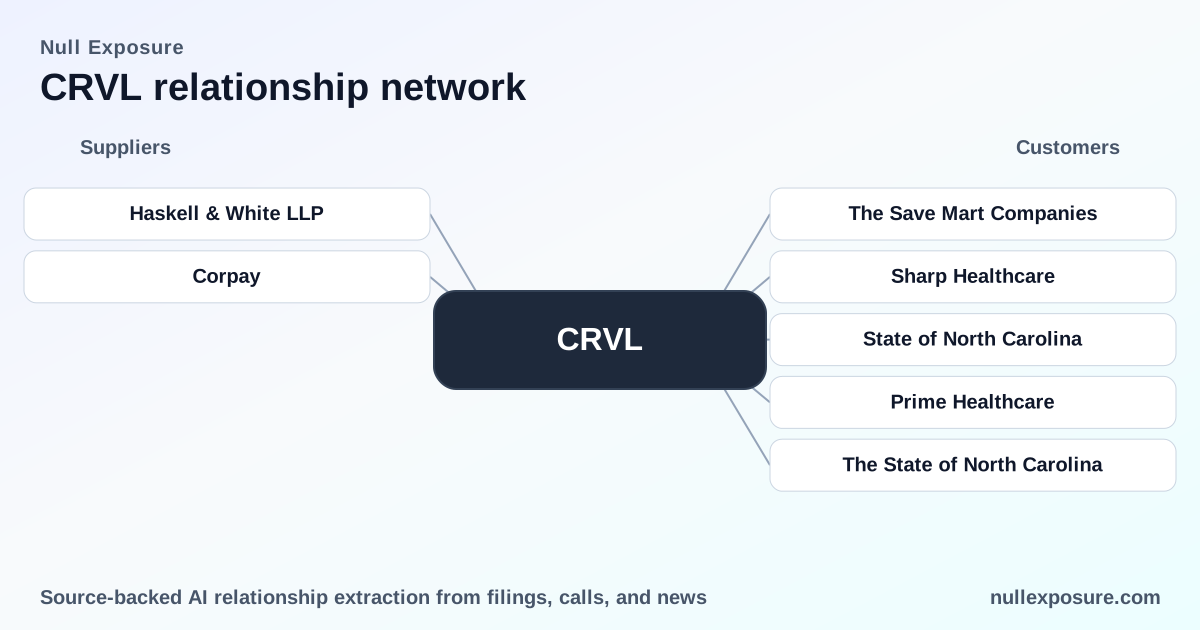
CorVel (CRVL): Supplier relationships, strategic constraints, and what investors should price in
CorVel monetizes a vertically integrated suite of claims and care-management services for workers’ compensation, auto, liability and health payors. The business captures fee-for-service revenue as a third‑party administrator and insurance services vendor, leveraging a proprietary national PPO network, directed-care programs, and value-added payment products to control medical costs and capture margins from utilization management and payments processing. For investors, supplier relationships reveal how CorVel externalizes specialty functions (payments, clinical networks, audit) while retaining contractual control over service delivery and financial flows—an important driver of both margin stability and operational risk.
If you want continuous monitoring of supplier signals for strategic diligence, visit the NullExposure homepage: https://nullexposure.com/
Two supplier relationships that matter today
Haskell & White LLP — auditor (governance partner)
Shareholders ratified the appointment of Haskell & White LLP as CorVel’s independent registered public accounting firm in FY2026, reflecting the company’s current external audit relationship and governance posture. According to an FY2026 filing aggregated on an SEC filings site, the vote passed overwhelmingly (48,879,993 For), underlining shareholder acceptance of the firm for statutory reporting and controls oversight. Source: SEC filing summary reported on StockTitan (FY2026).
Corpay — payments partner for Symbeo, a CorVel company
CorVel’s Symbeo unit launched a payments product built in partnership with Corpay to streamline B2B payments, automate invoice approval and expand working capital flexibility for customers. A July 25, 2023 GlobeNewswire release describes the collaboration as enabling automated invoice and payments approvals with centralized controls to reduce manual processing and cost. Source: GlobeNewswire press release (July 25, 2023).
What these relationships reveal about CorVel’s operating model
-
Contracting posture: CorVel operates with multi-year operational commitments where relevant. The company reports lease agreements with remaining terms between one and eight years, signaling a mix of short‑to‑medium-term fixed obligations for facilities and likely predictable operating rent exposure. This is a company-level signal rather than being specific to any supplier relationship.
-
National footprint and network scale: CorVel maintains a proprietary national PPO network comprising over 1.2 million providers as of March 31, 2025, and supplements it with leased network agreements to ensure coverage. This breadth reduces geographic concentration risk and underscores the company’s strategy of owning access to care as a competitive asset; it also raises the criticality of provider network management as a supplier-risk vector.
-
Principal / service-provider posture: For third‑party services tied to pharmacy, directed care, and ancillary networks, CorVel acts as the principal—directing third parties, managing utilization review, directing payments to providers, and accepting the associated financial risk of loss. That contractual structure concentrates operational control within CorVel and increases both the company’s margin capture potential and its operational exposure if network performance degrades.
-
Maturity and integration: The Corpay–Symbeo partnership illustrates a move to integrate payments capability into the claims stack, reducing manual workflows and unlocking working capital benefits. The appointment of an external auditor is a governance maturity signal; together, these elements indicate a company that is scaling integrated services while formalizing external oversight.
Risks and opportunities investors should price
-
Opportunity — margin leverage from integrated services. CorVel’s role as principal across its service lines allows the company to capture not only fees for care coordination but also benefits from payment-processing and network optimization, supporting the ~11% net profit margin and ~31% ROE reported in the trailing metrics.
-
Risk — operational concentration on network and payments performance. The business case depends on sustained network quality and tight execution of payments and utilization-control tooling; underperformance in either area could erode realized savings and revenues because CorVel accepts financial risk in certain service arrangements.
-
Risk — contractual and lease obligations. Multi-year leases (1–8 years remaining) create fixed-cost commitments that reduce near-term flexibility in a downturn and increase the importance of stable revenue to cover obligations.
-
Governance and audit continuity. The shareholder ratification of Haskell & White LLP for FY2026 is a governance stability indicator; changes in audit relationships can affect reporting cadence and investor confidence, although the recent vote confirms continuity. Source: SEC filing summary on StockTitan (FY2026).
-
Valuation context. Market capitalization (~$2.75B), trailing P/E ~26 and EV/EBITDA ~14.8 position CorVel in a premium segment relative to basic third‑party administrators; investors should assess whether further integration of payments and network services will expand multiples or if execution risk constrains re-rating. Source: company financial snapshot (latest TTM).
If you want structured signals like these delivered to your workflow, see how NullExposure surfaces supplier relationships: https://nullexposure.com/
Tactical takeaways for sourcing, procurement, and investor due diligence
- Prioritize contract clauses that preserve control over network performance (quality metrics, remediation rights, audit access) since CorVel’s principal role concentrates risk on service outcomes.
- Treat payments partnerships (Corpay + Symbeo) as both a working-capital lever and an operational dependency; vendors that reduce float increase cash conversion but add technical and counterparty risk.
- Monitor lease roll schedules and facility exposure given the 1–8 year remaining lease profile; leasing risk is a predictable fixed-cost vector that influences operating leverage.
- Keep audit and reporting continuity on the watchlist; auditor changes are governance events with potential for short-term market reaction.
Bottom line and next steps
CorVel’s supplier footprint shows a deliberate strategy: own or control the operational levers that drive savings (provider network, utilization management, payments), outsource specialized functions under tight contractual control, and codify governance through external audit relationships. That model supports profitability and ROE but embeds operational execution risk around network and payments performance and leaves modest fixed-cost exposure via multi-year leases.
For investors focused on supplier-risk signals and operational diligence, NullExposure provides continuous supplier relationship tracking and constraint analysis: https://nullexposure.com/
Contact NullExposure for a tailored supplier-risk screen and deeper coverage of CRVL counterparties.