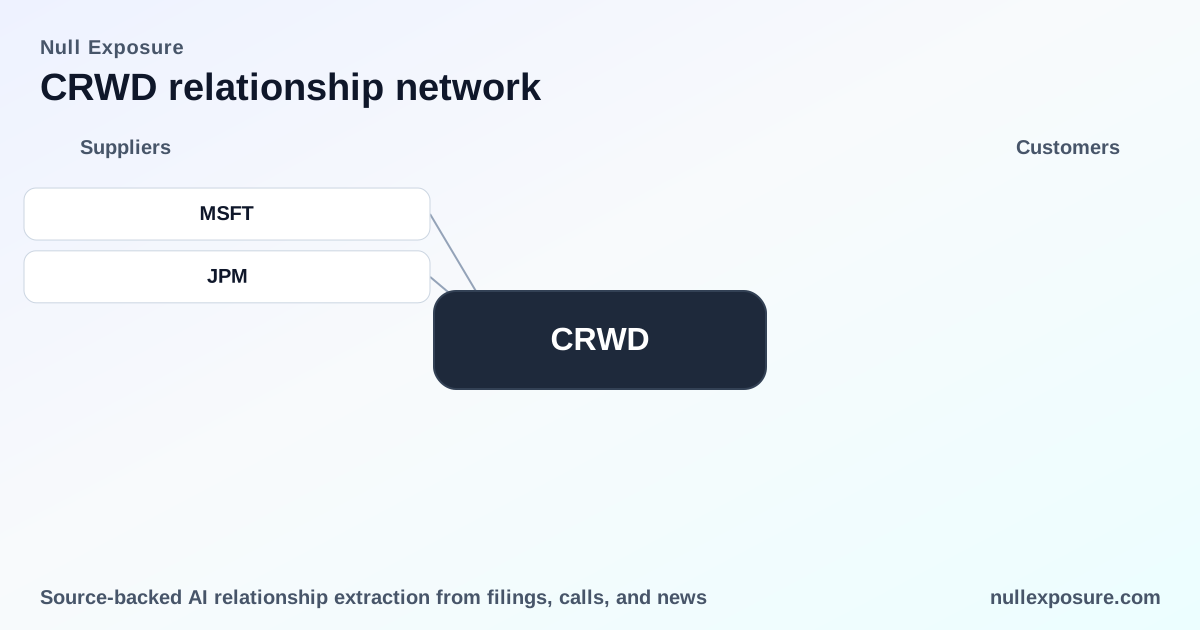
CrowdStrike Holdings (CRWD) — supplier relationships and operating constraints that matter to investors
CrowdStrike sells a cloud-native cybersecurity platform (Falcon) to enterprises and governments, monetizing primarily through subscription licensing, cloud consumption and professional services, while expanding distribution via marketplaces and OEM/channel partnerships. Revenue is recurring and gross-margin driven; growth depends on distribution scale, cloud footprint, and access to financing and enterprise channels. Explore how supplier relationships and company-level constraints shape operational risk and go-to-market leverage. For more curated supplier insights, visit https://nullexposure.com/.
Snapshot for investors: the commercial model in two lines
CrowdStrike’s business model is subscription-first: customers pay recurring fees for endpoint and cloud workload protection delivered from CrowdStrike’s cloud platform. Key monetization drivers are seat/endpoint growth, upsell of cloud workload modules, and distribution through partners such as cloud marketplaces. Fiscal metrics: $4.812B revenue TTM and $107.5B market cap (latest quarter Jan 2026) underline the scale and valuation premium investors assign to recurring security software.
What the headline supplier relationships are and why they matter
Microsoft Corporation — marketplace distribution accelerates go-to-market
Microsoft and CrowdStrike expanded their partnership so customers can buy CrowdStrike Falcon directly through the Microsoft Marketplace and apply existing Azure consumption toward those purchases, materially shortening procurement friction for Azure-centric customers. According to a news summary on March 9, 2026, this expansion explicitly enables purchases through Microsoft’s marketplace and ties CrowdStrike licensing to customers’ Azure spending (https://finviz.com/news/330263/openai-funding-gives-microsoft-msft-stock-breathing-space; also reported at https://www.insidermonkey.com/blog/openai-funding-gives-microsoft-msft-stock-breathing-space-1709156/).
Why it matters: marketplace distribution converts platform affinity into a sales channel, increasing velocity and lowering sales cycles for enterprise customers that are already standardized on Azure. That channel also raises partner concentration risk if a disproportionate volume shifts to one cloud marketplace.
JPMorgan Chase Financial Company LLC — financing and advisory ties
JPMorgan and its affiliates disclose that they currently or from time to time engage in business with CrowdStrike, including extending loans, making equity investments, or providing advisory services, indicating a standard banking relationship that can support capital markets activity and lending needs (SEC prospectus supplement referenced via StockTitan, March 2026: https://www.stocktitan.net/sec-filings/AMJB/424b2-jpmorgan-chase-co-prospectus-supplement-f8f7341cfa4f.html).
Why it matters: access to large banking relationships supports liquidity, M&A advisory and capital markets execution at scale; investors should track the terms and frequency of such engagements as they influence funding optionality and balance-sheet flexibility.
Company-level operating constraints and what they imply for resilience
CrowdStrike’s disclosures indicate several supplier and infrastructure signals that shape operational risk and contracting posture:
- Geographic footprint: The company operates data center co-location facilities in the United States and Europe and uses third-party data centers in both regions. This establishes a transatlantic infrastructure footprint that reduces single-region dependency while exposing the firm to cross-jurisdictional compliance demands and localized operational risk (company disclosure).
- Service-provider posture: CrowdStrike contracts with third-party information-technology providers for software, platform and infrastructure services. This is an intentional outsourcing model that prioritizes rapid scale and specialization over vertical integration, but it increases vendor management complexity and supplier concentration exposure.
Taken together, these constraints imply a contracting posture that is outsourced and partner-reliant, with moderate geographic diversification (NA and EMEA) and an operational criticality focused on cloud and data-center continuity. The model shows maturity in channel strategy—marketplace partnerships and large-bank relationships—balanced against the typical operational risks of third-party infrastructure.
(For enterprise buyers and procurement teams, review vendor SLAs for data residency, incident response, and continuity given the dual-region co-location approach.)
For actionable supplier intelligence and deeper supplier-mapping, see https://nullexposure.com/.
Investment implications and risk checklist
Investors and operators should track the following, each rooted in the supplier relationships and constraints above:
- Distribution risk vs. growth upside: Marketplace deals with Microsoft accelerate adoption but concentrate go-to-market exposure; measure how much ARR flows through marketplace channels over time.
- Infrastructure dependency: Third-party data centers in NA and EMEA reduce CapEx but create critical operational dependencies; monitor service-level credits, redundancy and cross-region failover plans.
- Financial counterparty exposure: Large banking relationships provide capital optionality; review recent prospectus language and debt covenants to assess flexibility.
- Regulatory and data-residency pressure: European operations require alignment with GDPR and local rules; cross-border processing agreements and vendor controls should be transparent.
- Vendor-management maturity: Outsourcing requires strong procurement, contracting and security oversight; look for evidence of mature vendor governance in filings and customer disclosures.
How operators and procurement teams should act
Operators negotiating with CrowdStrike should insist on explicit SLAs for data residency, breach notification and cross-region failover, and quantify how marketplace purchases affect licensing terms and discounts. Procurement teams should benchmark the share of spend routed through Microsoft Marketplace versus direct subscriptions to avoid unexpected pricing inflections as distribution scales.
Bottom line for investors
CrowdStrike’s go-to-market and operational posture is partner-centric and cloud-native: marketplace partnerships drive faster enterprise adoption while third-party infrastructure supports rapid scale with attendant vendor and regional risk. The Microsoft marketplace expansion is a clear commercial accelerant; the disclosed banking ties underpin financing flexibility. Investors should weigh recurring revenue quality and channel concentration against operational dependencies on third-party data centers and service providers.
Continue monitoring supplier dynamics and contractual constraints via curated coverage at https://nullexposure.com/.
For direct access to supplier relationship intelligence and tailored research, visit https://nullexposure.com/ for subscription and contact options.