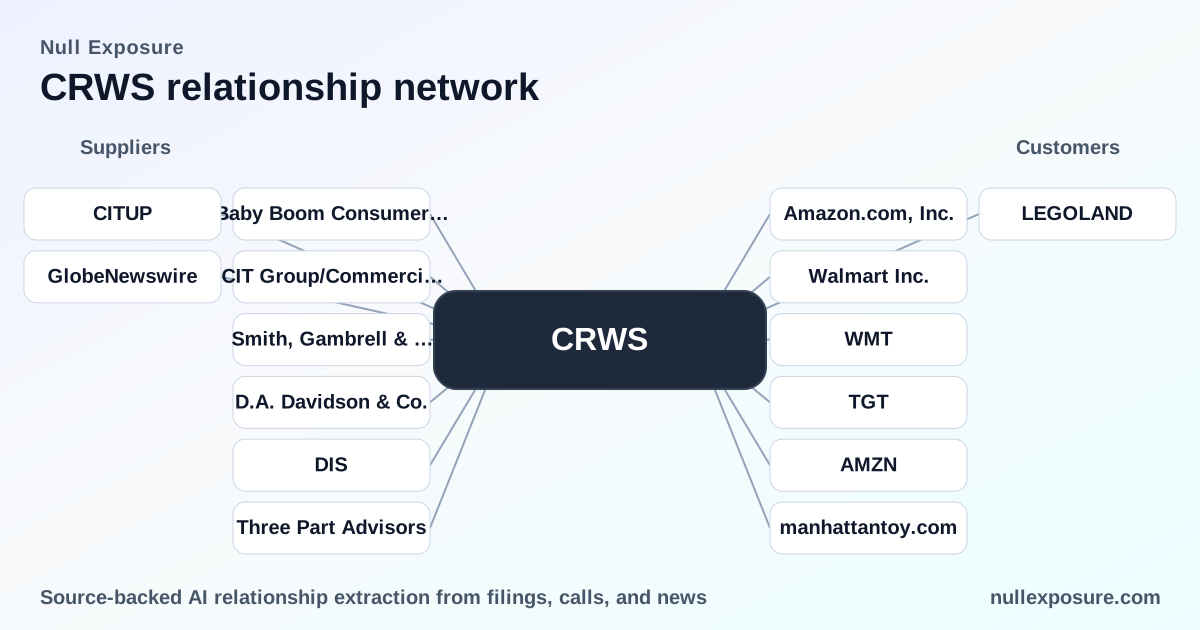
Crown Crafts (CRWS): Supplier Relationships and Commercial Risk Profile
Crown Crafts operates as a designer, marketer and reseller of infant, juvenile and adult bedding products and accessories, monetizing primarily through retail and licensed product sales sold to major retailers and specialty channels. The company outsources production to foreign and domestic contract manufacturers (large concentration in China), captures margin via brand and licensed-royalty economics, and augments growth through small acquisitions financed with short-term debt. For investors, the thesis is simple: earnings are sensitive to licensing revenue concentration, supply-chain geography, and access to working capital financing. Learn more on the supplier map at https://nullexposure.com/.
How Crown Crafts makes and scales revenue — the business model in plain terms
Crown Crafts sources designs and trademarks (many under license) and sells finished goods through retail channels. Licensed products accounted for roughly half of gross sales in FY2025, reflecting a business model that depends as much on intellectual property relationships as on product manufacturing and distribution. Manufacturing is largely outsourced, with China as the primary production base, which lowers fixed capital intensity but increases geographic concentration risks and logistics dependency.
Contracting posture, concentration and maturity are meaningful:
- Contracting posture: Licensing dominates and is predominantly short-term — licensing agreements generally run one to three years, creating recurring renegotiation and renewal events.
- Concentration and criticality: Licensed products are material to revenue (50% of gross sales in FY2025), and licenses with Disney-affiliated companies represented 21% of sales, making a handful of licensors strategically critical.
- Maturity: Crown Crafts operates in a mature, low-growth retail segment; it offsets that by leveraging licensed IP and periodic bolt-on acquisitions funded with bank debt.
These characteristics create a hybrid risk profile: low capital intensity and steady SKU turnover, coupled with high dependency on license economics and concentrated manufacturers.
The relationship map — what each partner means for investors
Baby Boom Consumer Products, Inc.
Crown Crafts acquired substantially all assets of Baby Boom Consumer Products for $18.0 million in cash on July 19, 2024, strengthening its product portfolio and revenue base. This was disclosed in Crown Crafts’ FY2025 10‑K filing (filed March 30, 2025).
CIT Group / Commercial Services, Inc.
CIT provided an $8.0 million term loan and additional revolver borrowings that funded the Baby Boom acquisition, highlighting the company’s reliance on third‑party credit for inorganic activity. The FY2025 10‑K identifies CIT as the lender for that transaction.
Smith, Gambrell & Russell LLP
Smith, Gambrell & Russell served as legal adviser to Crown Crafts on the Baby Boom acquisition, indicating outside counsel support for M&A and contract work tied to corporate transactions. A report in ROI‑NJ on July 23, 2024 records Smith Gambrell’s legal role on the deal.
D.A. Davidson & Co.
D.A. Davidson acted as financial adviser to Crown Crafts on the Baby Boom acquisition, showing use of boutique investment banking for deal execution and valuation support. ROI‑NJ’s July 23, 2024 coverage lists D.A. Davidson in that capacity.
Disney (affiliated companies)
Licensed sales include a substantial program with affiliates of The Walt Disney Company that accounted for 21% of sales in FY2025, and management referenced new Disney licensing initiatives in Canada beginning January (product transitions under discussion with major retailers). The FY2025 10‑K quantifies the Disney exposure, and a March 2026 earnings transcript covered the Canadian licensing initiative (reported via The Globe and Mail/Motley transcript).
Three Part Advisors
Three Part Advisors is identified as Crown Crafts’ investor relations firm for fiscal 2025, indicating outsourced IR and a point of contact for market communications. Crown Crafts’ Q1 FY2026 release and teleconference details (August 2025) list Three Part Advisors as the IR contact (QuiverQuant/GlobeNewswire distribution).
CIT Group (news reference)
A news item duplicated the role of CIT as the debt provider for the Baby Boom acquisition; this reinforces the lender relationship and the company’s dependence on banking partners for acquisition financing. ROI‑NJ and related press on the July 2024 transaction reiterate CIT’s financing role.
GlobeNewswire
GlobeNewswire distributed Crown Crafts’ investor communications (e.g., Q1 FY2026 release), and a press distribution was noted in QuiverQuant’s August 2025 notice; the distribution channel serves as the company’s public disclosure mechanism. QuiverQuant flagged the GlobeNewswire distribution for the quarter’s results.
What the relationships imply for risk and opportunity
- Revenue leverage to licensing: With licensed products representing 50% of gross sales and 21% tied to Disney affiliates, renewal and licensing terms are top-down drivers for revenue and margin. This is a structural concentration risk that also creates pricing and margin upside when renewals are favorable.
- Supply-chain concentration: The company’s manufacturing footprint is concentrated in China, which reduces capital spending but increases exposure to tariffs, freight volatility and regional disruption. Outsourced manufacturing also implies operational flexibility but reduces control over lead times.
- Short-term contracts and renewal cadence: Licensing agreements generally run 1–3 years, producing frequent negotiation points and revenue volatility around renewals; management signals an intent to renew, but renewal economics will determine near-term profitability.
- Financing posture: Crown Crafts has used borrowings (term loan and revolver) to fund acquisitions — evidence that the company relies on accessible credit lines for strategic moves. That expands optionality but introduces leverage-related cash‑flow constraints in weaker retail cycles.
How investors should act (practical next steps)
- Monitor quarterly disclosures for licensing renewal terms and any changes in Disney-related sales; an adverse renewal would be the single largest single‑counterparty risk.
- Watch working capital lines and covenant language tied to the CIT relationship; financing availability will dictate Crown’s ability to execute small acquisitions and manage inventory.
- Evaluate supply‑chain signals (shipping costs, lead times from China, inventory days) alongside retail sell-through to reconcile licensing revenue with actual order fulfillment.
Explore deeper supplier relationships and screening tools at https://nullexposure.com/ to track counterparty concentration and contract maturity in real time.
Bottom line
Crown Crafts combines low-capex, outsourced manufacturing with license-driven revenue concentration and selective acquisition funding. That structure yields operational flexibility and margin optionality, but also renewal and geographic concentration risks that dominate investor outcomes. For investors evaluating supplier and counterparty exposure, prioritize license renewal metrics, Disney exposure updates, and the company’s access to short-term credit. For an actionable supplier risk map, visit https://nullexposure.com/.