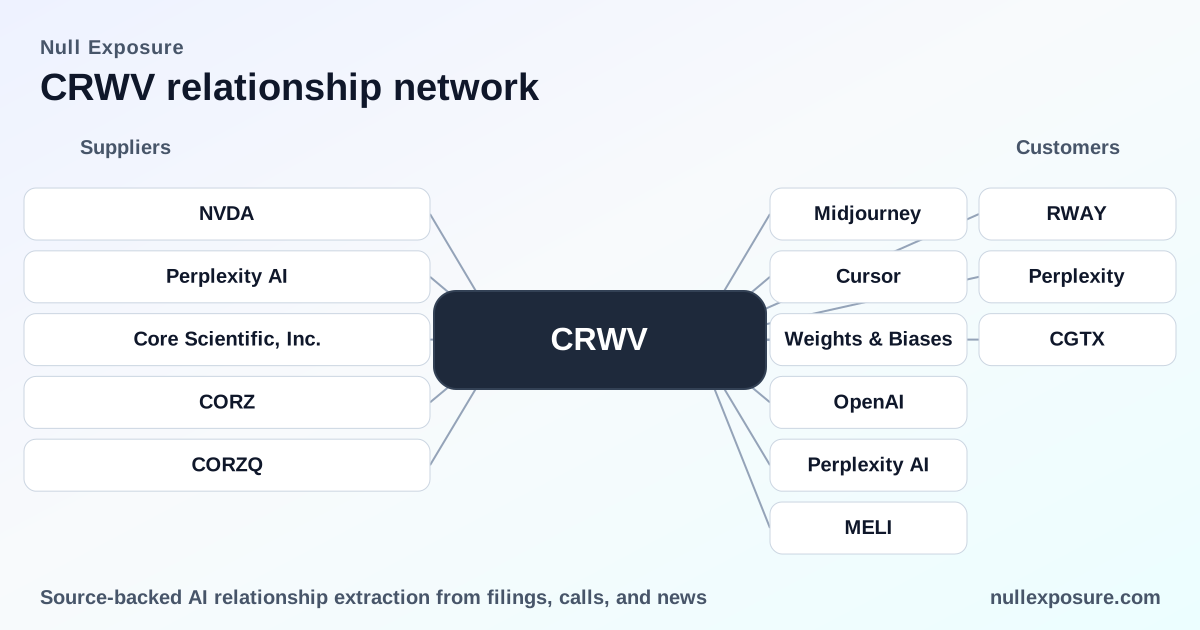
CoreWeave (CRWV): Supplier relationships that determine capacity, margin and execution risk
CoreWeave operates a specialized cloud platform that sells GPU compute, managed infrastructure and acceleration services to GenAI customers; it monetizes through capacity contracts, enterprise inference and training services, and premium deployments of NVIDIA hardware at scale. Revenue comes from selling high-margin GPU hours and differentiated service layers, while profitability depends on tight vendor relationships, timely data‑center builds and premium pricing for early access to next‑generation GPUs. If you evaluate supplier exposure for portfolio or operational risk, start with GPU OEM dependency and third‑party construction partners.
Discover more supplier signals at https://nullexposure.com/.
Why suppliers matter more for CoreWeave than for a generalist cloud vendor
CoreWeave’s operating model is purpose-built: it buys and deploys cutting‑edge GPUs, integrates a cloud stack, and resells capacity to AI customers. That creates four structural characteristics investors and operators must track:
- Contracting posture: CoreWeave engages in multi‑year, capacity‑style deals with enterprise customers and signs large OEM relationships for early access to new GPU families; those contracts lock in capital commitments and concentrated supply flows.
- Concentration: The company is materially dependent on NVIDIA for leading GPUs (GB200, Blackwell-series) and on external data‑center developers for physical expansion, creating single‑point suppliers that influence timing and margin.
- Criticality: For customers running state‑of‑the‑art models, CoreWeave’s ability to deliver latest‑gen GPUs at scale is mission‑critical, which supports pricing power but also raises reputational and revenue sensitivity to supply or build delays.
- Maturity and capital intensity: CoreWeave shows high gross margins (gross profit of $3.678B on revenue of $5.131B TTM) but remains net loss‑making on EPS of -$2.81, reflecting rapid growth, heavy capex and aggressive capacity rollouts.
These are company‑level signals — track vendor commitments and build schedules as the operational pulse for CRWV.
Supplier and partner relationships — what the record shows
Below I cover every partnership and supplier mentioned in the collected relationship records with direct, source‑based summaries.
NVIDIA / NVIDIA Corporation
CoreWeave positions itself as an early commercial channel for new NVIDIA GPUs and offers its proprietary cloud stack outside NVIDIA’s own data centers; the company highlighted this strategy on a 2025 Q4 earnings call as a path to margin‑accretive growth via new products and by serving the broader NVIDIA ecosystem. (CRWV 2025Q4 earnings call, reported 2026-03-07.)
CoreWeave has publicly deployed NVIDIA GB200 NVL72 systems and scaled RTX PRO 6000 Blackwell GPU offerings, supporting inference and enterprise workloads. (Coverage in MLQ.ai and SimplyWall, FY2026 reporting.)
Perplexity AI
CoreWeave signed a multi‑year commercial arrangement to support Perplexity’s enterprise inference, rolling out Perplexity Enterprise Max and providing GB200‑powered inference capacity as of FY2026; this is evidence of direct enterprise demand for CoreWeave’s latest‑gen GPU service. (Deal coverage on MLQ.ai, reported 2026-03-09.)
Core Scientific, Inc. (Core Scientific)
Multiple investor alerts and reports state that Core Scientific served as a building partner on several CoreWeave data‑center projects and that weather and design revisions produced construction delays — disclosures that were linked in market reporting to a material guidance revision in November 2025 and subsequent securities class‑action notifications in early 2026. (PR Newswire / GlobeNewswire investor alerts, and market reporting that cites the Wall Street Journal, Feb–Mar 2026.)
What each relationship implies for risk and upside
- NVIDIA relationship is a commercial moat and a concentration risk. Being one of the first providers to deploy GB200 and to roll out Blackwell‑class GPUs gives CoreWeave premium pricing and customer pull‑through, but it also concentrates procurement power with a single OEM. This drives upside in margins but elevates supply dependency.
- Perplexity deal proves enterprise demand for inference services and validates CoreWeave’s go‑to‑market for high‑value workloads. These deals convert capacity into recurring revenue and raise switching costs for customers who prioritize latency and model performance.
- Core Scientific as a construction partner highlights execution risk in physical buildouts. Outsourced build schedules are a direct lever on revenue recognition and guidance; the November 2025 guidance revision and subsequent legal notices are signals that build‑partner disruptions can materially move the stock.
Investment implications — balance between growth and execution
CoreWeave’s economics look like a classic capacity‑led growth story: very healthy gross profitability, but negative EPS and high valuation multiples (EV/Revenue ~13.99, EV/EBITDA ~29.09) reflect expectations of continued growth and margin expansion. That tradeoff creates a clear checklist for investors and operators:
- Confirm vendor diversification and contractual access to next‑gen GPUs — supplier exclusivity or priority windows with NVIDIA materially impact execution.
- Monitor data‑center build timelines and the reliability of third‑party developers; delays translate into deferred revenue and legal exposure as public filings and news coverage have shown.
- Watch customer composition and deal tenor — large, multi‑year inference contracts (like the Perplexity arrangement) de‑risk revenue but create capacity commitments that must be met on schedule.
- Consider the legal and disclosure risk tied to partner delays; recent class‑action notices reflect market sensitivity to execution shortfalls.
Further analysis and supplier signal tracking is available at https://nullexposure.com/ for investors probing counterparty exposure and operational readiness.
Bottom line: focus on GPU access and build execution
CoreWeave is a high‑leverage play on GenAI infrastructure: its value accrues from being first to market with new GPUs and converting that compute into enterprise inference revenue, but its shares are sensitive to supplier concentration and third‑party build timelines. For investors, the priority is to validate NVIDIA access and read the tea leaves on construction partners; for operators, the priority is contractual protections, slippage clauses and contingency capacity. Learn more about supplier intelligence and how these relationships affect valuation at https://nullexposure.com/.
Bolded takeaways: NVIDIA supply equals competitive advantage and concentration risk; Perplexity validates commercial demand; Core Scientific‑related delays translate directly into stock and legal volatility.