Champions Oncology (CSBR): Supplier relationships that shape the preclinical playbook
Champions Oncology develops and sells technology and services that tailor cancer-drug development—principally through patient‑derived xenograft (PDX) models and related laboratory solutions—and monetizes by contracting with biopharma customers for preclinical programs, model licensing and specialized profiling services. Revenue is generated through fee‑for‑service engagements and productized offerings tied to the company’s PDX platform and translational research capabilities, with recurring program work and one‑off profiling projects forming the commercial backbone.
For deeper supplier intelligence on Champions Oncology and comparable coverage, visit https://nullexposure.com/.
What Champions’ supplier relationships tell an investor
Champions operates in a vendor‑heavy scientific ecosystem: the business relies on external scientific service providers for advanced molecular characterization and on established audit and governance partners to support public company reporting. These supplier ties are operationally material because high‑quality external proteomics/metabolomics and robust financial controls directly affect the utility of Champions’ PDX bank to pharmaceutical customers and the company’s credibility in capital markets.
Key company metrics that set the context:
- Revenue (TTM): $57.945M; Gross profit: $26.584M.
- Operating loss and negative EPS (Diluted EPS TTM: -$0.18; Profit margin: -4.04%).
- Market capitalization: ~$86.8M; Shares outstanding: 13.886M; Institutional ownership: ~47.9%; Insider ownership: ~26.7%.
These figures underline a company that is commercial, generating mid‑tens of millions in revenue, but still operating at a loss while it invests in scientific capabilities and customer programs.
Supplier relationships and what they mean for CSBR
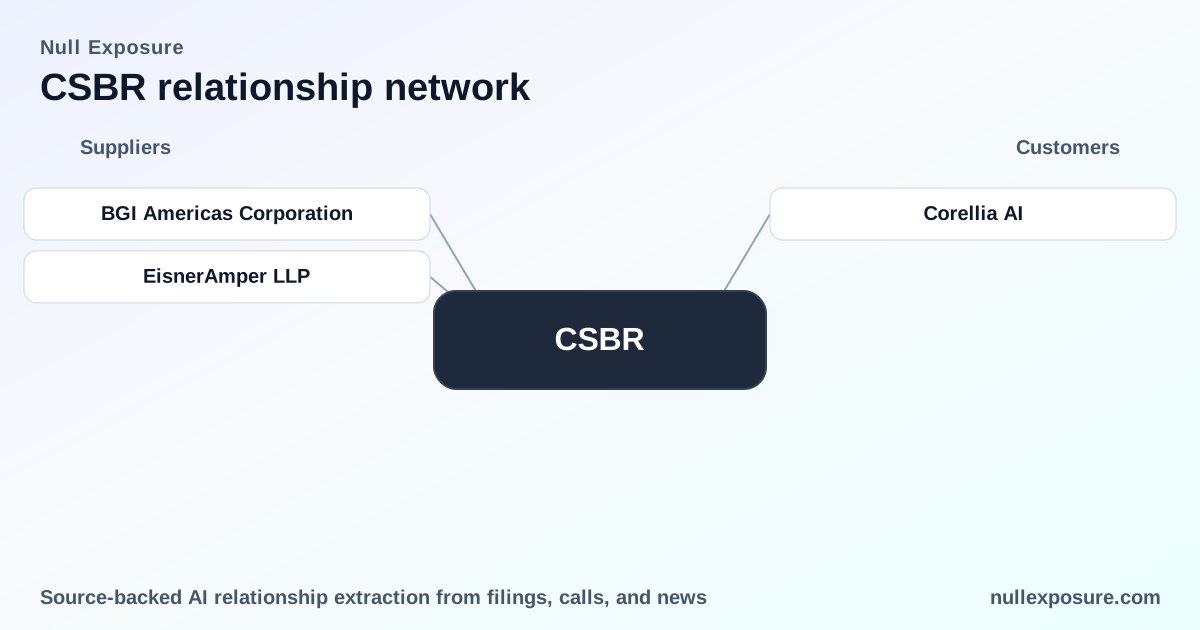
Champions’ public record lists two visible supplier relationships spanning scientific services and corporate governance. Below I cover each relationship in plain English and cite the source.
BGI Americas Corporation — strategic proteomics partner
Champions leverages BGI Americas’ mass spectrometry services to add proteomic and metabolomic profiling to its PDX characterization, improving the molecular richness of the company’s preclinical models for drug developers. According to a 2021 GlobeNewswire press release, Champions announced a partnership with BGI Americas to incorporate mass‑spec based multi‑omics analysis into its PDX bank characterization program (FY2021). This relationship is technically additive and clinically relevant, enhancing model value to customers.
EisnerAmper LLP — independent auditor ratified by shareholders
Shareholders ratified EisnerAmper LLP as Champions’ independent auditor in the FY2026 filing record, reflecting the company’s current external audit relationship and standard public‑company governance practice. A FY2026 SEC filing excerpt reported via StockTitan shows the appointment received affirmative shareholder votes (FY2026). This audit relationship is a governance signal that supports financial reporting credibility for investors and counterparties.
How these suppliers fit into Champions’ operating model
Champions’ supplier posture is characteristic of a mid‑market translational research provider:
- Contracting posture: Predominantly project and program‑based vendor contracts rather than long‑term commodity purchasing; scientific suppliers like BGI are engaged to augment in‑house capabilities for discrete characterization programs. This supports flexible, customer‑driven revenue but creates dependency on third‑party throughput and quality.
- Concentration and criticality: The listed scientific supplier (BGI) supplies high‑value analytical capabilities that are critical to model differentiation—lack of equivalent profiling could reduce model utility to customers. The auditor relationship is a non‑discretionary governance requirement for a public company.
- Maturity: The presence of an established independent auditor and mid‑market revenue scale indicate operational maturity in finance and reporting, while continuing negative margins show the company is investing in growth and capabilities rather than awaiting steady state profitability.
These are company‑level operating signals drawn from the relationship evidence and the financial profile; they do not assign contractual terms beyond what public disclosures state.
For a vendor map and supplier risk scoring tailored to Champions, see https://nullexposure.com/ for comprehensive coverage.
Investment implications and risk checklist
The two documented relationships convey complementary investor signals:
- Enhancement of core product value: The BGI tie strengthens Champions’ PDX offering via added multi‑omics layers, making its models more attractive to pharma customers that value molecular depth.
- Governance and reporting integrity: Ratifying EisnerAmper as auditor reinforces standard financial controls and reporting, which is important for investors monitoring cash flow, program accounting and long‑term capital access.
That said, investors should weigh these positive supplier links against company risks:
- Profitability gap: Champions operates at a loss (negative EPS, operating margin) despite healthy gross profit, indicating cost or scale pressures that require monitoring.
- Supplier dependency: Reliance on third‑party analytical providers for key value enhancements introduces execution risk around turnaround times, data quality and pricing.
- Valuation dispersion: The company trades with a high price‑to‑book ratio and elevated EV/EBITDA relative to its small market cap, reflecting growth expectations that must be met by continued commercial traction.
Practical next steps for due diligence
- Request contract terms and service‑level commitments for high‑value scientific suppliers to assess operational risk and potential supply fragility.
- Review recent audit opinions, management letters and the FY2026 filing package to evaluate financial reporting risk and any auditor commentary.
- Track commercial win‑rates for PDX engagements where multi‑omics profiling is explicitly included to quantify the incremental revenue contribution of these supplier-enabled features.
If you want a structured supplier analysis and risk matrix for Champions Oncology, browse our research hub at https://nullexposure.com/ for tailored reports and supplier mapping.
Bottom line
Champions Oncology’s disclosed supplier relationships cover two strategic vectors: scientific capability augmentation (BGI) that materially enhances product value, and auditor governance (EisnerAmper) that underpins financial transparency. Both relationships are consistent with a mid‑market life‑science vendor operating a fee‑for‑service commercialization model: partnerships expand technical capability while auditors maintain reporting credibility. Investors should treat supplier quality and contractual robustness as core inputs to any investment thesis—these are not peripheral vendor details but drivers of product differentiation and financial trust.
For supply‑side intelligence, benchmarking and alerting on Champions and its peers, visit https://nullexposure.com/ to subscribe to our coverage and supplier monitoring.