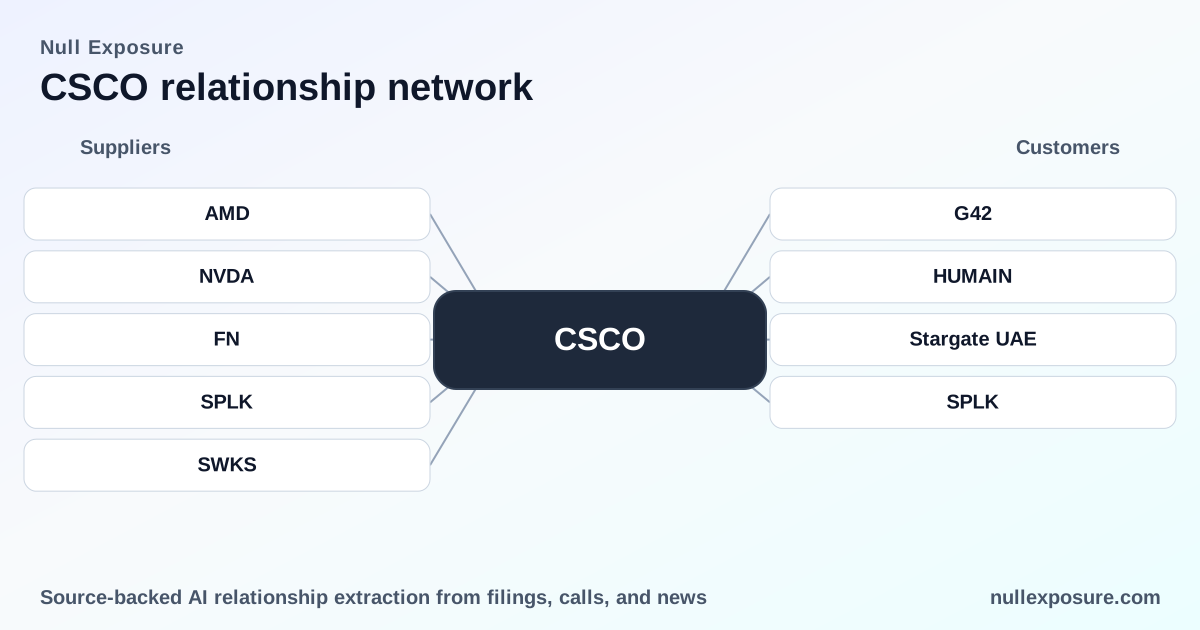
Cisco Systems (CSCO) — supplier relationships and what they mean for investors
Cisco sells networking hardware, software, and services to enterprise and hyperscale customers and monetizes through a mix of product sales, recurring software subscriptions, and managed/security services. The company leverages extensive third‑party manufacturing and long‑horizon procurement to secure component supply while bundling partner technology (GPUs, silicon, observability stacks) into higher‑margin integrated solutions for AI, security, and cloud networking. For a deeper look at supplier exposures and relationship signals, visit https://nullexposure.com/.
Why suppliers matter to Cisco’s strategy (and to your investment thesis)
Cisco is executing a platform strategy: convert low‑margin hardware sales into recurring, software‑centric revenue by integrating partner compute and observability stacks into Cisco networking products. That creates two simultaneous dynamics for suppliers and buyers:
- Large, committed procurement flows underpin Cisco’s product roadmap and inventory planning; the company reports multi‑year inventory purchase commitments in the billions, which anchors supplier revenue streams.
- Strategic integrations with GPU and software vendors increase the criticality of a subset of partners (AI compute, optics, observability) while shifting Cisco’s own margins upward through higher‑value bundles.
From the company disclosures, Cisco operates with a mixed contracting posture: it uses long‑term, firm, noncancelable purchase commitments and also relies on framework and shorter-term renewal agreements with contract manufacturers. Cisco characterizes a meaningful portion of purchase commitments as firm and noncancelable, and total inventory purchase commitments are reported in the multi‑billion dollar range, indicating material, centralized procurement that drives supplier scale and concentration. These are company‑level signals from Cisco’s filings rather than claims about a single partner. Visit https://nullexposure.com/ for full supplier mapping and signals.
Snapshot: every supplier relationship pulled from the latest results
Below are concise, plain‑English summaries of all relationship mentions found in the recent results, each with a source note.
AMD — close engineering collaboration on integrated solutions
Cisco told investors on its Q4 2025 earnings call that it is closely collaborating with AMD on several projects to deliver highly integrated solutions for customers going forward. Source: CSCO 2025 Q4 earnings call (quoted, March 2026).
NVIDIA — Nexus switches integrated with Spectrum‑X for AI clusters
In the same Q4 2025 call Cisco described an expanding partnership with NVIDIA, delivering integrated Cisco Nexus switches with NVIDIA’s Spectrum‑X architecture to support low‑latency, high‑speed networking for AI clusters. Source: CSCO 2025 Q4 earnings call (quoted, March 2026).
Fabrinet — beneficiary of hyperscaler AI capex, customer concentration flagged
A Simply Wall St piece noted Fabrinet’s FY2026 positioning as a primary beneficiary of AI capex from hyperscalers such as NVIDIA and Cisco, highlighting demand rerouting away from cyclical telecoms into AI optics and manufacturing services. Source: SimplyWallSt report on Fabrinet (FY2026 commentary, March 2026).
Splunk — integrated security and observability being adopted at scale
A market narrative reported that the Splunk integration is fully operational, enabling Cisco to deliver a unified security and observability platform that global CISOs are adopting to manage increased generative‑AI complexity. Source: SimplyWallSt narrative on Cisco (FY2026 commentary, March 2026).
NVIDIA — full‑stack “AgenticOps” positioning with Nexus HyperFabric + Blackwell GPUs
In broader press coverage, analysts described Cisco’s transition toward a full‑stack AgenticOps platform, integrating Nexus HyperFabric with NVIDIA Blackwell Ultra GPUs to sell end‑to‑end AI infrastructure rather than stand‑alone switches. Source: SimplyWallSt narrative on Cisco (FY2026 commentary, March 2026).
Skyworks Solutions — Cisco listed among a broad roster of customers
TradingView coverage on Skyworks Solutions lists Cisco among many large OEM and hyperscale customers, confirming Skyworks’ role as a component supplier to networking and communications vendors. Source: TradingView article on Skyworks (FY2026, March 2026).
Fabrinet — concentration risk caution tied to large tech buyers including Cisco
Sahm Capital highlighted customer concentration risks for Fabrinet because large tech buyers (including Cisco) account for a disproportionate share of AI networking demand, warning that any slowdown or supplier substitution by those buyers would be material. Source: Sahm Capital analysis of Fabrinet (March 2026).
What these relationships imply for operators and investors
- Strategic partner concentration: Cisco’s product strategy depends on deep integrations with GPU vendors (NVIDIA), silicon partners (AMD), and software/observability providers (Splunk). Those partnerships are value‑creating — enabling higher ASPs and recurring revenue — but also increase bilateral dependency and negotiating complexity for suppliers and for Cisco itself.
- Supplier scale and committed spend: The company‑level procurement posture shows multi‑year, large-dollar commitments and the use of contract manufacturers, which creates both revenue stability for qualified suppliers and execution risk if supply or demand shocks occur. Cisco’s reported inventory purchase commitments total in the billions, signaling high spend concentration at scale.
- Operational maturity and contractual mix: Cisco operates with a hybrid contract set: long‑term firm commitments coexist with framework agreements and short‑term renewals, which provides flexibility but requires active supplier management to avoid single‑point failures.
- Concentration risk for suppliers: Suppliers like Fabrinet that lean into Cisco and other hyperscalers have material exposure to AI capex cycles; investor diligence should focus on customer concentration, the potential for insourcing, and substitution risk.
- Bargaining power dynamics: Cisco’s size (FY2026 revenue ~$59.1B and strong operating margins) gives it procurement leverage, but strategic partners delivering unique integrated capabilities (e.g., NVIDIA GPUs) retain pricing and product power.
Practical next steps for investors and procurement operators
- For investors: model supplier concentration into scenario analyses for Cisco’s AI revenue ramp; stress test supplier interruptions and hyperscaler capex pullbacks against Cisco’s margins and recurring revenue trajectory.
- For procurement and operators: validate contractual windows and termination provisions across the supplier base (long‑term noncancelable commitments vs. short‑term frameworks) and prioritize dual‑sourcing for components tied to AI stack integrations.
- For both: monitor the evolution of Cisco’s partner integrations — NVIDIA, AMD, Splunk, and specialist manufacturers — because these relationships materially affect product roadmaps, margins, and supply stability.
For a full supplier map and ongoing monitoring of Cisco’s supplier exposures, see https://nullexposure.com/. If you want tailored supplier exposure reports or alerts tied to Cisco’s contract posture and partner integrations, start at https://nullexposure.com/ and request a demo.
Bottom line
Cisco’s supplier ecosystem is large, strategically concentrated, and contractually mixed: it delivers the scale and integration necessary to win AI and security deals while concentrating risk among a smaller set of high‑value partners and manufacturers. Investors should treat supplier dynamics as a first‑order input to Cisco’s platform monetization story and incorporate supplier concentration and contract maturity into both valuation and operational due diligence.