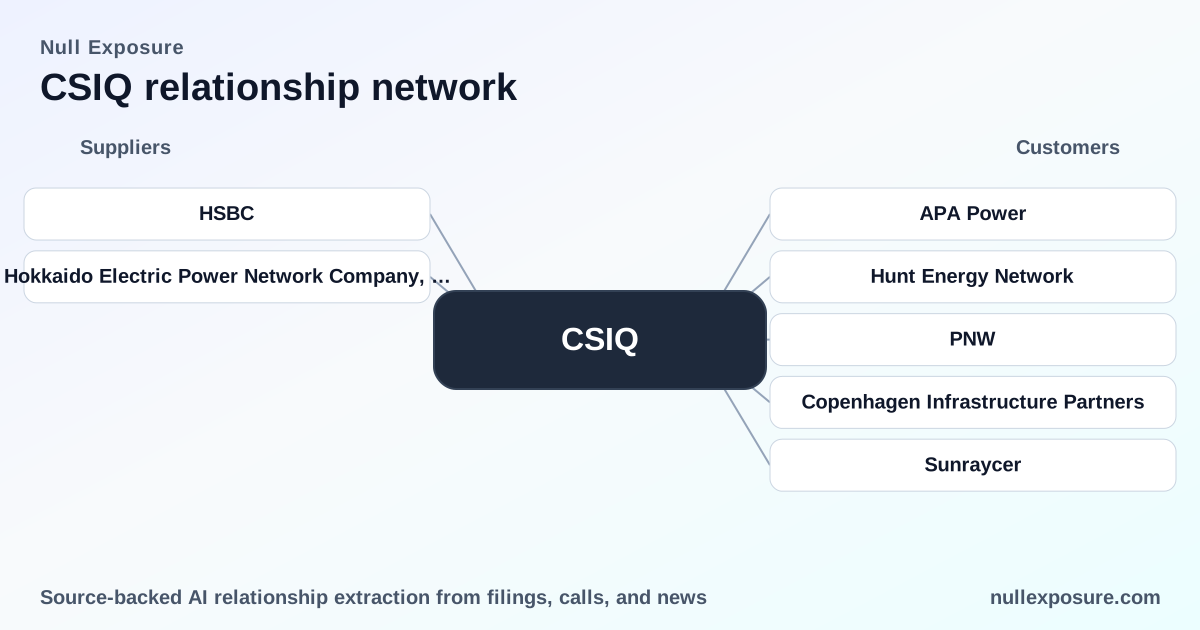
Canadian Solar (CSIQ) supplier relationships: what investors need to know
Canadian Solar designs, manufactures and sells solar cells and modules while developing and operating downstream projects; it monetizes through product sales (modules, cells, ingots) and project revenues from development, engineering and power generation. The company pairs manufacturing scale with project development activity, generating margin in modules and recurring cash from operating assets, and it uses external capital and local partnerships to underwrite international project deployment.
Explore deeper supplier and partner signals at https://nullexposure.com/ to support sourcing and counterparty diligence.
How Canadian Solar’s supplier posture drives economics
Canadian Solar is first and foremost a product manufacturer with a sizeable project development arm. That hybrid model creates a contracting posture that blends volume supply agreements for modules with project-level contracts and EPC (engineering, procurement and construction) execution. Financially, Canadian Solar reports strong top-line scale — roughly $5.9 billion in trailing twelve‑month revenue and $1.15 billion in gross profit — which underpins negotiating leverage with component suppliers while exposing margins to commodity cycles and trade dynamics.
Key financial and structural signals:
- Scale and capital intensity: Revenue of $5.9B and EBITDA of $656M (TTM) indicate a capital-intensive business that relies on working capital and project financing to execute growth.
- Margin sensitivity: Gross profit is meaningful but operating and net margins are thin, which makes supplier costs and logistics critical to profitability.
- Global footprint and vertical scope: Manufacturing plus project development increases supplier complexity — module inputs, logistics, and local partners for project delivery all matter for execution.
If you are evaluating counterparties or exposure to CSIQ’s supply chain, start with the company profile and supplier map at https://nullexposure.com/ to prioritize due diligence.
What the public relationships show (each relationship in the record)
HSBC Holdings — arranging project financing for U.S. expansion
A March 2026 news report indicates HSBC is arranging a proposed $350 million loan to support Canadian Solar’s U.S. expansion, with final terms under discussion; the facility is intended to provide capital as Canadian Solar navigates import scrutiny and scaling of its U.S. footprint. Source: Intellectia news report, March 9, 2026 — https://intellectia.ai/news/stock/canadian-solar-seeks-350-million-loan-for-us-expansion-amid-import-scrutiny
Hokkaido Electric Power Network Company — delivery partner for Japanese BESS project
Canadian Solar Projects K.K. delivered its first grid-connected battery energy storage system adjacent to the Naebo substation in Sapporo after being awarded the project through Hokkaido Electric Power Network’s 2023 public land leasing initiative, demonstrating local execution capability and a customer relationship in Japan’s utility segment. Source: AltEnergyMag, February 11, 2026 — https://www.altenergymag.com/news/2026/02/11/canadian-solar-delivers-its-first-grid-connected-battery-energy-storage-system-in-japan/46751/
What these relationships imply for investors and operators
The two relationships in the public record highlight two distinct operational levers Canadian Solar uses to scale:
- Capital partnerships (HSBC): The involvement of a global bank arranging a substantial loan underscores that Canadian Solar leverages third‑party financing to fund geographic expansion and project pipelines. This is consistent with a capital-light project growth strategy where project-level leverage and sponsor credit are central to deployment speed.
- Local utility contracting (Hokkaido Electric): Delivery of a battery energy storage system for a regional utility confirms Canadian Solar’s role beyond module manufacturing into turnkey project delivery, increasing the company’s exposure to local procurement rules, land-use processes and utility contracting cycles.
Both signals are materially different from a pure supplier relationship: one is financial intermediation that affects balance-sheet flexibility; the other is an operating contract that affects execution risk and recurring operations.
Company-level constraints and operating signals
The dataset did not flag explicit supplier constraints, but company-level operational signals worth integrating into investment or operational models include:
- Contracting posture: Canadian Solar operates with a hybrid contracting model — product sales governed by supply agreements and project execution by EPC/PPAs — requiring separate governance for vendor performance and project counterparties.
- Concentration and criticality: Manufacturing scale gives Canadian Solar bargaining power on commodity inputs, but its project pipeline creates concentrated exposure to local permitting and utility partners; individual projects are critical to achieving project-level returns.
- Maturity and scalability: Financial results show mature manufacturing capability with significant revenue scale, yet low net margins and negative diluted EPS indicate earnings remain volatile and sensitive to trade policy and commodity pricing.
- Capital dependency: The HSBC-linked financing signal confirms reliance on external lenders to underwrite expansion, making access to capital a key operational constraint.
These company-level signals should shape supplier diligence criteria: contract terms that protect margin, performance bonds for project delivery, and financing covenants that preserve liquidity.
Risk and upside for counterparties and investors
- Upside: Vertical integration into storage and project delivery diversifies revenue and offers higher-margin opportunities if Canadian Solar wins repeat utility contracts and scales operating assets.
- Risk: Margin compression is the primary operational risk because manufacturing and project execution both carry cost volatility; trade policy and local procurement rules in markets like the U.S. and Japan can impose execution friction.
If your investment or sourcing thesis depends on counterparty stability or execution certainty, prioritize counterparties with demonstrated financing relationships and local utility delivery experience — both themes visible in the recorded relationships.
Learn more about how these relationship dynamics change supplier risk and counterparty exposure at https://nullexposure.com/.
Bottom line and next steps
Canadian Solar operates as a hybrid manufacturer and project developer, monetizing through module sales and project revenues while leaning on external finance and local utility contracts to scale. The HSBC financing engagement and the Hokkaido Electric project together illustrate how capital partners and local utility relationships materially affect execution and balance-sheet flexibility.
For actionable diligence and to map supplier risk across Canadian Solar’s footprint, visit https://nullexposure.com/ and request the supplier relationship pack that aligns counterparties, contracts and financing lines with operational risk.