Centerspace (CSR) — Supplier relationships, capital posture, and what investors should watch
Centerspace (CSR) acquires, renovates and operates apartment communities, monetizing primarily through stabilized rental income and incremental value capture on asset repositioning and dispositions. The company runs a mix of self-managed and third‑party managed properties, funds growth through secured credit facilities and targeted acquisitions, and returns cash to holders via a regular dividend. For investors evaluating supplier relationships, the combination of long-dated credit capacity, material liquidity, and a practice of outsourcing operational management and specialized services defines both opportunity and counterparty exposure.
For a structured view of Centerspace’s supplier footprint and how it matters to investment risk, see Null Exposure: https://nullexposure.com/
How Centerspace sources and runs property operations — an investor lens
Centerspace is a REIT focused on residential assets that relies on a mixed operational model: it self-manages in markets where scale and margin justify it and engages third‑party managers where pre‑existing management or local specialization adds value. This operating posture drives the supplier strategy in three ways:
- Contracting posture is long-term and capital intensive. Company disclosures note an amended credit facility that matures in July 2028, with extension options and an accordion to increase borrowing capacity to $400 million—a signal that the firm plans predictable, multi‑year financing for acquisitions and working capital rather than short, ad hoc draws.
- Purchasing scale and liquidity justify large-ticket deals. As of December 31, 2024, Centerspace reported total liquidity of approximately $224.6 million, including roughly $212.6 million available on lines of credit. That financial posture supports $100m-plus purchasing and modernization activity and means suppliers in construction, property services and capital markets should be prepared for multi-year engagements.
- Operational outsourcing is strategic and operationally critical. The company explicitly uses third‑party property managers for specific assets and engages external cyber‑security providers that can act on its behalf—making those service providers mission-critical suppliers rather than incidental vendors.
These characteristics justify an investor view that Centerspace’s supplier relationships are strategic, concentrated and contractual: suppliers providing property management, renovation services, brokerage, and specialized IT/cybersecurity connect directly to revenue and capital deployment.
Explore supplier intelligence and relationship maps at Null Exposure: https://nullexposure.com/
Suppliers observed in disclosed reporting and press
Centerspace’s public footprint in FY2025 shows direct transactional links to local sellers and national brokers responsible for deal flow and acquisition execution. The following relationships are reported in public sources.
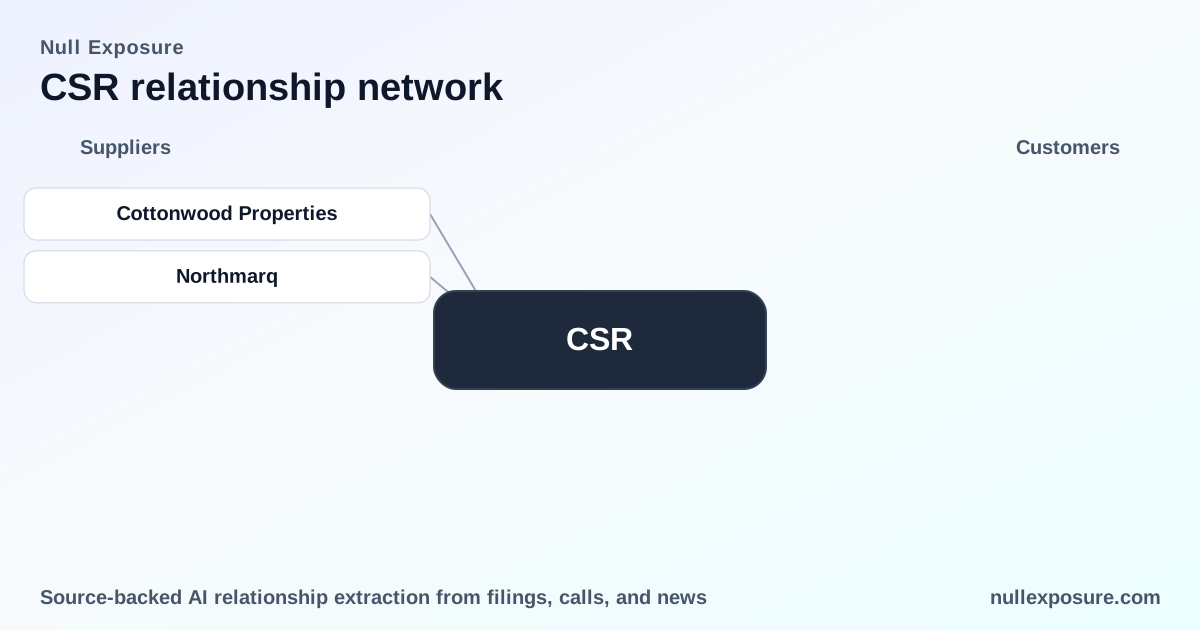
Cottonwood Properties — seller of an SLC rental community
Centerspace paid $149 million for a Salt Lake City rental community that Cottonwood Properties sold as the seller. This transaction illustrates Centerspace’s use of third‑party sellers to execute targeted portfolio expansion in high‑growth markets. Source: ConnectCRE coverage of the deal (reported March 2026).
Northmarq — investment sales broker on the SLC acquisition
Northmarq’s Salt Lake City Multifamily Investment Sales team, led by named brokers, acted as the broker for that transaction, facilitating the sale and market diligence. This highlights Centerspace’s reliance on national broker relationships for sourcing and executing major acquisitions. Source: ConnectCRE coverage (reported March 2026).
Why these relationships matter to investors and operators
The Cottonwood and Northmarq entries are not incidental: they map the common flow of capital and services in Centerspace’s model. Key implications:
- Deal sourcing and execution depend on established broker channels. National and regional brokers like Northmarq are a primary conduit for supply of assets; maintaining those relationships is essential to maintaining acquisition velocity.
- Seller relationships drive asset quality and integration risk. Purchases from operating owners such as Cottonwood can reduce integration friction if properties come with effective pre‑existing management, which the company explicitly values when deciding to outsource property management.
- Large-ticket transactions are supported by committed credit lines and liquidity. The company’s available liquidity and credit facility structure support meaningful acquisition spend but also create concentration on key lenders and covenant counterparties.
Constraints and company-level signals that affect supplier risk
Centerspace’s public disclosures provide three clear company-level signals that shape supplier diligence and contractual strategy:
- Long-term credit facility (contract_type: long_term). The credit facility matures in July 2028, can be extended twice in six‑month increments, and contains an accordion to $400 million—this signals multi-year capital commitments and the need for suppliers to structure pricing and delivery for longer-term engagements (company filings).
- Service provider posture (relationship_role: service_provider). The company explicitly engages third‑party property managers for certain assets and contracts external cyber providers that can act on its behalf; these suppliers are operationally critical and require stronger SLAs, onboarding and incident escalation protocols (company disclosures).
- Material balance sheet capacity (spend_band: 100m_plus). Total liquidity around $224.6 million as of December 31, 2024 indicates Centerspace can underwrite major capital projects and acquisitions without immediate equity raises—suppliers should plan for sizable, multi-phase engagements rather than single one-off jobs.
These constraints are company-level signals and influence supplier selection, contract length, performance guarantees, and credit terms. They do not assign a constraint to any individual supplier unless that constraint explicitly names the entity.
Practical takeaways for investors and supplier diligence
For investors and operators evaluating Centerspace supplier relationships, prioritize these areas:
- Contract length and renewal mechanics. Given the long-dated financing, negotiate multi-period pricing and clear extension terms that align with Centerspace’s financing windows.
- Operational criticality and SLAs. Property management and cyber vendors are directly tied to cash flow; demand clear uptime/recovery SLAs and escalation frameworks.
- Counterparty credit and concentration. The firm’s high institutional ownership and available liquidity lower immediate credit risk, but lenders and large broker relationships concentrate negotiation leverage—understand potential payment terms and recourse.
- Integration and transition risk. When assets are purchased from sellers with existing management, ensure onboarding processes and performance baselines are contractually embedded.
If you are mapping supplier exposures or structuring deals with Centerspace, Null Exposure’s relationship insights and vendor mapping tools provide a concise, investor-focused view: https://nullexposure.com/
Final assessment
Centerspace operates as a capital-intensive residential REIT that balances internal management with targeted outsourcing. Its financial capacity and long-dated credit facility enable sustained acquisition activity, while the company’s explicit use of third-party managers and cyber vendors makes certain suppliers functionally critical to revenue and risk management. The Cottonwood sale and Northmarq brokerage engagement are emblematic of Centerspace’s market behavior: acquisition-driven growth executed through national brokers and funded by committed credit lines.
For investors assessing counterparty risk or operators considering commercial relationships with Centerspace, the signal is clear: align contract duration and service levels with the firm’s financing horizon, treat property management and cyber vendors as strategic partners, and structure pricing for multi‑stage work. For more supplier intelligence and relationship analytics, visit Null Exposure: https://nullexposure.com/