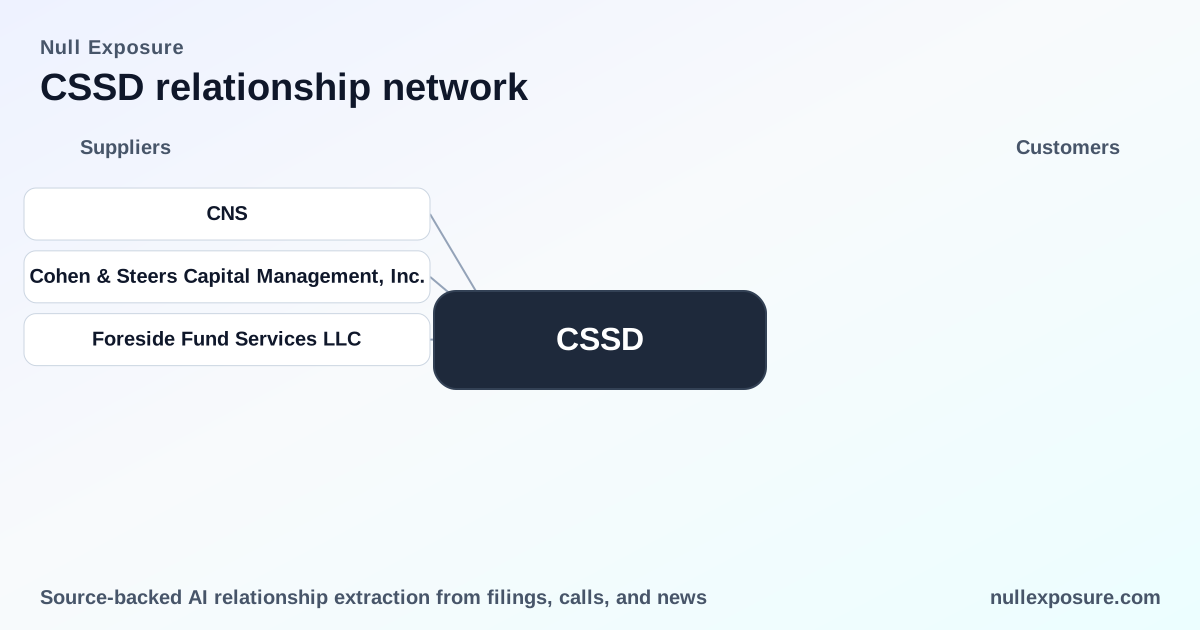
CSSD supplier map: who issues, advises, and distributes the shares
Cohen & Steers Defensive Equity ETF (ticker CSSD) is structured as a fund whose shares are issued by Cohen & Steers, Inc. and whose investment and distribution plumbing is concentrated with Cohen & Steers affiliates and a single named distributor. The fund monetizes through the traditional asset-management model: the advisor captures management and advisory economics, while the distributor and issuer capture operational and distribution fees tied to assets under management and share activity. Investors and counterparties should treat CSSD as a manager-centric product where counterparty concentration and operational dependency are the primary commercial characteristics.
If you want a concise supplier-risk profile or counterparty exposure memo for CSSD, start with the issuer and advisor pairings below — or get a structured supplier report at https://nullexposure.com/.
Who is on the record: issuer, advisor, distributor
The public footprint in our review identifies three named supply-chain roles for CSSD: the issuer, the primary advisor, and the distributor. Each relationship is described below with a short plain-English summary and the source cited.
Cohen & Steers, Inc. (issuer)
Cohen & Steers, Inc. is listed as the entity that issues CSSD shares; that places the company on the primary legal and regulatory line for the fund’s structure and governance. Source: TradingView AMEX-CSSD listing, FY2025 (March 2026).
Cohen & Steers Capital Management, Inc. (primary advisor)
Cohen & Steers Capital Management, Inc. is identified as the primary advisor, responsible for portfolio construction and day-to-day investment decision-making for CSSD. Source: TradingView AMEX-CSSD listing, FY2025 (March 2026).
Foreside Fund Services LLC (distributor)
Foreside Fund Services LLC is named as the distributor for CSSD, handling placement and distribution services for the shares. Source: TradingView AMEX-CSSD listing, FY2025 (March 2026).
What the relationship map implies for investors and counterparties
- Concentration of operational control. The payer/issuer (Cohen & Steers, Inc.) and the advisor are from the same corporate family, which creates a tightly integrated governance and operational model. This reduces inter-party negotiation complexity but increases single-vendor exposure for underwriting and governance functions.
- Criticality of the advisor role. With a single named primary advisor, investment performance, compliance, and reporting are tied to that advisor’s capabilities and track record; operational disruptions at the advisor level have direct consequences for the fund.
- Distribution outsourcing. Using Foreside as the distributor delegates sales, regulatory filings, and transfer-agent coordination, which creates an operational dependency external to the Cohen & Steers corporate group.
- Maturity signals. This is a standard institutional fund architecture: a corporate issuer with an in-group advisor and an external distributor, consistent with mature, market-standard fund operations.
These are company-level signals derived from the relationship map, not from any prescriptive constraint language.
If you want a detailed counterparty exposure dashboard, visit https://nullexposure.com/ for a structured supplier analysis.
Operational and commercial constraints (company-level signals)
The data we reviewed did not include explicit constraint excerpts tied to CSSD (no contract limitations, service-level constraints, or covenant text surfaced). Presently, the observable signals are therefore high-level and company-level rather than contract-level:
- Contracting posture: Centralized — the fund relies on an in-house corporate issuer/advisor pairing, which implies standard master services and advisory agreements rather than a diversified vendor model.
- Concentration risk: Elevated — critical functions (portfolio management, regulatory stewardship) are concentrated across the Cohen & Steers entities.
- Criticality: High — the advisor and issuer roles are critical to governance and NAV delivery; the distributor is essential for market access and share continuity.
- Maturity: Institutional — named parties are established market participants, so counterparty operational maturity is high even if concentration remains a risk.
Because no constraint text was provided in the source material, there are no contract-specific limitations to report. Investors should request the fund’s offering documents and advisory/distribution agreements to validate fee schedules, termination rights, indemnities, and service-level commitments.
Risk considerations that drive commercial decisions
- Counterparty concentration is the principal commercial risk. The fund’s operational model consolidates issuer and advisory functions within the Cohen & Steers organization; that simplifies governance but creates exposure if the manager’s operations or reputation suffer stress.
- Distribution dependency is minority risk but operationally relevant. Foreside’s role is essential for market access; disruption in distribution or regulatory filings could affect liquidity or administrative continuity.
- Transparency and governance are mitigants. Standard regulatory disclosures required of funds should surface fee arrangements and termination provisions; active investors should prioritize those documents when sizing operational risk premiums.
Practical takeaways for investors and operators
- Prioritize document review. Obtain the prospectus and advisory/distribution agreements to confirm fees, break clauses, and indemnities tied to Cohen & Steers and Foreside.
- Model concentration into stress tests. When projecting outflows or valuation shocks, include scenarios where advisor operations are impaired or the distributor is replaced.
- Monitor governance signals. Board composition and related-party transaction disclosures will indicate how independently the fund is overseen.
Explore a supplier-risk briefing for CSSD and comparable funds at https://nullexposure.com/ if you need a formatted counterparty memo.
Bottom line
CSSD is structured with an issuer-advisor core inside Cohen & Steers and an external distribution relationship with Foreside, creating a compact supplier network with high operational concentration. For investors, the primary decisions are governance diligence, contract review, and stress-testing counterparty failure scenarios. For operators, the action items are to document termination triggers, service continuity plans, and distribution failover mechanisms.
For a professional supplier-concentration report or to request the primary agreements and a tailored risk memo, visit https://nullexposure.com/ and request CSSD coverage.