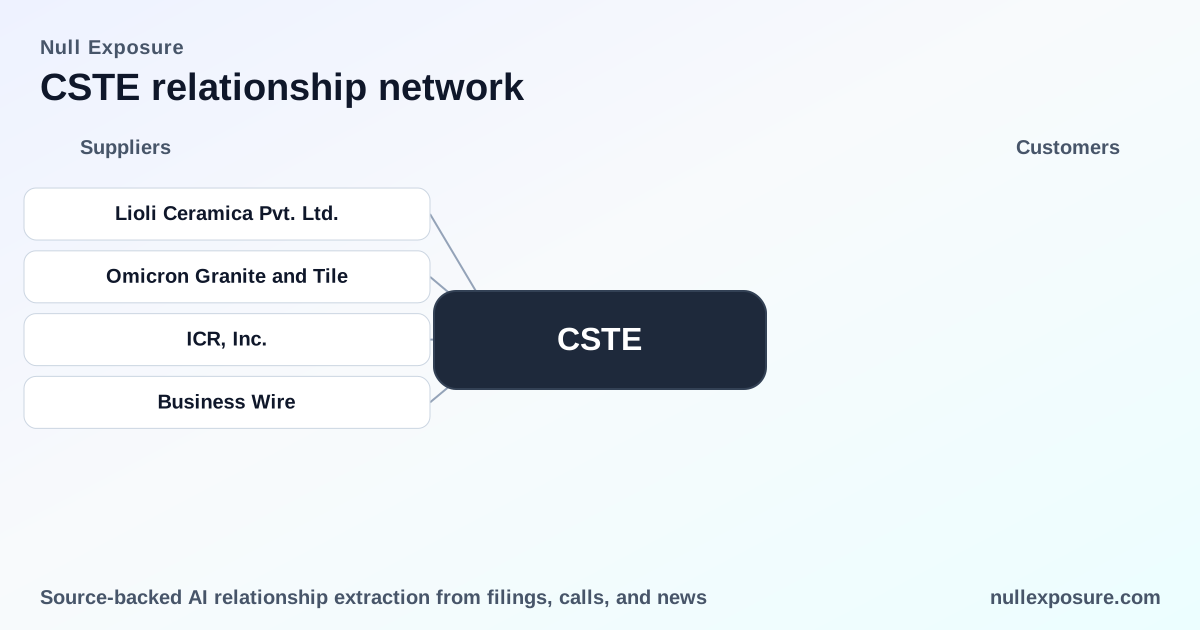
Caesarstone (CSTE) — supplier map, operating posture, and what investors should watch
Caesarstone manufactures and sells branded engineered quartz and countertop surfaces across major global markets, monetizing through product sales to distributors, trade partners and end‑market channels while supplementing reach with targeted acquisitions and marketing. The company combines manufacturing and global distribution with selective supplier partnerships and regional rollups that expand product range (porcelain) and U.S. footprint (regional stone dealers) while relying on outsourced investor‑relations and press distribution for market communications. Learn more at https://nullexposure.com/.
Why supplier relationships matter for investors evaluating CSTE
Caesarstone is a manufacturing‑led building‑products business with intensive upstream sourcing and midstream distribution dynamics. Its profitability is currently under pressure—negative EBITDA and a sizable loss per share—so supplier cost, product diversification, and distribution control directly influence free cash flow recovery and valuation. Key operating signals for financial stakeholders include contracting posture, concentration, criticality and maturity of supplier ties:
- Contracting posture: Caesarstone blends owned production with external suppliers and local rollups, indicating a hybrid model where supplier contracts can shift margin leverage quickly.
- Concentration: The company sells globally but retains manufacturing roots in Israel; regional supplier partnerships (e.g., India porcelain) imply targeted concentration exposures by product line and geography.
- Criticality: Suppliers that enable category expansion (porcelain) or strengthen U.S. distribution are strategically critical to revenue diversification and margin improvement.
- Maturity: The mix of acquisitions and long‑term sourcing relationships shows an intermediate maturity—established brand distribution plus ongoing integration risk as acquisitions are absorbed.
If you want a consolidated view of these relationships and how they shape supplier risk, start here: https://nullexposure.com/.
What the public record shows about Caesarstone’s partners
Below I cover every relationship turned up in the public results and summarize what each means for operators and investors.
Lioli Ceramica Pvt. Ltd.
Caesarstone contracted with Lioli Ceramica, a vertically integrated porcelain manufacturer in India, to supply porcelain countertop offerings marketed under the Caesarstone brand across all regions, signaling product diversification beyond quartz and potential cost arbitrage from India manufacturing (FY2020). Source: Globes reporting on the Lioli arrangement (FY2020) — https://www.globes.co.il/news/article.aspx?did=1001341187.
Omicron Granite and Tile
Caesarstone acquired Omicron Granite and Tile, an established U.S. stone supplier operating in 17 locations across Florida, Ohio, Louisiana, Michigan and Alabama, to boost U.S. distribution and physical retail presence, converting a supplier relationship into an owned distribution network (FY2021 acquisition reporting). Source: Globes coverage of the Omicron acquisition (FY2021) — https://en.globes.co.il/en/article-caesarstone-buys-omicron-to-boost-us-distribution-1001356187.
ICR, Inc.
Investor‑relations and public communications for Caesarstone are handled by ICR, Inc.; multiple company filings and press materials list ICR and contact Rodny Nacier as the investor‑relations point of contact (documented across FY2023–FY2026 filings and press releases). For investors, this is a governance and communications relationship that standardizes market messaging and access to management. Source: Company filings and press releases listing ICR, Inc. as Investor Relations (FY2023–FY2026) — sample filing and news syndication links such as https://www.stocktitan.net/sec-filings/CSTE/6-k-caesarstone-ltd-current-report-foreign-issuer-c7646398d54c.html.
Business Wire
Caesarstone uses Business Wire to distribute earnings and corporate press releases—e.g., the Q3 2025 earnings release was distributed via Business Wire—demonstrating reliance on institutional press distribution channels for investor communications. Source: Business Wire press release distribution of Caesarstone Q3 2025 results (FY2025) — https://www.stocktitan.net/news/CSTE/caesarstone-announces-date-for-third-quarter-2025-8b3xr6anxw3d.html.
You can view broader supplier and partner profiles for CSTE at https://nullexposure.com/.
Strategic implications: what operators and investors should focus on
The relationships above combine to create a strategic picture that drives near‑term risk and opportunity.
- Product diversification through suppliers: Partnering with Lioli to introduce porcelain expands Caesarstone’s addressable market beyond quartz and introduces a lower‑cost manufacturing node in India. That reduces single‑product dependence and can improve gross margins if scale is achieved.
- Distribution control via acquisition: Purchasing Omicron converts a channel supplier into owned capacity, accelerating U.S. market access but bringing integration risk, working capital needs and operating overhead.
- Communications discipline: Outsourcing investor relations to ICR and using Business Wire ensure consistent investor outreach but also concentrate disclosure channels; investors should monitor the cadence and content of these releases as leading indicators for operational recovery or restructuring.
- Financial constraint context: Company financials show negative EBITDA (-$35.2M) and a -34.6% profit margin on
$397.2M revenue (TTM), with a small market capitalization ($23.0M), making supplier terms and working‑capital cycles highly material to survival and turnaround prospects. These figures make supplier negotiations and acquisition ROI central to any path back to profitability.
Risks and mitigation — what to watch in the next 12 months
- Integration risk from the Omicron acquisition can strain cash flow if same‑store sales or synergies lag expectations.
- Supplier execution risk with new porcelain sourcing requires quality and logistics controls to protect brand reputation.
- Capital constraints given current loss profile mean any supplier with tight payment terms or concentration in a key region represents outsized operational risk.
For due diligence, request supplier contracts, integration plans for Omicron, and recent freight/cost data tied to the Lioli arrangement. Public filings and press cadence via ICR and Business Wire will reveal management’s timeline and milestones.
Bottom line and recommended next steps
Caesarstone’s supplier strategy is active and directional: expand product capability with offshore porcelain supply and tighten U.S. market control through targeted acquisitions while maintaining professional investor communications. For investors and operators, the critical questions are execution on integration, supplier quality control, and how fast margins recover from current losses.
If you want a consolidated supplier exposure dashboard and deeper supplier‑level sourcing intelligence for CSTE, visit https://nullexposure.com/ for the full supplier map and primary source links.
Take action: review the Omicron integration disclosures, monitor upcoming ICR‑distributed earnings releases, and validate porcelain supply chain KPIs reported after FY2020 Lioli engagement. Full supplier detail and source links are available at https://nullexposure.com/.