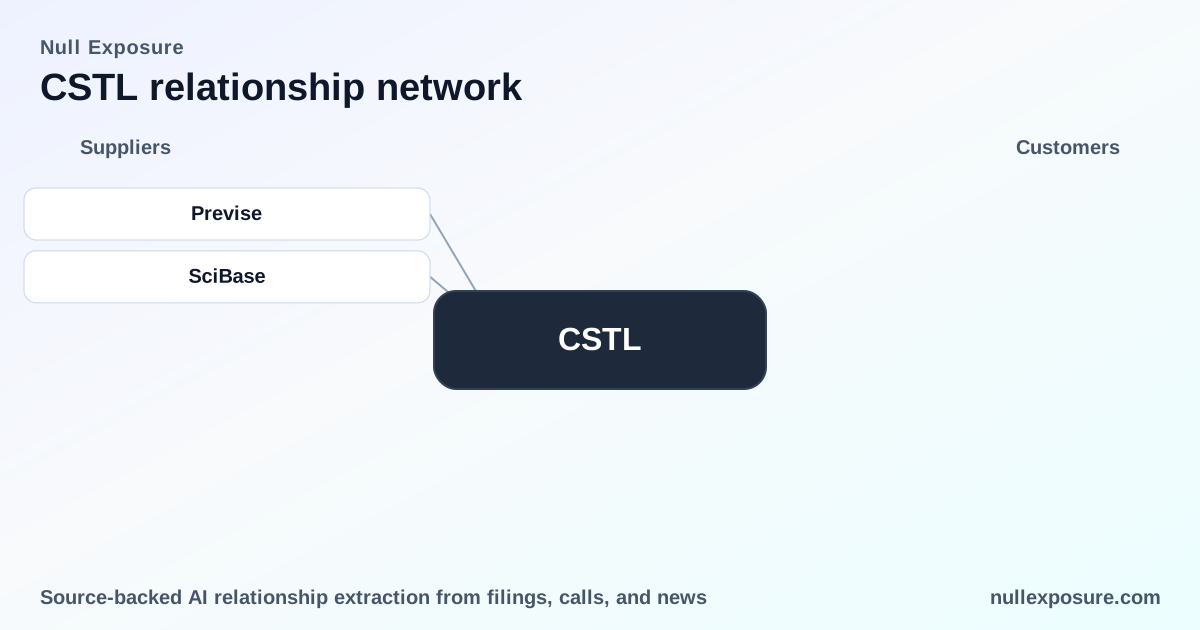
Castle Biosciences (CSTL): supplier relationships that change the risk-reward profile
Castle Biosciences sells precision oncology decision tools and monetizes primarily through fee-for-service diagnostic testing and licensing of assay technology, with recurring revenue driven by its DecisionDx®-Melanoma franchise and expanding commercial partnerships. Investors should evaluate the company as a clinical-platform operator that combines lab-based margin leverage with selective device and licensing acquisitions to extend addressable markets. For an integrated view of supplier and partner signals, visit https://nullexposure.com/ for continual supplier monitoring and due-diligence resources.
How Castle makes money and why supplier ties matter
Castle converts biological assays into monetizable clinical decisions. The company bills payors and healthcare providers for gene-expression tests, which generates high gross margins (roughly 79% on reported TTM figures) while operating margins remain negative as Castle continues to invest in scale and commercialization. Castle’s value equation is straightforward: clinical utility of an assay drives test volume, volume drives lab throughput, and throughput expands gross-profit leverage. Strategic supplier and partner moves—acquisitions of collection devices and licensing of external diagnostic technologies—change the company’s contracting posture from pure lab services toward a hybrid model that includes device ownership, resale/licensing rights, and collaborative R&D.
Company-level signals to factor into supplier analysis:
- Revenue base: $344m TTM, providing meaningful commercial scale for supplier negotiations.
- Profitability profile: Negative net and operating margins despite high gross profit, indicating continued investment and sensitivity to operating leverage.
- Capital markets posture: EV/Revenue ~1.47 and Price/Sales ~2.23, reflecting market expectation for growth and margin expansion.
- Ownership concentration: Institutions own >93% of float, suggesting decisions and supplier strategies will be scrutinized by sophisticated shareholders.
If you want a running feed of supplier signals tied to this thesis, bookmark https://nullexposure.com/ and check supplier updates as they publish.
All supplier and partner mentions in the public record
Below are every supplier relationship identified in recent public reporting, each with a concise, plain-English summary and a source you can read yourself.
Previse — acquisition of a non‑endoscopic cell collection device
Castle disclosed that it acquired a non-endoscopic cell collection device via its purchase of Previse, a move that vertically integrates a specimen-collection capability adjacent to its lab services and supports non-invasive sample capture for downstream assays. See the Q4 2025 earnings call transcript on InsiderMonkey for the company’s description of the Previse acquisition (March 9, 2026): https://www.insidermonkey.com/blog/castle-biosciences-inc-nasdaqcstl-q4-2025-earnings-call-transcript-1706247/
SciBase — evaluation collaboration on Electrical Impedance Spectroscopy (EIS)
Castle announced a collaboration to evaluate SciBase’s Electrical Impedance Spectroscopy (EIS) technology, positioning Castle to test whether an outside skin-screening modality can be integrated into its diagnostic workflow or referral funnel. The collaboration was outlined in the same Q4 2025 earnings call transcript on InsiderMonkey (March 9, 2026): https://www.insidermonkey.com/blog/castle-biosciences-inc-nasdaqcstl-q4-2025-earnings-call-transcript-1706247/
SciBase — expanded license and SEK20 million financing
Separately, markets reporting covered a license expansion between Castle and SciBase accompanied by a SEK20 million loan, indicating a deeper commercial and financial linkage that can accelerate distribution or adoption of the licensed technology in markets where Castle operates. Marketscreener summarized the expanded license terms and the SEK20 million arrangement in their Q4 revenue coverage (March 9, 2026): https://www.marketscreener.com/news/earnings-flash-cstl-castle-biosciences-inc-reports-q4-revenue-87-0m-vs-factset-est-of-79-9m-ce7e5cd9d18cf52c
Why these supplier moves matter operationally and strategically
Castle’s Previse and SciBase relationships reveal a deliberate dual strategy: acquire adjacent device capabilities and license/explore third‑party screening technologies. Acquisition of a collection device lowers sample-collection friction and creates proprietary capture-to-lab workflows, improving specimen integrity and potentially increasing downstream test volumes. Licensing deals like SciBase’s expand Castle’s addressable market by creating non‑overlapping screening modalities that feed the lab. These supplier choices shift Castle’s contracting posture from a pure service purchaser to a mix of owner/operator and licensee, which changes bargaining leverage and operational complexity.
Key operating-model takeaways:
- Contracting posture: Moving toward integration—owning collection devices and holding licenses increases control but requires device supply chain management and regulatory oversight.
- Concentration and criticality: DecisionDx remains core; supplier integrations that increase test volume are materially critical to Castle’s margin expansion thesis.
- Maturity signal: Commercial revenue scale allows Castle to fund acquisitions and structured license-financings rather than relying solely on equity or dilutive measures.
If you need supplier risk scores and scenario analysis for CSTL relationships, find structured supplier intelligence at https://nullexposure.com/ for tailored reports.
What investors and operators should watch next
- Monitor adoption metrics for the Previse collection device and any claims of increased specimen yield or reduced sample rejection—those operational improvements convert directly into margin upside.
- Track commercial rollouts and reimbursement updates tied to any SciBase-enabled screening pathway; licensing and loan terms suggest a step-up in commercial prioritization.
- Watch operating-margin trajectory: given the company’s high gross margins but negative operating margins, any supplier-driven volume lift should show up quickly in operating leverage.
- Pay attention to regulatory and reimbursement conversations, as device ownership or new screening modalities introduce additional payer negotiations.
Bottom line and action steps
Castle is executing a pragmatic expansion from a lab-service company into a platform that controls key parts of the diagnostic value chain. The Previse acquisition and the SciBase collaboration/licensing together create a mix of owned and chartered capabilities that increase market optionality while raising execution complexity. For investors and operators, the core question is whether these supplier ties accelerate profitable volume growth without adding disproportionate operational drag.
For ongoing supplier monitoring and to see how these relationships evolve into revenue and margin outcomes, visit https://nullexposure.com/ and subscribe for updates.