Carriage Services (CSV): How distribution partners and financial posture shape preneed growth
Carriage Services operates funeral homes and cemeteries across the United States and monetizes through a mix of at‑need services, cemetery operations, merchandise sales and preneed contracts—often financed and held in state‑regulated trusts that generate predictable cash flow over time. Management is explicitly focused on raising preneed penetration by leveraging third‑party sales and technology partnerships that expand customer access and accelerate funded contracts. For investors evaluating supplier and partner exposure, the key question is whether these relationships are commercially material and structurally durable enough to change the company’s revenue mix and margin profile.
Explore a concise supplier map and implications on strategy at https://nullexposure.com/.
What management says about its sales partners and how that matters
Management referenced external partners in the 2025 Q3 earnings call when describing a deliberate push to increase preneed sales through technology and third‑party distribution. The company framed these alliances as sales channels rather than passive vendors, indicating commercial alignment aimed at expanding funded preneed volumes and lifetime customer relationships.
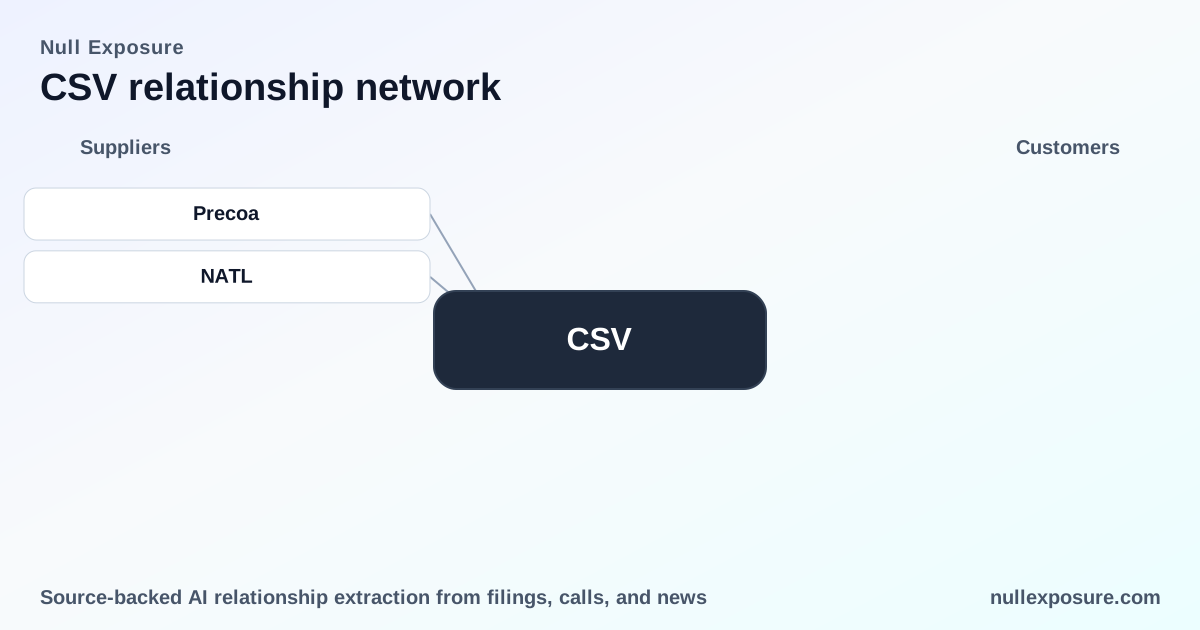
- Precoa: Management described Precoa as a sales partner working with Carriage Services to leverage technological capabilities and increase preneed sales. According to the company’s 2025 Q3 earnings call (first seen March 7, 2026), Precoa is positioned as an active collaborator on distribution and sales execution.
- National Guardian Life Insurance Company: The same earnings call names National Guardian Life as a sales partner that Carriage Services works “hand‑in‑hand” with to deploy technology and grow preneed originations. This was stated in the 2025 Q3 earnings call (first seen March 7, 2026).
Takeaway: Both named relationships are presented as strategic sales partners focused on preneed; investors should treat them as distribution relationships that can scale volume rather than as commodity suppliers.
How these partnerships translate into business model constraints
Two company‑level disclosures clarify the contracting posture and operational structure that underlie partner relationships.
- Long‑term financial commitments: A credit facility amendment filed July 31, 2024 extended Carriage Services’ senior secured revolving credit facility maturity to July 31, 2029, signaling a multi‑year financing horizon and a preference for stable, long‑dated capital structures that support preneed investments and M&A activity.
- Service provider posture for trust administration: Carriage Services confirms it uses independent financial institutions to administer preneed and perpetual care trusts required by state law, which frames certain third parties as regulated service providers responsible for fiduciary functions rather than simple vendors.
These are company‑level signals about contracting posture and operational maturity rather than attributes attached to a specific named partner. The long‑term credit facility indicates financial stability and multi‑year planning, while the trust administration language demonstrates that some supplier roles are legally critical and tightly controlled.
Why partner concentration and criticality matter for investors
Carriage Services is not a broad tech company; it is a service operator using distribution partners to grow a specific revenue stream—preneed contracts—that improve predictability and lifetime customer value. Several finance signals are relevant:
- Capital structure supports long‑term initiatives. The extended credit facility to 2029 shows management is comfortable locking in multi‑year leverage to support growth and working capital for preneed expansion.
- Third parties operate in a legally constrained role. Trust administration is outsourced to independent institutions, elevating the regulatory and operational importance of those suppliers.
- Distribution partners are commercially important. Naming Precoa and National Guardian Life in public remarks frames them as scalable channels for funded preneed sales rather than incidental vendors.
For reference on scale: Carriage Services reports market capitalization near $669 million, an EV/EBITDA of roughly 9.7 and a profitable operating margin, which sets a pragmatic valuation baseline for judging the contribution of incremental preneed growth to enterprise value.
If you want a supplier risk scorecard built from these signals, see how we standardize partner exposure at https://nullexposure.com/.
Short, plain-English descriptions of the named relationships
- Precoa works with Carriage Services as a sales partner to leverage technological capabilities and increase preneed sales, according to remarks in the 2025 Q3 earnings call (first seen March 7, 2026). This positions Precoa as a distribution channel for funded preneed contracts.
- National Guardian Life Insurance Company was identified alongside Precoa as a sales partner focused on technology-enabled preneed growth in the 2025 Q3 earnings call (first seen March 7, 2026). This relationship represents an insurer’s distribution and financing role tied to preneed offerings.
Risk matrix and what to watch
- Concentration risk: Public references name only two sales partners; incremental reliance on a small set of distribution partners increases sensitivity to partner performance and contract renewal outcomes. Monitor signage of partner diversification in future earnings materials.
- Execution risk: Technology integration and sales coordination determine how effectively partnerships convert into funded preneed contracts. Operational execution is the key determinant of revenue leverage.
- Legal/regulatory risk: Trusts are administered by independent institutions; changes in state trust regulation or custody practices could materially affect cash flow timing and company cash conversion.
Actionable takeaways for investors and operators
- Treat Precoa and National Guardian Life as strategic distribution partners that expand preneed reach, not as peripheral vendors.
- Use the company’s credit facility extension and trust‑administration disclosures as evidence of a long‑term contracting posture and an operational model that externalizes fiduciary functions to regulated providers.
- Track future earnings commentary for quantification: management’s narrative establishes intent; subsequent metrics should demonstrate converted preneed volume and funded contract value.
If you need a structured risk and exposure brief for board or portfolio review, get targeted supplier intelligence at https://nullexposure.com/.
Bottom line
Carriage Services is intentionally leaning on a small set of technology‑enabled sales partners to scale preneed revenue. The firm’s extended credit facility and the formal use of independent trust administrators are company‑level signals of maturity and long‑term financial planning that support this strategy. Investors should value these partnerships as potential multipliers of predictable, funded revenue while monitoring concentration, execution, and regulatory risks as the primary drivers of upside or downside to the thesis.
For a deeper supplier relationship dossier and follow‑up alerts, visit https://nullexposure.com/.