CSW Industrials: Supplier relationships that drive distribution margins and M&A-led growth
CSW Industrials operates a hybrid industrial platform that manufactures mechanical and chemical products and acts as a master distributor for complementary product lines, monetizing through product sales, distribution margins and targeted acquisitions that expand end-market reach. The company leverages a decentralized manufacturing base, bolt-on M&A and master-distributor deals to accelerate channel penetration—an operating model that converts small-to-mid acquisitions into higher-margin recurring revenue. For a mapped view of CSW’s supplier and distribution footprint visit https://nullexposure.com/.
How CSW makes money and why supplier ties matter
CSW’s economics rest on three predictable drivers: manufacturing margin on in-house products, distribution margin on master-distributed brands, and incremental scale from acquisitions. FY2025 revenues crossed roughly $1.0 billion with EBITDA near $236 million, supporting a premium valuation (trailing P/E ~38.0) driven by steady margin expansion and low cyclicality across diversified end markets. The company’s strategy is explicitly acquisitive—adding small, category-leading brands that plug into CSW’s Contractor Solutions and Specialty Oils platforms—so supplier and distribution agreements are direct levers of top-line growth and margin mix.
Key financial context frames supplier risk and opportunity: CSW reports broad sourcing across many vendors and expects roughly $44.6 million in purchase obligations over the next 12 months, signaling a mid-range procurement run-rate consistent with a $10–100 million spend band and manageable supplier concentration. Investors should value CSW as a roll-up operator where distribution agreements can both accelerate organic growth and compress customer acquisition costs for acquired brands.
Operating constraints that shape supplier relationships
CSW’s corporate disclosures present consistent company-level signals:
- Low concentration on critical raw inputs. Management states it sources raw materials and components from numerous suppliers and does not depend on a single source for any significant amount of supply, which reduces single-vendor operational risk and supports resiliency across cycles.
- Integrated manufacturer-distributor posture. CSW manufactures the majority of its mechanical and chemical products internally while selectively outsourcing and acting as a master distributor for certain product lines; this hybrid posture preserves gross-margin control while enabling fast go-to-market for partners.
- Mid-sized procurement commitments. Contractual and purchase obligations (~$44.6 million expected next 12 months) place CSW in a $10m–$100m spend band, a scale that supports both negotiated supplier economics and financial flexibility for M&A activity.
Taken together, these constraints indicate a mature, diversified supply model: not single-source dependent, vertically integrated where it matters, and scaled to support recurring purchase commitments without outsized concentration risk.
Supplier relationships: the specific partners investors should know
Below are the supplier and partner ties reported in public sources; each relationship is summarized in plain language with the cited source.
- Duckt‑Strip. CSW has been the master distributor for Duckt‑Strip since September 2022 and executed an acquisition to fold the product into CSW’s Contractor Solutions offering, intending to accelerate growth of the HVAC electrical cable solution. According to a GlobeNewswire press release dated March 12, 2026, CSW positioned Duckt‑Strip to expand its HVAC presence (https://www.globenewswire.com/news-release/2026/03/12/3254636/0/en/CSW-Industrials-Deploys-25-8-Million-of-Investment-Capital-in-Contractor-Solutions-Segment.html).
- Flair. Since 2024, CSW has maintained a master distribution relationship with Flair that the company says has supported product development, stronger distribution capabilities and streamlined operations; this relationship is presented as an established channel partnership within Contractor Solutions. Management referenced this master distribution role in the same GlobeNewswire communication in March 2026 (https://www.globenewswire.com/news-release/2026/03/12/3254636/0/en/CSW-Industrials-Deploys-25-8-Million-of-Investment-Capital-in-Contractor-Solutions-Segment.html).
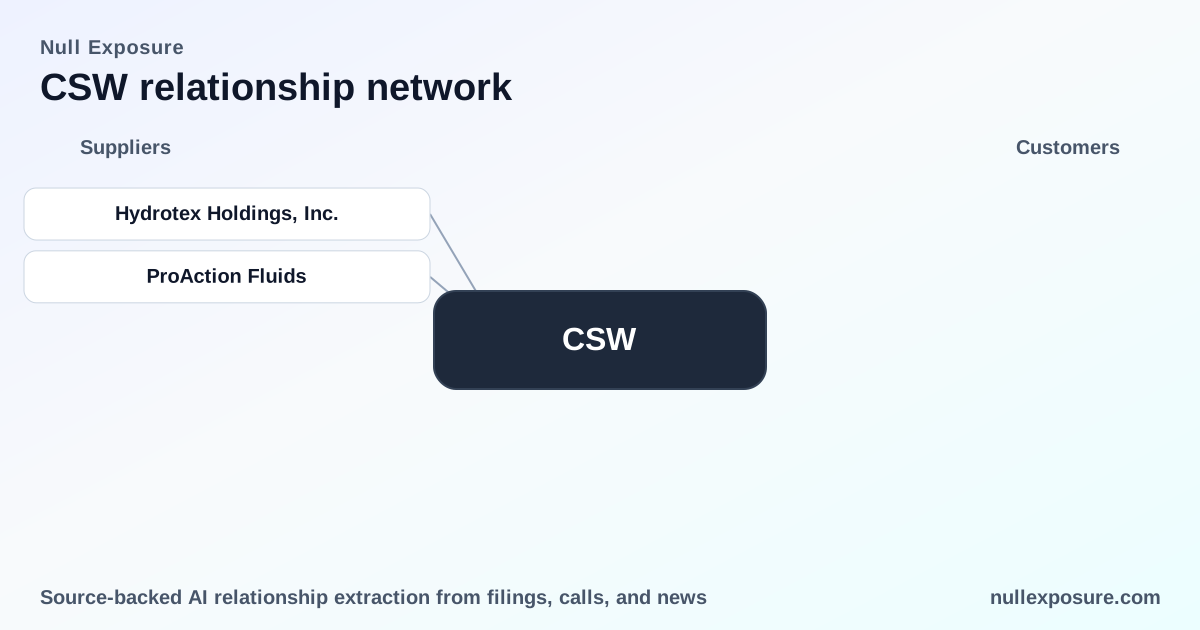
- Hydrotex Holdings, Inc. CSW acquired Hydrotex Holdings to add a family of high-performance lubricants that diversify CSW’s end-market exposure across industrial, agriculture, food processing, transportation and utilities customers, expanding the Specialty Oils and Lubricants portfolio. Coverage of the Hydrotex acquisition was reported by Quiver Quantitative on March 9, 2026 (https://www.quiverquant.com/news/CSW+Industrials+Invests+Over+%2426.5+Million+in+Strategic+Acquisitions+of+Hydrotex+Holdings+and+ProAction+Fluids+to+Enhance+Specialty+Oils+and+Lubricants+Portfolio).
- ProAction Fluids. CSW purchased ProAction Fluids to add complementary lubricant products that can be sold alongside existing offerings, reinforcing cross-sell opportunities in its specialty oils business. Quiver Quantitative reported the transaction and strategic rationale on March 9, 2026 (https://www.quiverquant.com/news/CSW+Industrials+Invests+Over+%2426.5+Million+in+Strategic+Acquisitions+of+Hydrotex+Holdings+and+ProAction+Fluids+to+Enhance+Specialty+Oils+and+Lubricants+Portfolio).
What these partnerships imply for investors
- Distribution-first product expansion. The Duckt‑Strip and Flair master-distributor relationships illustrate CSW’s playbook: secure channel control first, then either scale the brand organically or acquire it to internalize margin and operational control.
- M&A-driven portfolio diversification. Hydrotex and ProAction reflect targeted tuck-ins that broaden adjacency exposure and support cross-sell; these moves materially shift revenue mix toward higher recurring channels within Specialty Oils.
- Moderate procurement leverage. The company’s stated purchase obligations and diversified supplier base indicate CSW has negotiating leverage without dependency risk, supporting reliable gross-margin management even as the firm integrates acquisitions.
Potential risks and monitoring points
- Execution on integration. The valuation premium implies continued margin expansion; investors must monitor integration timelines and realized synergies from acquired brands to validate multiples.
- Concentration of management attention. The roll-up model relies on repeatable integration playbooks; any slip in operating discipline or capital allocation could compress returns.
- Procurement and working-capital dynamics. Purchase obligations around $44.6 million create working-capital needs that investors should track against inventory turns and receivable collection.
Actionable takeaways
- Buy-side view: CSW’s hybrid manufacturer-distributor model and focused tuck-in strategy create durable margin expansion levers; target investors should underwrite further accretive acquisitions and monitor integration metrics.
- Watchlist items: integration KPIs (gross-margin after acquisition), supplier payment cycles, and the cadence of master-distributor signings into Contractor Solutions.
For a deeper mapping of CSW’s supplier relationships and to see how these ties compare to peers, visit https://nullexposure.com/.
Bottom line
CSW Industrials executes a repeatable, distribution-led acquisition strategy supported by internal manufacturing and a diversified supplier base. Its supplier relationships are strategic levers—used to accelerate channel penetration, broaden product portfolios and deliver margin expansion—but the investment case demands discipline on integration and close monitoring of working capital as purchase obligations scale.