Community Trust Bancorp (CTBI): supplier profile and partner implications for investors
Community Trust Bancorp operates as the holding company for Community Trust Bank, providing commercial and retail banking services across small and mid-sized communities in Appalachia and surrounding regions. The company monetizes through net interest margin on loans, fee income from treasury and deposit services, and targeted government‑backed lending programs that extend credit to local businesses. With roughly $270 million in trailing revenue and a market capitalization near $1.07 billion, CTBI presents as a regional banking franchise combining steady deposit funding with a moderate dividend yield and a conservative capital footprint. For a concise supply‑chain and partner risk view, review the full supplier profile at https://nullexposure.com/.
How CTBI runs the business and where suppliers fit in
Community Trust Bank is a classic regional bank: it originates commercial and consumer loans, funds those assets with a mix of core deposits and short‑term wholesale funding, and supplements lending activity through participation in government‑sponsored loan programs. Key financial signals: revenue of $270.2M (TTM), return on equity about 12.1%, and a P/E near 11, which anchor the shareholder return profile and constrain how aggressively the bank can outsource critical services.
From the supplier and contracting perspective, CTBI exhibits a dual posture:
- Maturity mix: the company carries meaningful long‑term borrowings (including junior subordinated debentures) alongside short‑term instruments that reprice daily, implying an operational need for both durable vendor relationships and flexible, tactical service contracts. According to the company’s December 31, 2024 disclosure, outstanding long‑term debt included $64.0 million with $57.8 million in junior subordinated debentures and $6.2 million in loan‑related borrowings.
- Vendor criticality and governance: CTBI explicitly segments vendors into criticality tiers and performs annual evaluations for tiers 1 and 2, requiring attestation reports, financials, and insurance certificates—a sign the bank treats key service providers as mission‑critical and subjects them to formal controls.
- Spend scale: recorded non‑cancellable purchase obligations of $9.3 million as of December 31, 2024, which suggests mid‑single digit millions of contractual supplier commitments rather than heavy outsourced spend.
These operating characteristics mean suppliers that provide processing, network connectivity, loan servicing or treasury platforms are likely treated as strategic, subject to lifecycle oversight, and expected to meet stringent control and continuity standards.
One supplier/partner relationship in the record: the SBA partnership
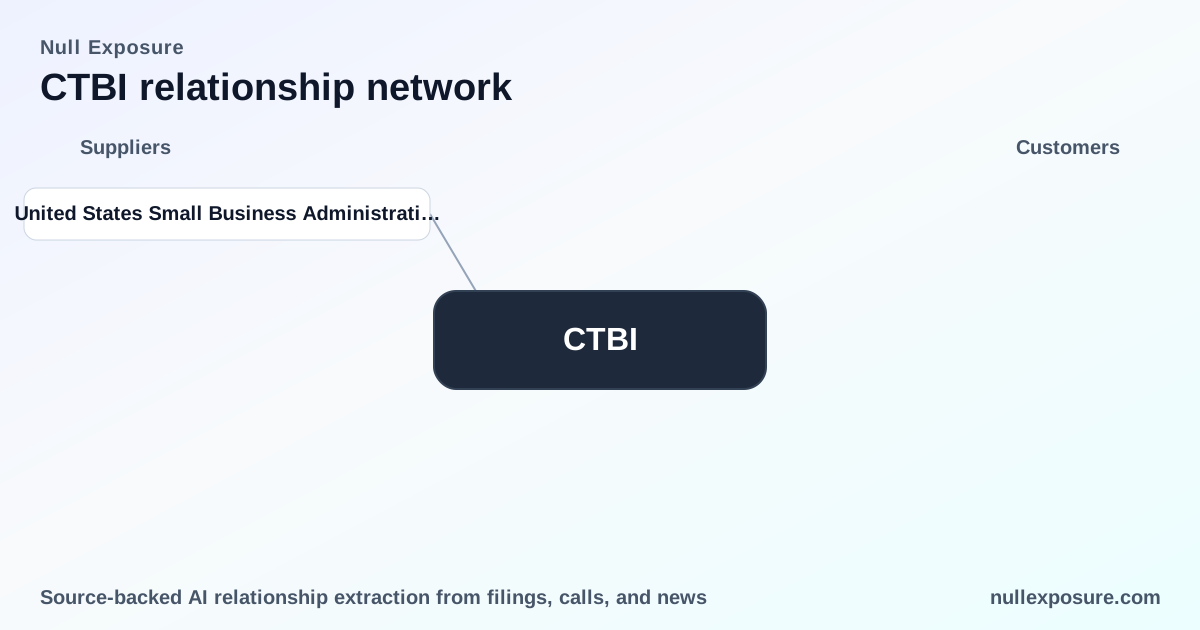
A single relationship surfaced in the underlying results: the United States Small Business Administration.
Community Trust Bank partnered with the U.S. Small Business Administration to fund three 504 loan projects in Kentucky totaling $17,477,879 in FY2025, reflecting active engagement in SBA‑backed economic development lending in its footprint. A news report from Mountain‑Top Media covered the transactions on March 9, 2026 (Mountain‑Top Media, March 2026).
Why that matters: SBA 504 projects are typically long‑dated, collateralized community development loans that extend CTBI’s reach into commercial real estate and small business finance while shifting some credit risk to government guarantees or program structures. The relationship is operationally additive (increasing fee and interest income) and strategically aligned with CTBI’s community banking franchise.
Constraints and what they reveal about CTBI’s supplier posture
Company disclosure excerpts and supplier‑related controls provide a coherent picture of how CTBI contracts and manages external parties:
- Contract duration and funding implications: CTBI runs both long‑term obligations (debt that supports the balance sheet) and short‑term funding that reprices daily; this creates mixed contracting needs—stable, long‑term agreements for core infrastructure and flexible short‑term arrangements for liquidity and market access (company 2024 filing excerpts).
- Critical vendor treatment: the bank’s vendor program evaluates tiers 1 and 2 annually and requires SSAE/SSAE18 equivalents, financials, and insurance—this elevates providers of processing, network and cloud services into critical supplier status and subjects them to formal attestations.
- Spend concentration and procurement scale: with $9.3 million of non‑cancellable purchase obligations reported, the bank’s third‑party spend profile is material but not large‑scale, concentrating supplier risk in a modest mid‑range spend band that favors high‑control procurement over broad outsourcing.
- Service provider dependencies: CTBI explicitly calls out third parties for processing, internet, and network access, and classifies relationship roles as service providers—vendors in those categories are operationally critical to day‑to‑day banking functions.
These signals indicate CTBI expects high assurance from a limited roster of strategic suppliers rather than broad, commoditized vendor dispersion. For supplier firms evaluating CTBI as a customer, this translates to a demanding due diligence process and recurring compliance obligations; for investors, it signals lower operational leverage from outsourcing but higher concentration risk in a few critical partners.
If you want a deeper mapping of CTBI’s supplier relationships and risk posture, see the full supplier intelligence at https://nullexposure.com/.
Operational and investment implications
Investors and operators should focus on three immediate takeaways:
- Credit and community lending are core revenue drivers: SBA participation and an emphasis on small‑business lending align with fee generation and local deposit growth, supporting CTBI’s stable margin profile.
- Vendor controls are robust and prescriptive: service providers should anticipate annual audits, SSAE‑style attestations, and insurance requirements; this increases entry friction but reduces operational counterparty risk.
- Contracting is mixed‑term and capital sensitive: the coexistence of long‑term debt and daily repricing short‑term funding creates a need for suppliers to support both durable infrastructure and rapid liquidity services.
For those tracking CTBI’s supplier risk or seeking to bid on critical contracts, prioritize compliance readiness, financial transparency, and continuity planning—these are non‑negotiable prerequisites for engagement.
Consider reviewing CTBI’s supplier profile further on NullExposure to align diligence and go‑to‑market plans: https://nullexposure.com/.
Final read: positioning, risk, and where to watch next
Community Trust Bancorp is a tightly run regional bank with stable profitability metrics (ROE ~12.1%) and a conservative supplier posture that emphasizes control over scale. The SBA partnership is a concrete example of the bank’s strategy to leverage government‑backed programs to expand lending without materially increasing balance‑sheet concentration. Investors evaluating CTBI should watch quarterly disclosures for changes in non‑cancellable obligations, shifts in vendor tiering, and any expansion of SBA or other programmatic lending that would affect fee and credit mix. For a complete supplier risk dossier and ongoing monitoring, visit https://nullexposure.com/.