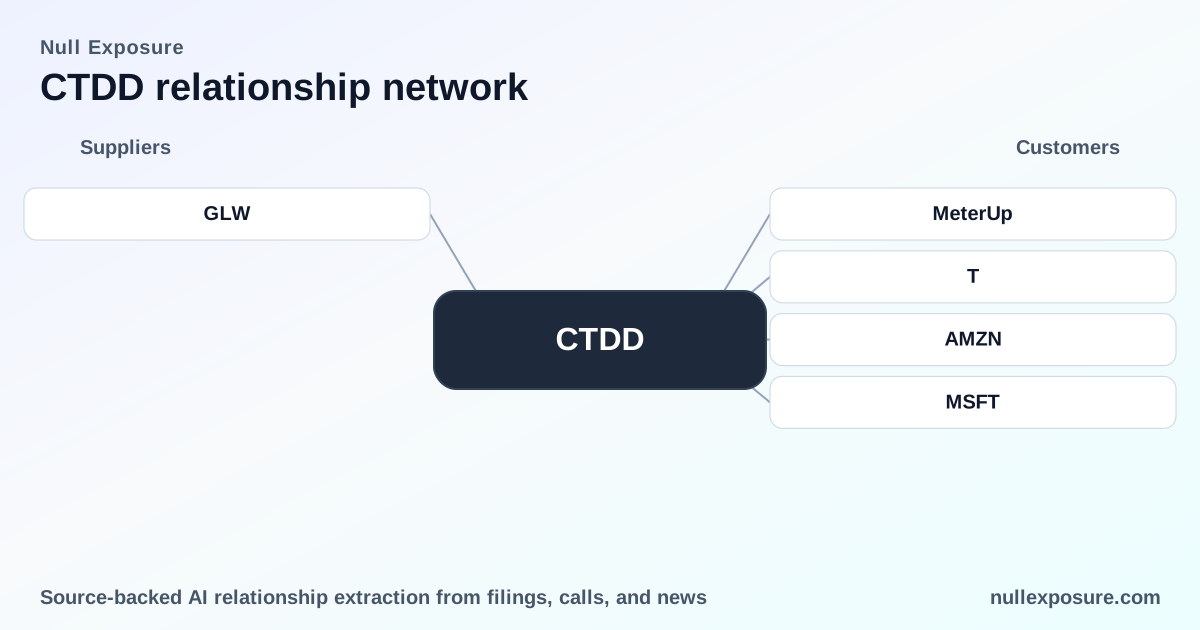
CTDD supplier relationships: what investors need to know
Qwest Corporation (ticker CTDD in this supplier-scope review) operates as an integrated communications company across 14 western and midwestern states, monetizing primarily through recurring voice, data and enterprise connectivity services and by leasing network capacity to third-party customers. Supplier relationships — particularly for fiber and network services — are direct drivers of service quality, capital deployment and margin stability for CTDD; investors should treat supplier posture and contract renewal cycles as first-order operational risks.
For a consolidated view of supplier exposures and to monitor changes in real time, visit https://nullexposure.com/.
The short operating thesis: network access is the business model
CTDD’s core economic model is simple: own (or control) the route and sell the pipe. Revenue comes from subscriptions and enterprise agreements for connectivity; costs come from maintenance, capacity purchases, and third-party leases. Supplier contracts for fiber and related equipment translate immediately into either fixed operating expense or capital commitments, which compress margins when renegotiated at higher rates or when capacity upgrades are required.
This supplier-led cost structure gives CTDD a predictable revenue base but a structurally capital- and supplier-dependent cost profile, so supplier relationships are inherently strategic, not tactical. For more context on supply-side exposures across similar communications firms, see additional analysis at https://nullexposure.com/.
What the filings tell us about CTDD’s contracting posture
CTDD’s public disclosures make two corporate-level points that shape supplier risk:
- CTDD purchases services from affiliates — including telecommunications, marketing and employee-related services — and recognizes these as operating expenses on its consolidated statements of operations. This indicates a mix of internalized services and third-party outsourcing that adds counterparty layers to the cost base.
- CTDD leases a substantial portion of its fiber network from several other communications companies, and those arrangements will periodically need renewal or replacement to sustain current operations. Lease renewals introduce timing and pricing risk to both operating margin and capital planning.
Both points come from company disclosures and should be treated as company-level signals about concentration and contract renewal exposure. These contract structures imply medium-to-high supplier criticality (fiber and network services are mission-critical), ongoing maturity risk (leases rolling at intervals), and counterparty concentration (several communications firms supply essential capacity).
Where Corning fits and what that means for operations
Corning — priority access to advanced fiber technology
CTDD has expanded its partnership with Corning to secure priority access to the newest state-of-the-art fiber technology, according to comments made on the company’s 2025 Q4 earnings call on March 7, 2026. This expansion signals a deliberate strategic tie to a leading fiber equipment supplier that can accelerate capacity deployments and potentially lower upgrade lead times. (Source: CTDD 2025 Q4 earnings call, March 7, 2026.)
This relationship should be seen as operationally critical: Corning’s equipment and product roadmap influence CTDD’s upgrade cadence and service capability. Priority access reduces supply chain lead times and supports quality control, but it also concentrates technology dependence on a single advanced supplier.
Implications for capital allocation, margins and downside
CTDD’s supplier posture translates into concrete investor implications:
- Capital allocation sensitivity: When CTDD must expand capacity, priority supplier access (e.g., Corning) can shorten deployment cycles but typically requires predictable capex schedules. Investors should watch capex guidance and any supplier-driven acceleration or delays.
- Margin volatility on contract renewals: Leased fiber and third-party services expose CTDD to periodic price reset risk. Renewals that reset at higher rates will compress operating margins; conversely, longer-term contracts with stable pricing support margin predictability.
- Counterparty concentration risk: Partnership dependency on top-tier suppliers like Corning improves technology posture but concentrates risk if a supplier faces manufacturing or logistics issues.
- Operational resilience: Affiliate-provided services embed intra-group dependencies that can be beneficial (integrated support) but create single points of failure if those affiliates experience disruptions.
Midway action: for a streamlined supplier risk dashboard and ongoing updates to CTDD’s counterparty exposure, visit https://nullexposure.com/.
Practical monitoring checklist for investors
Investors evaluating CTDD should track a short list of high-signal items on a quarterly cadence:
- Contract renewal timelines for leased fiber and large service agreements (renewal windows are the primary event risk).
- Capex guidance vs. realized spend, particularly any supplier-driven acceleration.
- Supplier concentration disclosures and any additions/removals of priority suppliers.
- Operational KPIs tied to network availability and upgrade completion dates.
These monitoring items convert supplier commentary into actionable investment signals.
Key risks that will move the stock
- Renewal shock: Multiple large leases re-priced upward in the same period would hit margins and cash flow.
- Supplier disruption: Manufacturing or delivery problems at a primary supplier like Corning could delay revenue-generating upgrades.
- Affiliated-service dependency: If affiliates change service terms or internal chargebacks increase, operating expenses could rise without corresponding revenue improvement.
Bottom line and investor actions
CTDD’s supplier relationships are a core determinant of near-term operational performance: priority ties to Corning improve technological access and deployment speed, while broad leasing of fiber and reliance on affiliates create renewal and concentration risk that directly affects margins. Investors should prioritize disclosure-driven monitoring of contract renewal schedules, capex cadence and supplier concentration metrics.
If you are building a watchlist or performing counterparty diligence, start with the renewal calendar and Corning’s supply commitments as the first two items. For a concise, up-to-date supplier exposure report and alerts, go to https://nullexposure.com/.
Key takeaway: supplier contracts are the operational lever that will move CTDD’s earnings and valuation over the next 12–24 months — treat Corning access as a structural positive, and lease-renewal clusters as a primary downside trigger.