Claritev (CTEV): Supplier posture, strategic partners, and what investors should price in
Claritev monetizes healthcare cost-management and revenue integrity by selling technology-enabled analytics and payment services to payors and providers; the company runs hosted applications and integrates payment rails to extract margin from recurring SaaS and transaction flows. Claritev’s supplier relationships—cloud platforms for compute and third-party payment processors—are structural to revenue delivery and operational continuity. For a focused read on supply-side exposure and counterparty concentration, visit https://nullexposure.com/ for ongoing supplier intelligence.
How Claritev operates and why supplier choices matter for valuation
Claritev delivers its value proposition through analytics software and managed services that require continuous access to scalable compute, secure data storage, and payment processing. The business generates nearly $965 million in trailing revenue with gross profit of $712 million, indicating material scale, while reporting a negative EPS and a mixed margin profile that underscores reliance on operational efficiency and uptime. Supplier decisions convert directly into product reliability and cost base: cloud agreements determine latency, compliance posture, and variable costs; payment partners determine throughput, fees, and product scope.
This operational dependency is reflected in company disclosures that categorize third‑party cloud and payment providers as core to service delivery. Investors should treat supplier contracts as first‑order risk factors when modeling revenue retention, margin normalization, and capital expenditure needs.
What Claritev’s public filings and news reveal about suppliers
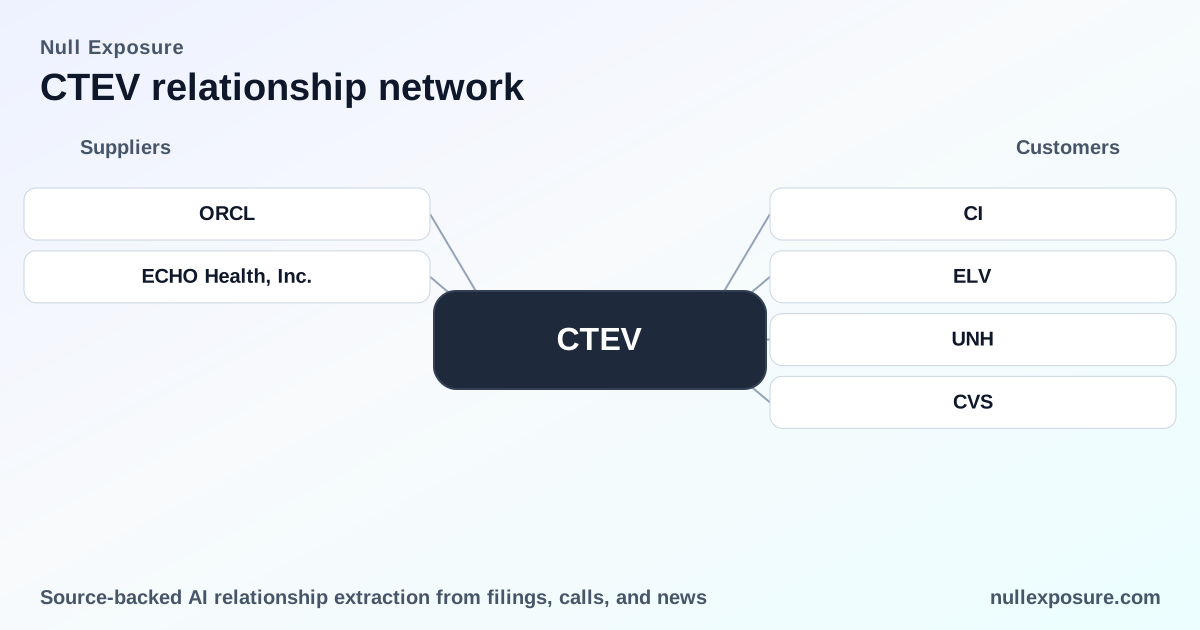
Claritev’s public disclosures and contemporaneous news reports show two named supplier relationships in FY2025: a cloud transformation with Oracle Cloud Infrastructure and a payments partnership with ECHO Health. Both relationships were cited in market reporting on March 9, 2026.
Oracle Cloud Infrastructure — multi‑year digital transformation
Claritev entered a multi‑year partnership with Oracle Cloud Infrastructure (OCI) to modernize parts of its stack and support scale. TradingView reported the OCI partnership as part of Claritev’s FY2025 disclosures, noting the strategic intent to migrate and modernize infrastructure on OCI (TradingView news, 3/9/2026: https://www.tradingview.com/news/tradingview:1eeca4d266738:0-claritev-corp-sec-10-k-report/).
ECHO Health — adding payment processing capabilities
Claritev also formed a payments partnership with ECHO Health to add payment processing to provider claim workflows, expanding Claritev’s value proposition to payors and consumers through integrated payment rails. This arrangement was disclosed in the same FY2025 reporting highlighted by TradingView (TradingView news, 3/9/2026: https://www.tradingview.com/news/tradingview:1eeca4d266738:0-claritev-corp-sec-10-k-report/).
Operational constraints and what they reveal about vendor risk
Claritev’s filings surface a consistent set of constraints that shape vendor risk and contracting posture. These are company‑level signals investors must fold into diligence and scenario analysis:
- Geographic redundancy, U.S.-centric: Primary data center co‑location in Texas with a redundant site in Illinois signals an on‑shore hosting strategy that prioritizes regulatory control and latency management. This reduces cross‑border data‑sovereignty risk but concentrates physical risk in two states.
- Material dependency on third‑party cloud services: Management explicitly states that disruption of cloud services could materially and adversely affect operations and financials—an investor should treat cloud availability and contract terms as material risk drivers.
- Outsourced core infrastructure: Claritev outsources much of its core infrastructure to major providers—Amazon Web Services, Microsoft, and Salesforce are named as providers in disclosures—indicating a hybrid sourcing model with multiple strategic providers but also a reliance on Tier‑1 cloud vendors for uptime and tooling.
- Active supplier posture: Relationships are described as active, not dormant; this indicates ongoing operational and contractual ties rather than exploratory pilots.
These constraints translate into practical implications for contracting posture, concentration, criticality, and maturity: Claritev contracts with large cloud vendors and specialized payment processors to scale quickly but retains operational exposure to those vendors’ SLAs, price adjustments, and service roadmaps. Concentration is moderate—multiple cloud vendors are used—but criticality is high because core product delivery depends on these external platforms.
Investment implications: key risks and where upside lives
Claritev’s supplier map produces a clear checklist for investors and operators:
- Operational continuity risk is material. Downtime at a major cloud provider or a failed migration project with OCI would affect revenue recognition and client retention.
- Contract negotiation leverage is asymmetric. Large cloud and payments vendors hold pricing and change‑control leverage; monitor upcoming contract renewals and pass‑through cost risk.
- Execution on integrations drives product breadth. The ECHO Health payment tie‑in expands monetizable service lines; successful integration increases wallet share with payors and providers.
- Capital and margin sensitivity to vendor costs. Given the company’s mixed profitability metrics, vendor cost inflation will compress margins unless Claritev successfully offsets with pricing or operational gains.
For professional diligence on supplier concentration and counterparties, consider a focused audit of contract terms, termination rights, and SLA credits. You can explore structured supplier intelligence at https://nullexposure.com/ to benchmark counterparty risk across peers.
Tactical signals investors should track next
Near-term monitoring should concentrate on three items that directly affect valuation and downside protection:
- Migration milestones with OCI — completion timelines, cost overruns, and performance improvements post‑migration.
- Payment volumes and fee capture from the ECHO integration — revenue attribution and incremental margin from payment processing.
- Cloud spend trajectory across AWS, Microsoft, and Oracle — whether Claritev consolidates, diversifies, or faces step‑ups in vendor pricing.
Catalysts that increase conviction: public updates confirming lower operating costs post‑OCI migration, materially accretive payment volumes from ECHO, or contract renewals that lock in favorable pricing. Red flags: protracted migration delays, customer incidents tied to vendor outages, or vendor lawsuits/force majeure claims affecting service delivery.
Final recommendation and next steps for due diligence
Claritev is a scale operator in healthcare information services with material supplier dependence that is both a vulnerability and a lever for operational improvement. Investors should model scenarios that treat vendor outages and price increases as first‑order risks while giving credit for successful vendor integrations that expand product capabilities and margin capture.
For ongoing supplier monitoring and to compare Claritev’s counterparty exposure across the market, visit https://nullexposure.com/ and review supplier intelligence feeds and contract‑level signals. That resource provides the practical supplier-level detail necessary to move from thematic conviction to defensible position sizing.