Castellum Inc. (CTM) — supplier relationships, strategic posture, and what investors should watch
Castellum, Inc. operates as a small-cap provider of cyber security, information technology, electronic warfare, and information operations services to government customers and defense-focused clients. The company monetizes through a mix of direct services contracts and channel/reseller arrangements that let Castellum market third-party technologies to its public-sector customer base, generating revenue from services delivery, product resale margins, and ongoing support engagements. For investors assessing supplier risk and upside, Castellum’s supplier deals are less about large-scale product ownership and more about channel amplification into high-value government budgets. Explore full supplier intelligence at https://nullexposure.com/.
How the financial profile shapes strategic behavior
Castellum’s financial and ownership profile reads like a classic early-stage government contractor scaling channel reach. The company has roughly $52.9M in trailing twelve‑month revenue against a market capitalization near $78M, but it is not yet profitable: EBITDA is negative and operating margins are in the red. These facts drive the company’s contracting posture and partner strategy:
- Contracting posture: Focus on reseller agreements and government deliveries rather than heavy internal product R&D, which accelerates go-to-market for adjacent technologies and reduces capital intensity.
- Concentration & ownership: Insider ownership sits at ~21% while institutions account for ~14%, signaling founder/operator influence and modest institutional scrutiny.
- Criticality: The services (cyber, electronic warfare, information operations) are mission-critical for government customers, which supports higher long-term revenue stickiness when contracts are secured.
- Maturity: Revenue growth trends (quarterly revenue growth YoY ~21.9%) show momentum, but negative profitability and small scale imply execution risk and sensitivity to a few contract wins or partner rollouts.
These characteristics mean Castellum behaves like a highly mission-focused, channel-led small cap—partners are a core mechanism to convert technical capability into government program revenue.
Who Castellum is working with — direct relationship summaries
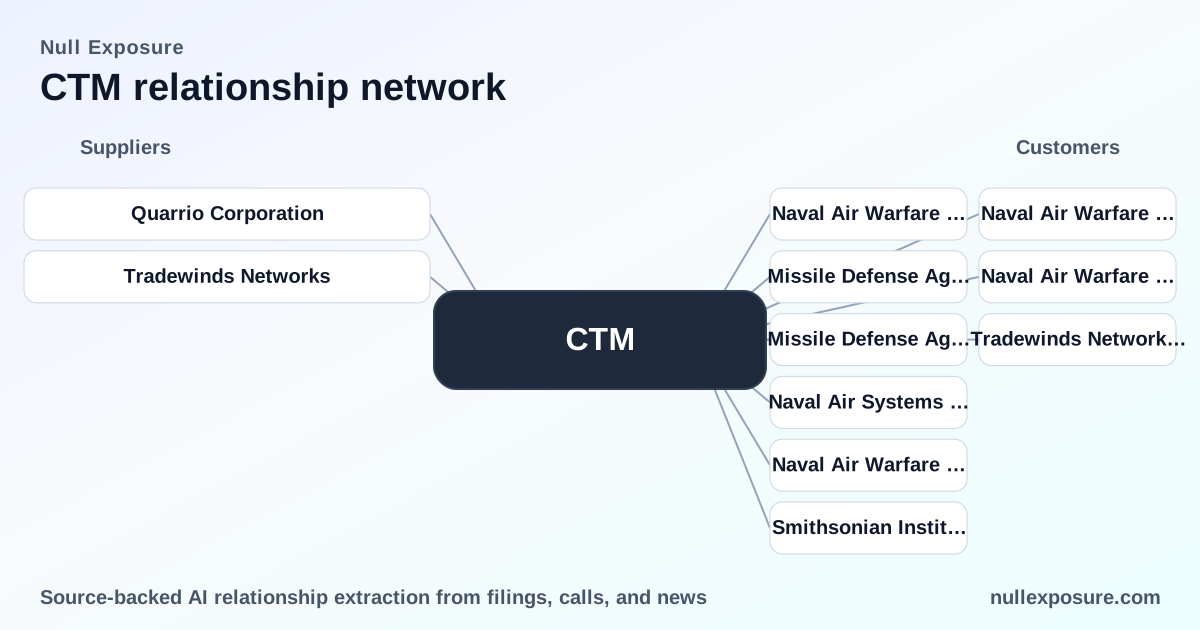
- Quarrio Corporation — Castellum signed a reseller agreement to deliver Quarrio’s TrustworthyAI solution to government customers, positioning Castellum as a channel for verified agentic AI that emphasizes accuracy, verifiability, and security; this relationship was announced in a GlobeNewswire press release dated August 12, 2025 (https://www.globenewswire.com/news-release/2025/08/12/3131518/0/en/Castellum-Inc-Teams-with-Quarrio-to-Provide-Trustworthy-Agentic-AI-for-Government.html).
- Tradewinds Networks — Castellum entered a deal to market Tradewinds’ products, expanding its product portfolio and enabling cross-sell of network/security hardware and services into its government accounts; this arrangement was reported in a StocksToTrade article dated September 2, 2025 (https://stockstotrade.com/news/castellum-inc-ctm-news-2025_09_02/).
Each relationship is a channel extension: Quarrio adds AI capability to Castellum’s government offering, and Tradewinds broadens the underlying networking and security product set Castellum can sell alongside professional services.
Why these partnerships matter operationally and commercially
The two supplier relationships share the same strategic intent: extend Castellum’s addressable market into adjacent technology stacks without the time and capital required to build these solutions in-house. That translates into three concrete operational implications:
- Faster bid capacity: Reseller agreements let Castellum include proven third-party tech in proposals for government programs, improving win probability on time-limited solicitations.
- Revenue diversification (near-term): Product sales and resell margins provide a different margin mix versus purely labor-based services, which can stabilize top-line volatility from contract start/stop dynamics.
- Program-level criticality: Adding trustworthy AI and hardened networking products raises the technical bar for Castellum’s proposals, increasing the perceived mission value to defense and civilian agencies.
For buyers and partners, these arrangements signal that Castellum is prioritizing go-to-market leverage and credibility in mission-critical domains rather than pursuing heavyweight proprietary product development.
Explore deeper supplier relationship mapping and alerts at https://nullexposure.com/.
Risk and upside — what investors and operators must price
- Execution risk is material. Castellum’s negative EBITDA and operating margins require continued top-line growth and partner monetization to reach sustainable profitability. A failed channel rollout or delayed government procurement cycle would have an outsized profit impact.
- Concentration risk exists. Small-cap scale combined with limited institutional ownership increases volatility; a handful of contracts or partner deals will drive material swings in quarterly results.
- Regulatory and program risk for AI products. Selling AI to government buyers requires compliance, verification, and contracting mechanisms that lengthen sales cycles—the Quarrio relationship is strategically valuable but brings procurement cadence and standards scrutiny.
- Upside: differentiated market positioning. Castellum’s focus on electronic warfare and trustworthy AI places it in higher-margin, harder-to-penetrate niches that government budgets prioritize, creating the potential for durable contracts once relationships are established.
Key market signals to monitor this thesis include contract award announcements, revenue contribution from partner-sourced deals, margin expansion, and any changes in insider/institutional ownership. Analyst coverage is limited but constructive: the consensus target price offered in sources is $3.50 with one strong-buy rating recorded in public data.
Bottom line — where this fits in an investor/operator playbook
Castellum is a small, unprofitable provider of mission-critical cyber and defense services that is using reseller relationships to accelerate access to government demand for AI and networking solutions. The Quarrio and Tradewinds agreements are strategically consistent: they turn Castellum into a channel for higher-value technologies, increasing its relevance to government buyers while keeping capital intensity low. For investors, the trade is clear: high operational leverage if the partner rollouts convert to contracts; high sensitivity to procurement timing and execution.
If you are evaluating CTM as a supplier or investment, focus on pipeline visibility for partner-led deals, contract win rates, and margins on resale transactions. For continuous monitoring and deeper supplier analytics, visit https://nullexposure.com/.
If you want alerts on new Castellum partner announcements or a concise supplier-risk brief, go to https://nullexposure.com/ and request coverage tailored to your diligence needs.