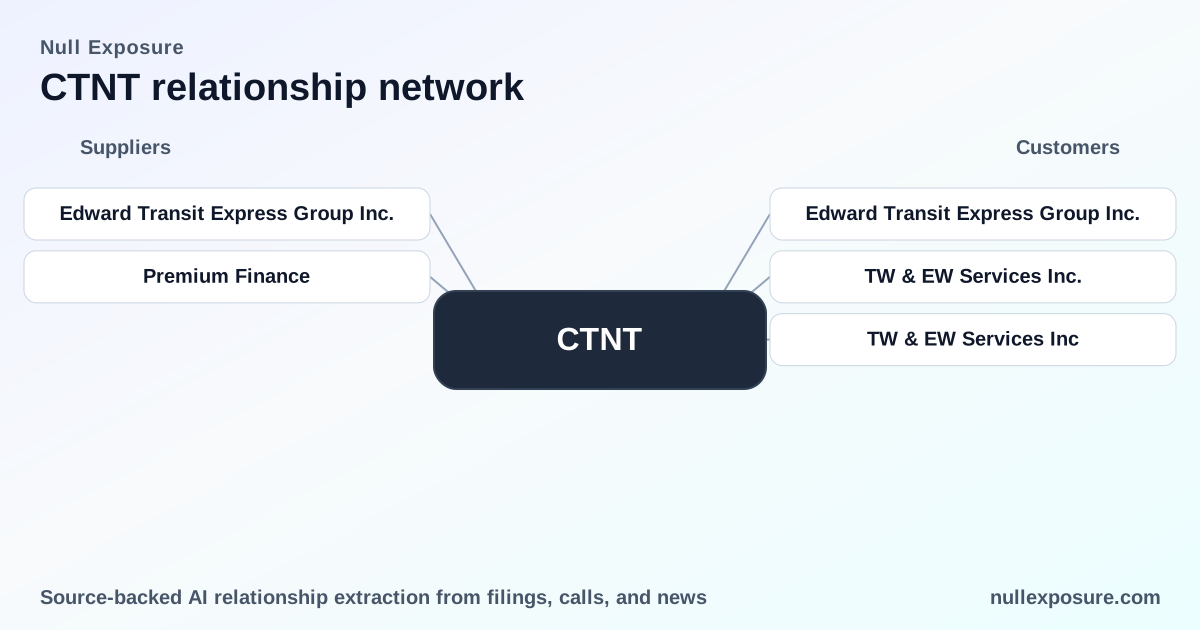
Cheetah Net (CTNT): Supplier Relationships That Define a Small but Strategic Logistics Play
Cheetah Net Supply Chain Service Inc. operates a parallel-import vehicle dealership and logistics business that monetizes through vehicle sales, third‑party logistics and warehousing services, and ancillary transportation contracts. The company supplements revenue by offering logistics and warehousing to other parallel‑import dealers while leveraging short-term ocean carrier agreements and leased facility capacity to scale quickly. For a concise supplier-mapping and deeper counterparty intelligence, visit https://nullexposure.com/.
The business model in one line: logistics as both enabler and product
Cheetah Net’s business model blends retail parallel imports with vertically adjacent logistics services. Revenue is split between vehicle turnover and logistics/warehousing fees, and management has pursued an acquisition strategy to internalize key service providers. The company is small by market cap (roughly $5.3M) with negative operating margins and constrained cash flow, so supplier arrangements—both inherited and contractual—have outsized impact on operating leverage and near-term viability.
For a full supplier dossier and verification of sources, see https://nullexposure.com/.
Supplier relationships that matter now
Edward Transit Express Group Inc.
Cheetah Net completed an acquisition of Edward Transit Express Group Inc., effectively bringing in-house a logistics and warehousing operator that reduces operating overhead and enables the company to sell logistics services to other parallel‑import dealers. AJOT reported that Edward’s capabilities were expected to jumpstart Cheetah’s third‑party services offering, and a follow‑up AJOT article noted that Edward contributed roughly $0.25 million to Cheetah’s 2023 revenue before the deal closed (AJOT, March 2026). The acquisition also came with pre‑existing carrier relationships: Cheetah now works with three ocean carriers that had longstanding partnerships with Edward prior to the acquisition, preserving continuity of ocean freight access (company filings referenced in transaction coverage).
Source: AJOT coverage of the Edward acquisition and completion (March 9, 2026) and related company disclosures.
Premium Finance (credit counterparty)
Cheetah lists a loan payable from Premium Finance of approximately $131,083 in its third‑quarter 2025 press release, recorded among current liabilities alongside operating lease liabilities and other short‑term payables. This represents a modest but immediate financing relationship that influences short‑term liquidity and the company’s working capital profile (company press release distributed via The Globe and Mail, Q3 2025 results).
Source: company press release for Q3 2025 results (The Globe and Mail / company filing, March 2026).
What the constraints tell you about CTNT’s supplier posture
The disclosed constraints and excerpts amount to a concise portrait of CTNT’s supplier strategy and operational risk profile:
-
Contracting posture: mixed short-term and medium/longer-term commitments. The company signs 12‑month master service agreements with ocean carriers, indicating flexibility and the ability to reprice or change carriers annually, but it also holds non-cancelable operating leases of 12 to 55 months for offices and facilities, creating fixed occupancy costs. This mix gives Cheetah operational agility on freight spend while locking in occupancy expenses that pressure margins if demand softens.
-
Concentration and counterparty profile: skewed toward small businesses. Suppliers and counterparties on the vehicle side are predominantly small, family‑owned dealers that do not buy at scale, increasing the administrative burden per vehicle and elevating revenue volatility. This is a company-level signal rooted in the nature of the parallel‑import market rather than a single counterparty.
-
Criticality of service providers: logistics and third‑party labor are mission‑critical. The company explicitly depends on limited customers and third‑party transportation and labor providers for its logistics offering. Acquiring Edward mitigates some external dependency by internalizing warehousing and carrier relationships, but third‑party carriers and labor remain operationally central.
-
Maturity of relationships: mixed. The ocean carrier relationships are governed by short annual agreements (short-term), yet facility leases demonstrate multi‑year commitment (longer-term), which implies an operational footprint that is committed in real estate but flexible in freight procurement.
-
Spend and vendor concentration in audit/consulting: The company reported aggregate audit and review fees around $0.25M (2024) and $0.43M (2023) paid to specific auditors, indicating a non-trivial portion of professional spend concentrated on a small set of firms—useful when assessing vendor risk and fixed overhead.
Where an excerpt explicitly names a counterparty—Edward—the constraint that those ocean carrier relationships carried over is attributed to that transaction; other constraints are presented as company-level characteristics.
For further supplier-centered due diligence and map visualization, consult https://nullexposure.com/.
Investment implications — what investors should weigh
-
Operational leverage is high and supplier decisions are material. Given the company’s small scale (market cap ~ $5.3M) and negative margins, any supplier insolvency, carrier rate shock, or warehouse disruption will have outsized P&L and cash impacts.
-
Acquisition of Edward reduces some execution risk but does not eliminate dependence on carriers and labor. Bringing warehousing in-house strengthens margins if utilization increases, but ongoing carrier contracts remain short-term and require active management.
-
Counterparty quality is uneven. The supplier base is largely composed of small, concentrated dealers and specialized service providers, which increases credit and operational risk on both revenue and cost sides.
-
Liquidity and financing relationships are modest yet relevant. The recorded loan from Premium Finance is small in absolute terms but is a reflection of CTNT’s use of external financing for working capital; monitor any shifts in short‑term borrowings or covenant triggers.
Key checklist for investors:
- Confirm continuity and pricing terms of the three ocean carrier agreements inherited via Edward.
- Monitor warehouse utilization rates and third‑party warehousing revenue ramp post-acquisition.
- Track short-term debt movements and loan covenants tied to Premium Finance or other financers.
- Watch audit and professional service spend as an indicator of fixed overhead pressure.
Bottom line and next steps
Cheetah Net has taken a pragmatic step to internalize critical logistics capability via the Edward acquisition, which materially reduces certain outsourcing costs and creates a new B2B revenue vector, but the operating model remains exposed to carrier pricing and a fragmented small‑dealer customer base. For investors and operators, the focus should be on carrier contract renewal dynamics, warehouse utilization, and near‑term liquidity movements.
For a complete supplier relationship breakdown and historical document links, visit https://nullexposure.com/. If you want a tailored counterparty risk brief on CTNT’s supplier network, request a supplier report at https://nullexposure.com/ and get source-level details and risk scoring.