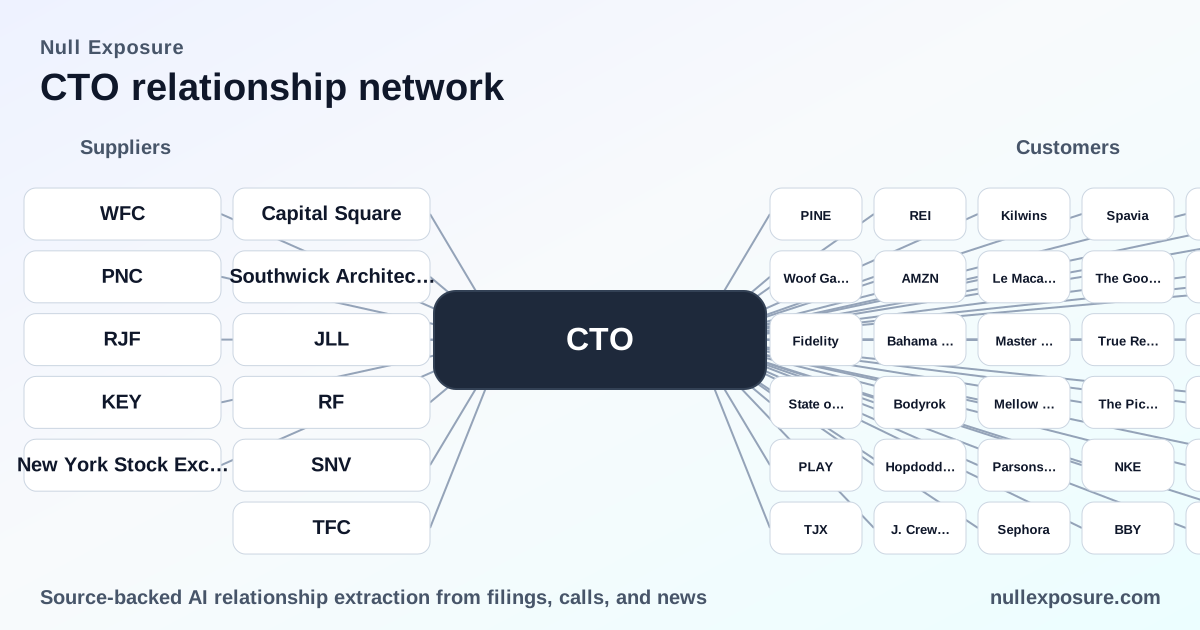
CTO Realty Growth: supplier map and what it means for investors
CTO Realty Growth operates as a small-cap, publicly traded REIT that acquires, repositions and leases retail and mixed‑use commercial real estate and generates cash flow from tenant rents, leasing fees and selective asset sales. The company monetizes through active asset management and targeted redevelopment of lifestyle centers, and leans on third‑party specialists for leasing, design and capital markets execution. For investors evaluating counterparty risk and operational resilience, the supplier footprint is concentrated in professional leasing/design firms and a syndicated bank financing base that underpins liquidity and growth.
Explore a concise supplier-risk profile and sourcing history at NullExposure.
How CTO’s supplier posture shapes capital allocation and operations
CTO’s operating model is outsourced and asset‑management centric: the company acquires retail assets and brings in external firms to execute leasing, architecture and capital structuring. Company disclosures indicate the use of third‑party property management and a managed IT service provider for cybersecurity, which signals a deliberate contracting posture that prioritizes external expertise over in‑house scale. This produces three practical investor takeaways:
- Contracting posture: CTO contracts out core operating functions (property management, leasing, IT security), which reduces fixed overhead but creates dependency on external execution quality.
- Concentration and criticality: A syndicated lending structure and a small roster of professional services providers concentrate operational risk into a handful of vendors and banks; those relationships are operationally critical when executing redevelopments and refinancing.
- Maturity: Several supplier ties are recent and transaction‑specific (leasing and financing events in FY2023–FY2025), indicating a dynamic, deal‑driven supplier ecosystem rather than long‑standing captive arrangements.
For more on supplier influence in small‑cap REITs, visit NullExposure.
Company‑level constraint signals
CTO’s public filings state that it utilizes third‑party property management companies and a third‑party managed IT service provider to deliver cybersecurity capabilities, including threat detection, vulnerability monitoring and incident response—this is a company‑level signal of an outsourced operating model rather than an internal services build‑out (company filing excerpts, FY2024–FY2025).
Supplier relationships: the counterparties cited in public coverage
Below are the relationships found in the record, presented as concise plain‑English summaries with source context.
-
Capital Square — CTO purchased a parcel from Capital Square for $1.5 million after earlier plans by Capital Square were abandoned, reflecting CTO’s opportunistic land acquisition approach in mixed‑use neighborhoods (Richmond BizSense, May 21, 2025; https://richmondbizsense.com/2025/05/21/west-broad-village-owner-eyes-new-retail-buildings-in-center-of-the-neighborhood/).
-
Southwick Architecture + Interiors — Charlotte‑based Southwick is the designer engaged for CTO’s preliminary plans for four retail "jewel box" buildings at West Broad Village, indicating CTO’s use of external design specialists for small‑scale redevelopment (Richmond BizSense, May 21, 2025; https://richmondbizsense.com/2025/05/21/west-broad-village-owner-eyes-new-retail-buildings-in-center-of-the-neighborhood/).
-
JLL — JLL’s retail group was selected to reposition and lease The Collection at Forsyth following CTO’s acquisition, and JLL’s Sherri Wilson handles retail leasing on CTO’s behalf at that center; this demonstrates CTO’s reliance on institutional leasing brokers for asset repositioning (JLL press release, FY2023; ShoppingCenterBusiness report, FY2024; https://www.jll.com/en-us/newsroom/cto-realty-growth-inc-taps-jll-retail-team-to-reposition-and-lease-the-collection-at-forsyth, https://shoppingcenterbusiness.com/cto-announces-new-retail-openings-leases-at-collection-at-forsyth-in-metro-atlanta/).
-
KeyBank National Association — KeyBank led and served as Administrative Agent for CTO’s 2030 Term Loan, positioning the bank as the administrative center of a multi‑bank financing facility that anchors the company’s capital structure (Yahoo Finance press release summarizing FY2025 financing; https://finance.yahoo.com/news/cto-realty-growth-strengthens-balance-200500661.html).
-
PNC Bank, National Association — Listed as a co‑syndication agent in the 2030 Term Loan, PNC is part of the bank group providing committed financing capacity to CTO (Yahoo Finance, FY2025; https://finance.yahoo.com/news/cto-realty-growth-strengthens-balance-200500661.html).
-
Regions Bank — Regions served as a co‑syndication agent on the 2030 Term Loan, contributing to the syndicated liquidity package backing CTO’s balance sheet (Yahoo Finance, FY2025; https://finance.yahoo.com/news/cto-realty-growth-strengthens-balance-200500661.html).
-
Truist Bank — Named among co‑syndication agents for the 2030 Term Loan, Truist participates in CTO’s syndicated financing structure (Yahoo Finance, FY2025; https://finance.yahoo.com/news/cto-realty-growth-strengthens-balance-200500661.html).
-
Synovus Bank — Identified as an additional participating bank in the syndicate, Synovus provides incremental lender capacity on the financing (Yahoo Finance, FY2025; https://finance.yahoo.com/news/cto-realty-growth-strengthens-balance-200500661.html).
-
Wells Fargo Bank, National Association — Included among participating banks on the 2030 facility, Wells Fargo is part of the lender base underpinning CTO’s liquidity (Yahoo Finance, FY2025; https://finance.yahoo.com/news/cto-realty-growth-strengthens-balance-200500661.html).
-
Raymond James Bank — Cited as an additional participating bank in the 2030 Term Loan syndicate, Raymond James contributes to the diversity of CTO’s lending partners (Yahoo Finance, FY2025; https://finance.yahoo.com/news/cto-realty-growth-strengthens-balance-200500661.html).
-
New York Stock Exchange — The NYSE approved CTO’s listing in connection with its REIT conversion and merger, securing public market access and continuous liquidity for shareholders (GlobeNewswire release, Feb 1, 2021; https://www.globenewswire.com/news-release/2021/02/01/2167132/0/en/CTO-Realty-Growth-Completes-Merger-in-Connection-With-REIT-Conversion-and-Uplists-to-the-NYSE.html).
What this supplier map means for risk, execution and valuation
- Execution risk is vendor‑dependent. CTO consistently leverages external firms for leasing, design and cybersecurity; investors should underwrite operational performance that depends on counterparty execution timing and quality rather than internal capabilities.
- Financing diversity reduces single‑lender dependency. The 2030 Term Loan is syndicated across regional and national banks (KeyBank as admin, with PNC, Regions, Truist, Wells Fargo, Synovus, Raymond James participating), which lowers refinancing concentration risk while keeping bank underwriting terms relevant to market cycles (Yahoo Finance summary, FY2025).
- Transaction‑driven supplier engagements point to portfolio agility. JLL’s appointment to reposition The Collection at Forsyth (FY2023) and the West Broad Village land purchase (FY2025) show a playbook of targeted redevelopment financed through syndicates rather than large, permanent operating teams.
If you want a deeper supplier risk scorecard and counterparty exposure map for CTO and peer REITs, start here: NullExposure.
Bottom line and investor actions
CTO runs a lean, outsourced operating model anchored by professional leasing/design services and a multi‑bank financing base. For investors, the critical diligence points are counterparty execution history (JLL, design partners), syndicate loan covenants and maturities (KeyBank‑led 2030 facility), and the company’s vendor oversight for property management and cybersecurity (company filing excerpts, FY2024–FY2025).
To translate these signals into investment decisions: review loan covenant language and amortization schedules, monitor leasing outcomes at core assets like The Collection at Forsyth, and track vendor performance on redevelopment milestones. Learn more and access supplier‑level intelligence at NullExposure.