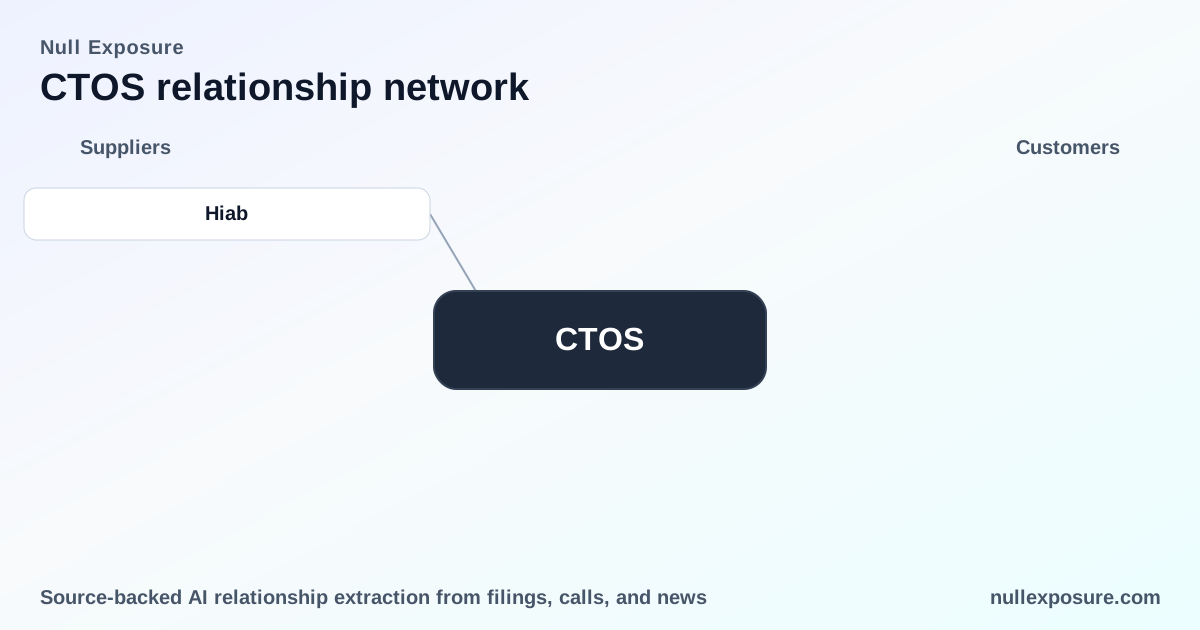
Custom Truck One Source (CTOS): Supplier relationships that shape a capital‑intensive rental platform
Custom Truck One Source operates a specialized equipment rental and services platform that monetizes through short‑ and long‑term rentals, equipment sales, and parts/service for electrical, telecommunications and rail T&D customers across North America. The company sources chassis, attachments and finished equipment under purchase agreements and then captures recurring revenue through fleet utilization and aftermarket service—making its supplier network a direct driver of both growth and operational risk. For a deeper look at how these supplier ties change the investment thesis, see more at https://nullexposure.com/.
Why supplier relationships matter to investors
Custom Truck’s business is capital intensive and vendor‑dependent: equipment availability, chassis supply and manufacturer support determine utilization, rental pricing and repair costs. CTOS reports almost $1.944 billion in trailing revenue and roughly $190 million of EBITDA (TTM), which positions supplier contracts as operational levers that affect margins and return on invested capital. Vendor concentration and purchase agreements are therefore strategic, not incidental—they influence fleet composition, maintenance cycles and market coverage for sales and service.
The Hiab distribution deal and what it changes today
Three recent press reports document the same strategic move: Hiab signed a dealer/distribution agreement with Custom Truck One Source in February 2026 expanding sales and service coverage for HIAB loader cranes and MOFFETT truck‑mounted forklifts across multiple U.S. states. The deal broadens CTOS’s access to attachment and crane product lines and strengthens its service footprint in targeted regions.
- A Sahm Capital article from 16 February 2026 reported Hiab’s agreement expands coverage for HIAB loader cranes across 12 U.S. states and MOFFETT forklifts across eight Northeastern states, directly increasing CTOS’s product and service reach. (Sahm Capital, 2026‑02‑16)
- A separate Sahm Capital piece on 13 February 2026 reiterated that the partnership extends coverage into Western and Northeastern states and framed the agreement as a growth data point for investors assessing CTOS’s expansion strategy. (Sahm Capital, 2026‑02‑13)
- A follow‑up Sahm Capital note on 25 February 2026 emphasized that the dealer agreement expands sales and service coverage and gives CTOS broader access to equipment customers. (Sahm Capital, 2026‑02‑25)
Takeaway: The Hiab relationship is a distribution and service extension, not an equity or JV partnership—CTOS gains product access and service rights that feed rental inventory and aftermarket revenue without taking on manufacturer balance‑sheet risk.
Every supplier relationship reported (concise, source‑backed)
Below are the relationships found in the supplier results; each entry is summarized in plain English with its source.
- Hiab — The company executed a dealer agreement enabling CTOS to sell and service HIAB loader cranes and MOFFETT truck‑mounted forklifts across expanded U.S. state coverage, improving CTOS’s attachment and lifting‑equipment distribution network. (Sahm Capital news coverage, February 13–25, 2026)
- Hiab — Same Hiab deal reported again with emphasis on 12 states for HIAB cranes and eight Northeastern states for MOFFETT forklifts, highlighting the geographic specificity of the expansion. (Sahm Capital, February 16, 2026)
- Hiab — Subsequent coverage reiterated broader access to equipment customers through the dealer agreement, presented as a tangible growth catalyst for fleet and service demand. (Sahm Capital, February 25, 2026)
Each mention is a distinct media report documenting the same commercial relationship and its phased public disclosures in February 2026.
Company‑level constraints that frame those relationships
Several supplier constraints from CTOS’s corporate disclosures are material for underwriting counterparty risk and execution:
- Geographic sourcing is predominantly North American but not purely domestic. The company discloses most raw materials and components are sourced domestically while acknowledging some suppliers and subcomponents come from outside the U.S., exposing CTOS to cross‑border supply chain considerations. This is a company‑level signal rather than an item tied to a single supplier.
- Vendor concentration is material. CTOS disclosed that in 2024 one vendor accounted for 15.3% of purchases and that in 2023 two vendors each represented more than 10% (combined roughly 31%), primarily related to chassis. High concentration in chassis supply is a structural risk because chassis availability and pricing directly affect fleet deployment and replacement cycles.
- Contracting posture is buyer‑centric but reliant on manufacturer agreements. Formally, CTOS purchases raw materials, component parts and finished goods via purchase agreements with manufacturers and suppliers for fleet and inventory—CTOS is the buyer, and many supplier relationships carry commercial provisions that affect delivery timing and warranty/service coverage.
- Outsourced advisory services exist. The company records management fees under a Corporate Advisory Services Agreement (Platinum) indicating use of external advisory contracts that are material to operating cost and governance.
These constraints define a business model with concentrated supplier exposure, buyer negotiation leverage, but sensitivity to manufacturer capacity and service commitments.
Strategic implications for investors
The Hiab distribution agreement is incremental but strategic: it deepens CTOS’s product catalog and service footprint without substantially changing balance‑sheet leverage. Given CTOS’s scale—nearly $1.95B in revenue TTM and an EV/EBITDA of about 9.6—operator economics improve if utilization and aftermarket attach rates rise. But with vendor concentration in chassis procurement and a negative net profit margin reported (TTM profit margin -1.6%), execution risk persists.
- Upside: Expanded distribution increases access to higher‑margin attachments and recurring service revenue. CTOS’s operating margin (10.7% TTM) suggests operational gearing that could benefit from improved fleet mix and higher utilization.
- Downside: Concentrated chassis suppliers create supply bottlenecks that reduce fleet growth optionality; inflation in input prices compresses margins before rental rate pass‑through. Supplier disputes or manufacturer service failures would have amplified effects because of concentration.
- Operational posture: CTOS operates as a buyer that must secure manufacturer commitments to protect uptime and parts availability—contracts like the Hiab dealer agreement are defensive moves to secure product pipelines and service rights.
For more detailed research and supplier‑level signals on CTOS, visit https://nullexposure.com/.
What investors should watch next
Monitor the following signals over the next 12 months: dealer roll‑out timelines and service center openings tied to Hiab, chassis purchase concentration metrics in quarterly filings, utilization trends and aftermarket attach rates, and any supplier delivery delays or price escalations disclosed in MD&A.
Strong calls to action: For model‑ready supplier exposure analysis and cross‑reference research on CTOS supply chain dynamics go to https://nullexposure.com/. For portfolio managers evaluating counterparty concentration or sourcing risk, visit https://nullexposure.com/ for supplier‑centric intelligence and tracking.
Conclusion: CTOS’s Hiab agreement is a clear tactical enhancement to distribution and service coverage that supports the rental and aftermarket thesis, but the company’s vendor concentration and capital intensity remain the structural constraints that determine whether those gains translate into durable margin expansion.