Castor Maritime (CTRM): Strategic counterparties that finance growth and underwrite transformation
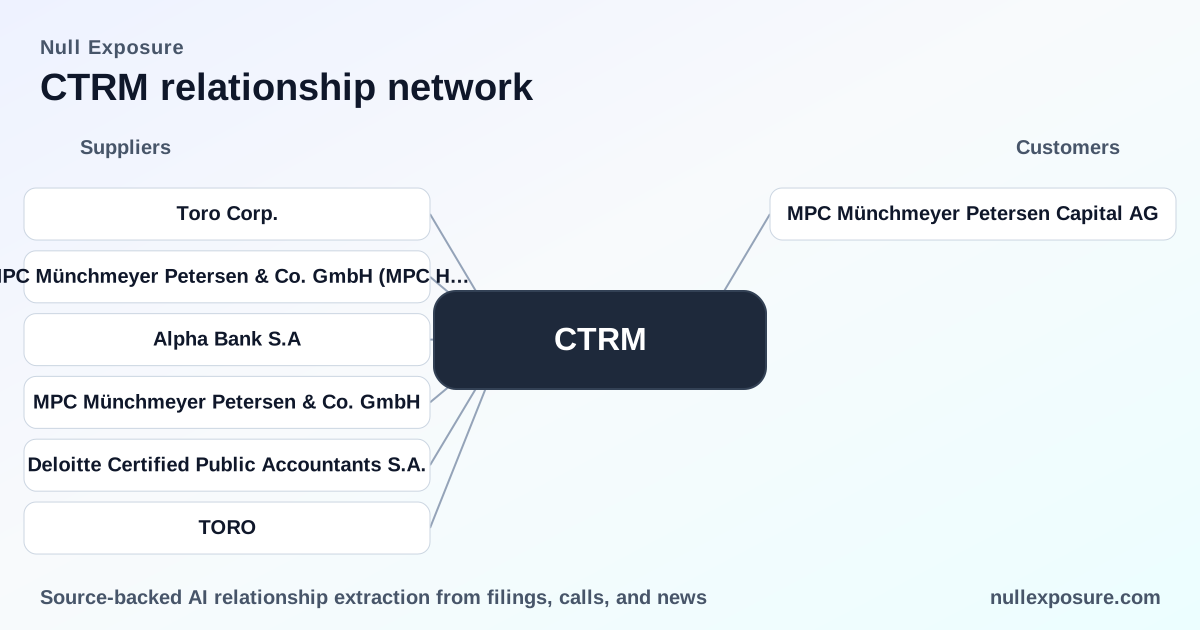
Castor Maritime operates a simple but capital-intensive business: own and operate dry-bulk vessels and monetize them through freight contracts, while using financing and equity instruments to scale fleet and pursue strategic acquisitions. The company converts shipping revenue and asset transactions into growth by structuring vessel-backed debt, related-party financing, and equity/preferred issuance tied to deal activity. For investors and operators evaluating supplier and counterparty exposure, the key signal is that Castor’s growth is funded through a small set of high-touch counterparties whose credit and commercial alignment materially affect Castor’s balance sheet and strategic optionality. Learn more about how we map counterparty risk at NullExposure: https://nullexposure.com/
Why these supplier and financing relationships matter for investors
Castor is a shipping operator with low organic capital intensity relative to industrial manufacturers but with high balance-sheet leverage to pursue transactions. Counterparties that provide term loans, preferred equity, or act as sellers/targets in acquisitions are therefore simultaneously financiers and strategic partners. This dual role elevates counterparty criticality: disruptions or repricing in those relationships translate quickly into funding stress or deal failure. Below I walk through each named relationship in the public record and extract what it means for capital structure and execution risk.
Toro Corp. — growth financier and related-party lender
Castor has taken a $100 million senior term loan from Toro Corp. and issued $50 million in Series D preferred proceeds tied to Toro as part of its acquisition activity in late 2024, and made substantial partial prepayments against Toro’s term loan in March–April 2025 totaling tens of millions of dollars. According to Castor’s disclosures and subsequent press coverage, Toro — an entity controlled by Castor’s Chairman and CEO — provided both debt and preferred proceeds used to fund the company’s expansion and transactions (reported December 2024 and referenced in 2025 filings and news). (Sources: Castor press release/GlobeNewswire, Dec 11–12, 2024; Manila Times/GlobeNewswire coverage of FY2025 repayments.)
MPC Münchmeyer Petersen & Co. GmbH (MPC Holding) — seller of a strategic stake
Castor agreed to acquire a controlling stake from MPC Holding, resulting in an agreement to purchase 26.1 million shares that represent a large majority position in MPC Capital; the purchase was structured as a direct share purchase from MPC Holding for an aggregate cash consideration. This transaction tied Castor’s acquisition agenda to MPC Holding as the counterparty in a high-value asset deal. (Source: Castor announcement/GlobeNewswire, Dec 12, 2024 and related disclosures published May 2025.)
MPC Münchmeyer Petersen Capital AG (MPC Capital) — an acquisition target and strategic move into asset management
Castor committed to buy 74.09% of MPC Capital for approximately €182.8 million (reported as the cash price in December 2024), positioning Castor to broaden its footprint beyond dry bulk into investment and asset management activities through the Frankfurt-listed MPC Capital. This acquisition is a strategic pivot that required material external financing and reallocated balance-sheet risk toward an enlarged corporate perimeter. (Source: Company announcement in December 2024 and follow-up reporting in May 2025.)
Alpha Bank S.A. — traditional secured lender, loan repaid
Castor fully repaid a senior secured term loan facility with Alpha Bank that had been secured against two dry bulk vessels (the M/V Magic P and M/V Magic Moon); the remaining $1.6 million balance was paid off on December 3, 2024. The repayment is evidence of active liability management on legacy vessel financings. (Source: Castor’s FY2024/FY2025 results release via GlobeNewswire, May 14, 2025.)
Deloitte Certified Public Accountants S.A. — corporate governance and audit provider
Deloitte was appointed as Castor’s independent auditors for fiscal 2025, a standard governance step for a NASDAQ-listed shipping operator that signals compliance with public reporting and audit expectations. The appointment was announced in the company’s 2025 AGM materials. (Source: Castor AGM notice/GlobeNewswire, Sep 15, 2025.)
What the counterparty mix implies for Castor’s operating model and business model constraints
Castor’s public filings and press releases reveal a set of company-level signals that investors must treat as structural features of its operating model:
- Contracting posture: Castor relies on a mix of related-party financing (large loan and series D preferred from Toro) and traditional bank facilities for vessel-level finance. This dual posture — market lenders plus related-party capital — accelerates deployment but concentrates decision-making.
- Concentration: Financing and strategic acquisitions are concentrated among a few counterparties. A single related-party lender (Toro) provided the lion’s share of deal funding for the MPC transaction, increasing exposure to a counterparty linked to management.
- Criticality: These relationships are critical to execution; the $100 million facility and preferred proceeds were decisive to effect the MPC Capital acquisition. Loss or repricing of that capital would materially alter Castor’s transaction set and growth trajectory.
- Maturity and governance: The company uses both short-to-medium term vessel-backed loans and corporate-level facilities for deals, while appointing a Big Four auditor, indicating an intent to maintain standard public-company governance even as deal complexity rises.
Together these constraints mean investors must underwrite both shipping market cyclicality and concentrated funding counterparties when assessing Castor’s risk-adjusted upside.
Key takeaways and what investors should watch next
- Financing is the engine of growth: Toro’s $100 million senior term loan and the $50 million in Series D preferred were structurally central to Castor’s acquisition strategy in late 2024. (GlobeNewswire/Dec 2024; Protothema Dec 16, 2024.)
- Acquisition risk is now a balance-sheet risk: The €182.8 million purchase price for the MPC Capital stake converts strategic ambition into liquidity and execution risk. (GlobeNewswire May 14, 2025.)
- Repayments and cleanup on legacy facilities: The Alpha Bank loan payoff in December 2024 reduced short-term secured liabilities but was followed by sizeable drawdowns from new facilities, changing the shape of leverage. (GlobeNewswire May 2025.)
- Governance signal: Appointment of Deloitte for fiscal 2025 confirms ongoing public-reporting discipline even as the company pursues complex cross-border transactions. (GlobeNewswire Sep 15, 2025.)
If you are modeling Castor’s credit profile or sizing counterparty risk, prioritize scenarios where Toro’s financing conditions change and where the integration or performance of MPC Capital affects consolidated cash flow.
Explore a deeper counterparty map and tailored risk scoring at NullExposure: https://nullexposure.com/
Practical next steps for investors and operators
- Re-run liquidity stress tests that remove related-party funding or increase cost-of-capital assumptions for Toro-funded facilities.
- Monitor quarterly disclosures for covenant language on the $100m facility and any consolidation effects from MPC Capital.
- Factor in the governance uplift from a Big Four auditor, while recognizing auditor appointment does not substitute for concentrated funding review.
For more structured counterparty intelligence and to receive updates on these counterparties, visit NullExposure’s home page: https://nullexposure.com/
Castor’s growth story is clear: fleet and capability expansion through acquisition, financed largely by concentrated counterparties. That creates opportunity, but also an asymmetric dependence that investors must quantify explicitly in any valuation or credit assessment. For tailored exposure analysis and counterparty tracking, see our research portal: https://nullexposure.com/