CTRMV (Castor Maritime) — Supplier relationships and what they signal for investors
Castor Maritime operates and monetizes a dry-bulk shipping platform by owning and chartering vessels, generating revenue through time and voyage charters and related voyage economics. For investors and operators evaluating supplier and counterparty exposure, the most material supplier-level evidence in the public record for CTRMV shows active debt servicing behavior and a narrow set of disclosed counterparties — signals that affect liquidity assessment, counterparty negotiation leverage, and operational continuity planning. For a deeper look at related supplier disclosures and supplier-focused intelligence, visit https://nullexposure.com/.
What the supplier picture tells you about the business model
The supplier lens is not peripheral for a shipping operator: contracting posture, counterparty concentration, criticality to operations, and maturity of arrangements directly shape cash flow volatility and operational risk. From the reviewed material, company-level signals are as follows:
- Contracting posture — active debt management. The public materials include evidence of large term-loan repayments, indicating Castor prioritizes deleveraging activity as part of capital allocation.
- Concentration — sparse supplier disclosure. Only one supplier-level counterparty is captured in the public results provided, which is a signal of limited supplier transparency in the reviewed records rather than a definitive statement about the full supplier base.
- Criticality — financial counterparties are material. Financing relationships are operationally critical because they affect fleet financing, refinancing risk, and the ability to fund working capital for voyage operations.
- Maturity — recent activity in FY2025. The supplier-related activity is dated within FY2025, showing current and active counterparty interactions during that fiscal year.
Key takeaway: the limited supplier disclosures combined with large loan repayments means investors should treat financing relationships as high-priority for counterparty risk review and liquidity stress testing.
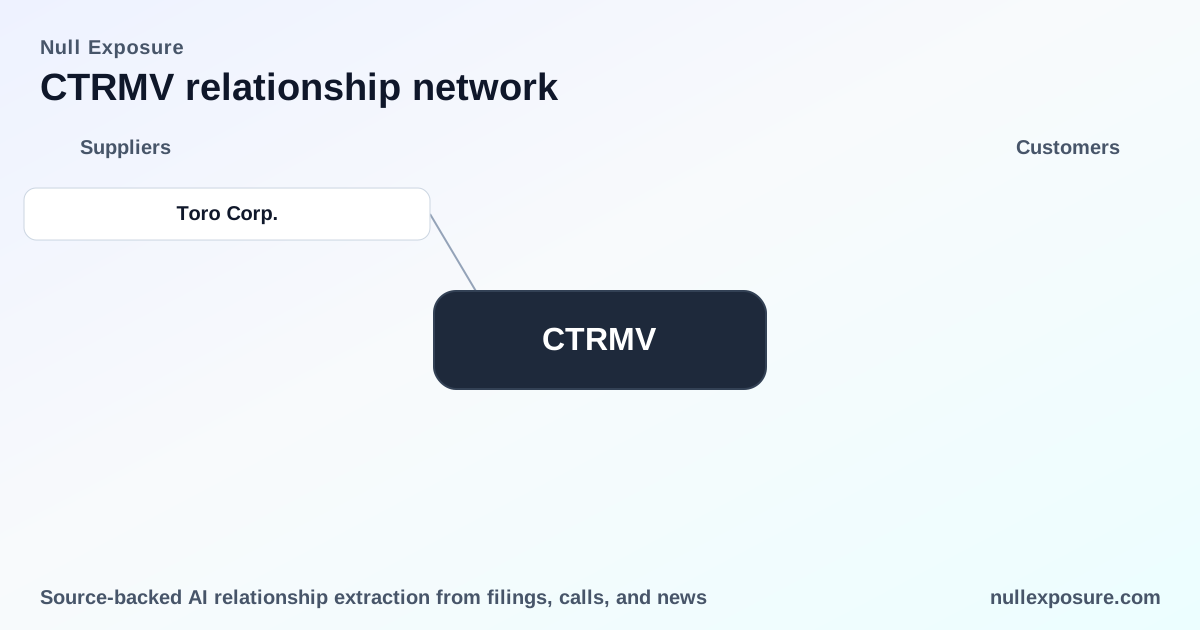
The single supplier relationship disclosed: Toro Corp.
Castor recorded partial prepayments to a term loan provided by Toro Corp., showing meaningful cash outflows to a financing counterparty during FY2025. According to a GlobeNewswire release dated December 3, 2025, Castor made partial prepayments of $13,500,000, $34,000,000 and $14,000,000 on March 24, 2025, March 31, 2025 and April 29, 2025, respectively, in addition to a $2,500,000 scheduled repayment — a cumulative cash repayment of $64,000,000 during the period. (GlobeNewswire, December 3, 2025).
This relationship matters because a $64 million repayment cadence to a financing supplier in the fiscal year represents a consequential use of free cash flow and changes leverage dynamics; investors should treat Toro as a financial counterparty with direct influence on Castor’s short-term liquidity and refinancing flexibility. (GlobeNewswire release, FY2025).
Why this financing relationship changes how you underwrite CTRMV
The presence of a large, active lender relationship shifts evaluation from pure operating metrics to balance-sheet and counterparty dynamics:
- Liquidity sensitivity: Large scheduled and ad hoc repayments reduce immediate liquidity available for voyage ops or opportunistic charters.
- Refinancing risk: If Toro is a principal lender and alternative liquidity sources are constrained, the company’s options for fleet financing tighten.
- Counterparty leverage: A lender with significant exposure can influence covenant terms, collateral treatment, and the timing of capex or vessel sales.
Investor action: Stress-test liquidity under scenarios that strip out the repayments listed and model the effect on chartering flexibility and minimum working capital. For operators negotiating with lenders, use repayment history to set realistic covenant language and prepayment scheduling.
Practical next steps for investors and operators
- Obtain full loan documentation and covenant schedules tied to the Toro facility to confirm collateral, maturity ladder, and prepayment rights.
- Reconcile the repayment amounts and dates provided in public filings with internal cash flow forecasts to identify timing mismatches that could force asset sales or distress refinancing.
- Expand supplier mapping beyond publicly disclosed items: a single disclosed supplier in public results is not equivalent to a single counterparty in reality; build a more complete counterparty registry for operational resilience.
If you want a structured supplier-risk checklist and prioritized next steps for counterparties, review the supplier intelligence tools and templates at https://nullexposure.com/ to standardize diligence and monitoring workflows.
Constraints and company-level signals (what isn't in the record)
No supplier-level contractual constraints or term excerpts were recorded in the reviewed materials. As a company-level signal, the absence of explicit supplier constraints suggests the public record provided does not include detailed supplier contract terms such as indemnities, termination rights, or collateral schedules. That absence itself is informative:
- Disclosure posture: The firm’s supplier disclosures in the reviewed material are limited, which elevates the premium on direct diligence.
- Risk transparency: Without published supplier contract terms, counterparties and investors must request primary documents to evaluate legal and operational exposure.
- Negotiating leverage: The lack of published constraints reduces public visibility into how flexible or restrictive supplier agreements are; access to the underlying loan agreement is decisive.
Final takeaways and suggested actions
- Primary signal: Castor Maritime’s most visible supplier relationship in the reviewed materials is a financing relationship with Toro Corp. that involved $64 million in repayments during FY2025, which materially affects liquidity and leverage positioning (GlobeNewswire, December 3, 2025).
- Secondary signal: The scarcity of supplier disclosures in the reviewed record increases the importance of direct diligence and sourcing loan documents to evaluate counterparty rights and collateral structures.
- Recommendation: Prioritize obtaining the Toro loan agreement and perform a scenario analysis that isolates the repayment flows observed versus alternative liquidity outcomes.
For a practical toolkit to convert these insights into due-diligence workflows and vendor negotiation playbooks, visit https://nullexposure.com/. For bespoke supplier-risk assessment and monitoring services tailored to shipping and capital-intensive operators, explore engagement options at https://nullexposure.com/.