Cognizant (CTSH) as a supplier: how partnerships and regional cost structure drive the business
Cognizant is a global IT services and consulting company that monetizes through long-term outsourcing contracts, fixed-price digital transformation programs, and time-and-materials engagements anchored by large enterprise clients. The company captures margin by combining a scale delivery model with cloud and AI partnerships that let it sell higher-value managed services and software-enabled outcomes rather than pure labor. For investors and procurement teams, the central thesis is simple: Cognizant is executing a transition from labor arbitrage to platform-enabled services, and its supplier relationships determine how quickly that transition converts into durable revenue and higher-margin offerings.
Explore supplier risk and relationship intelligence at https://nullexposure.com/ for a structured view of counterparties and exposures.
How Cognizant makes money and why supplier ties matter
Cognizant’s business model is built on three monetization levers: consulting and digital transformation fees, recurring managed services, and large-scale outsourcing contracts billed on a people-plus-platform basis. The company reports $21.1 billion in trailing twelve-month revenue with operating margins around 16% and a net margin near 10.6%, reflecting a mature services operator that generates strong cash flow while reinvesting in cloud and AI capabilities. Partnerships with hyperscalers and AI vendors are strategic — they expand the addressable market for higher-value services and shorten sales cycles for enterprise AI rollouts.
Contracting posture is conservative and enterprise-focused: Cognizant wins multi-year agreements that shift operational risk to its delivery footprint while locking in clients through integration and managed service SLAs. Concentration and criticality are high in accounts where Cognizant runs mission-critical applications; that enhances pricing power for transformation projects but increases exposure if a major client changes vendor or insources. The company’s cost base is geographically diversified but materially exposed to India-denominated costs, which influences pricing flexibility and margin resilience.
Supplier relationships in the public record — what to know now
This section covers every relationship flagged in recent coverage and provides concise, source-backed takeaways for investors and vendor managers.
Google Cloud — scaling agentic AI across enterprise accounts
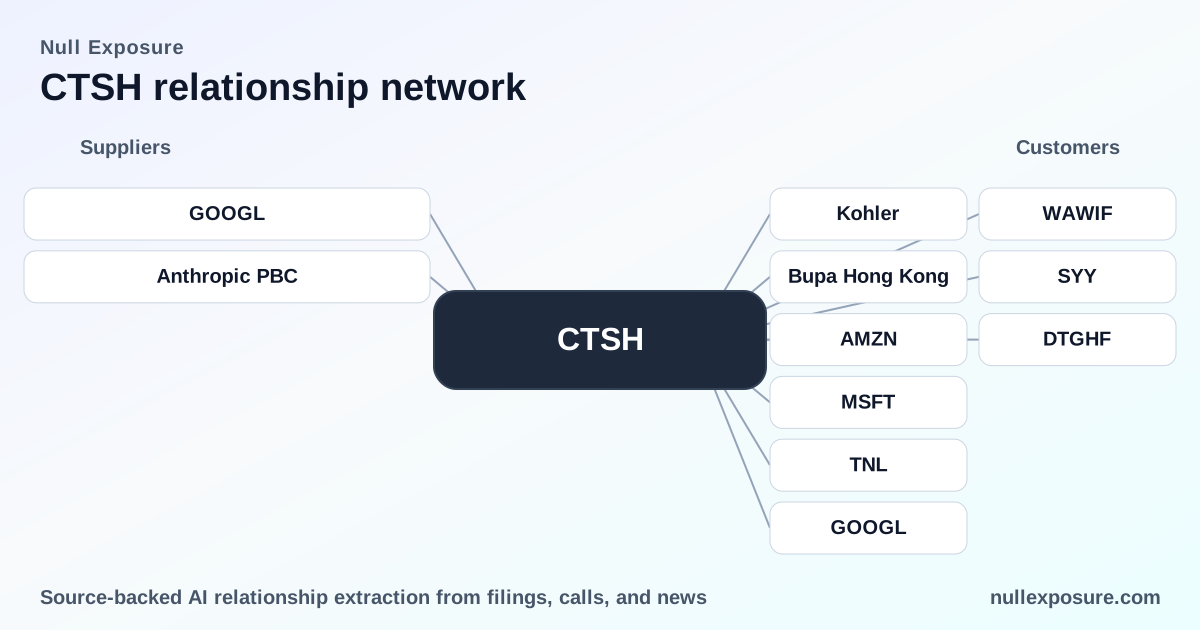
Cognizant expanded its partnership with Google Cloud to accelerate enterprise deployments of agentic AI and cloud-native services, reinforcing its go-to-market for large-scale AI transformations. According to an InsiderMonkey report referencing a February 16 announcement, the expansion deepens joint offerings and commercialization efforts with Google Cloud (InsiderMonkey, March 9, 2026: https://www.insidermonkey.com/blog/cognizant-technology-solutions-ctsh-renews-partnership-with-travel-leisure-co-1709782/). SahmCapital also covered the arrangement, highlighting Cognizant’s intent to scale agentic AI across its enterprise customer base (SahmCapital, March 4, 2026: https://www.sahmcapital.com/news/content/cognizants-ai-partnerships-and-leadership-shift-contrast-with-share-weakness-2026-03-04).
Anthropic PBC — embedding AI coding agents into delivery workflows
Anthropic is embedding its AI coding agent within prominent Indian firms, including Cognizant, to accelerate developer productivity and automation in delivery centers. Taipei Times reported that Anthropic’s marquee coding agent is being integrated into operations at Cognizant and other Indian enterprises, which pushes AI into the software engineering layer of outsourced work (Taipei Times, February 18, 2026: https://www.taipeitimes.com/News/biz/archives/2026/02/18/2003852476).
Operational constraints and what they imply for investors and partners
Cognizant’s own disclosures signal a noteworthy constraint: approximately 23% of global operating costs were denominated in Indian rupees for the year ended December 31, 2025, creating meaningful foreign-exchange sensitivity in operating results. This is a company-level signal: currency swings in APAC affect margins, pricing competitiveness, and the economics of fixed-price engagements.
- Contracting posture: Multi-year managed services give Cognizant steady revenue streams, but fixed-price deals increase exposure to wage inflation and FX if hedging is imperfect.
- Concentration: Large accounts and hyperscaler partnerships concentrate strategic risk; losing a major transformational deal would have outsized revenue and margin consequences.
- Criticality: When Cognizant operates core client systems, vendor lock-in strengthens pricing power, but it also raises reputational risk if delivery falters.
- Maturity: The firm is a mature IT services operator repositioning toward AI and cloud-enabled services; this reduces pure labor sensitivity but increases dependence on partner technology roadmaps.
These constraints combine into a pragmatic supplier profile: vendors that align with Cognizant’s cloud and AI roadmaps — particularly those that lower implementation risk or provide differentiated IP — command better negotiating outcomes.
Explore how this profile affects counterparty exposures and procurement strategies at https://nullexposure.com/.
What the partnerships mean for revenue, margins and negotiating leverage
The Google Cloud and Anthropic relationships are strategically complementary. Google Cloud broadens go-to-market reach and positions Cognizant to sell infrastructure-plus-services at scale, while Anthropic’s coding agent targets productivity gains within delivery centers — both actions increase the probability of higher-margin, software-adjacent revenue.
Key investor takeaways:
- Revenue mix upgrade is underway. Cognizant’s modest quarterly revenue growth (around 4.9% year-over-year) is now being channeled into higher-value AI and cloud projects that carry better gross margins.
- Margin leverage will depend on delivery productivity and FX management. Automation from Anthropic-style tools reduces labor hours per engagement; however, the company’s India cost base and rupee exposure mean margin improvement is conditional on currency stability.
- Negotiating leverage with suppliers and hyperscalers is asymmetric. Cognizant’s scale gives it commercial heft, but deep technical dependencies on platform partners mean some supplier terms — especially for proprietary AI models and cloud infrastructure — will be dictated by partner roadmaps and pricing.
Analyst sentiment is constructive: consensus target price sits near $89 with a mix of buy and hold recommendations, reflecting confidence that partnerships will convert into recurring, higher-margin streams (company analyst aggregates, FY2026).
Bottom line: what operators and investors should do next
Cognizant is executing a credible pivot from resource-led outsourcing to platform- and AI-enabled services, and its supplier relationships with Google Cloud and Anthropic are pivotal to that strategy. Procurement teams should prioritize contract terms that protect margins against FX and labor inflation while securing favorable access to partner technology stacks. Investors should monitor three signals closely: revenue uplift from AI-enabled services, margin expansion relative to legacy outsourcing, and FX-driven cost volatility tied to the India rupee.
For a practical assessment of supplier exposure and to map counterparties across your portfolio, visit https://nullexposure.com/ — the platform centralizes supplier relationships and constraint signals to inform investment and operational decisions.
Concluding recommendation: treat Cognizant as a transitioning services leader whose upside depends on execution of AI/cloud partnerships and disciplined management of APAC cost exposure; both investors and vendor managers gain by tracking partner integrations and contract protections closely.