Corteva (CTVA) — supplier relationships, contract posture, and what investors should price in
Corteva Agriscience operates as a global seeds and crop protection company that monetizes through product sales, seed royalties, licensing of biotechnology traits, and collaborative R&D partnerships. The business combines direct-to-market seed and crop protection revenues with strategic collaborations and licensed technologies; this hybrid monetization model creates both steady commercial cash flows and event-driven upside from partnership milestones. For a deeper look at counterparty exposures and supplier finance signals, visit https://nullexposure.com/.
How Corteva makes money and what the headline numbers tell you
Corteva is a large-cap agribusiness: TTM revenue of $17.4 billion, EBITDA of $3.799 billion, and a market capitalization around $53.4 billion, reflecting a mature industrial business with modest margins (profit margin ~6.3%, operating margin ~5.6%). The firm balances high-volume commodity-facing sales with higher-margin proprietary seed and trait revenues and collects recurring cash from licensing and long-term purchase commitments embedded in its supply base. These drivers explain why Corteva maintains both long-term sourcing arrangements for raw materials and active financial risk-management programs tied to commodity price and FX volatility.
Direct relationship mentions discovered in public coverage
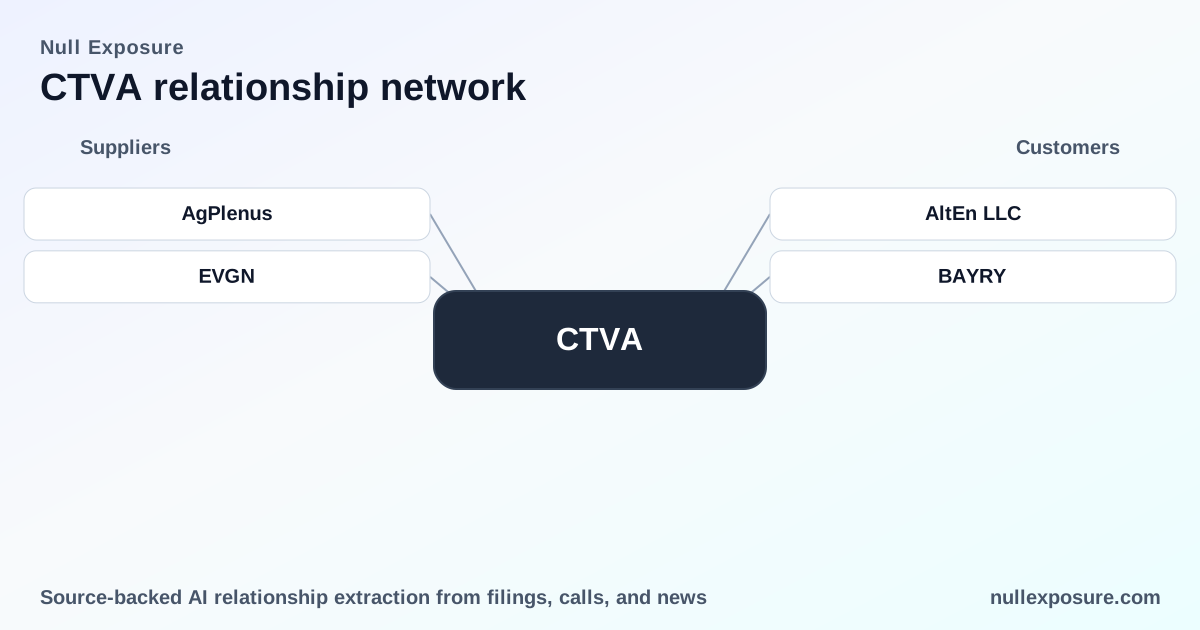
AgPlenus
InsiderMonkey’s transcript of Evogene’s Q4 2025 earnings call noted that revenue recognized from AgPlenus activity declined, with the drop explained in part by a one‑time payment in Q1 2024 and the completion of a collaboration agreement with Corteva during 2024. This indicates Corteva was a counterparty in that collaboration that delivered milestone or contract-driven flows to AgPlenus through 2024. (Source: Evogene Q4 2025 earnings call transcript published March 9, 2026 on InsiderMonkey.)
Evogene Ltd. (EVGN)
Evogene’s management described the maturity and robustness of its platform through strategic collaborations with Bayer and Corteva, underlining Corteva’s role as an R&D and innovation partner as well as a commercial off-taker for advanced traits or discovery work. That public acknowledgement positions Corteva as an active collaborator in third‑party discovery pipelines. (Source: Evogene Q4 2025 earnings call transcript published March 9, 2026 on InsiderMonkey.)
What the company-level constraints reveal about its operating model
The public record and filings deliver a consistent portrait: Corteva runs a mixed contracting posture, combining short-duration risk-management programs with long-term procurement and licensing commitments. That mix has specific implications:
-
Contracting posture: Short-term derivatives and risk-management arrangements are used extensively for commodity and FX exposure, with many instruments not extending beyond two years; conversely, major raw materials are typically purchased under long-term contracts, frequently with minimum purchase commitments. This dual posture supports both tactical hedging and strategic supply continuity.
-
Counterparty profile: The counterparties include major financial institutions, commodity exchanges, and multinational grain exporters, which signals that Corteva transacts with large, creditworthy market participants but also relies on broad market intermediaries for its commodity management.
-
Role breadth: Corteva functions as a licensee and a manufacturer, holding thousands of patent applications and multiple long‑term biotechnology trait licenses while also relying on contract manufacturers to produce inputs and formulations. That combination elevates both IP and manufacturing continuity as core operational concerns.
-
Spend and balance-sheet exposure: Supplier finance obligations and accounts-payable balances are non-trivial—supplier finance program obligations were approximately $121 million at December 31, 2025, and total accounts payable was about $4.398 billion, including seed grower compensation around $420 million. These figures confirm material working-capital linkages to external suppliers and growers.
-
Maturity and criticality: Long-term leases for certain facilities and extensive licensing portfolios indicate a mature supply and IP base; however, the scale of accounts payable and seed grower compensation means supplier disruptions would produce immediate P&L and cash-flow effects.
For a consolidated view of supplier-risk metrics and how they interact with your portfolio, check https://nullexposure.com/.
Investor implications — what to watch and how to price exposure
Corteva’s model creates a set of predictable investment trade-offs:
-
Upside from partnerships and licensing — active collaborations with biotechnology firms such as Evogene validate Corteva’s role in innovation pipelines and provide milestone-driven valuation upside. These relationships should be modeled as distinct revenue components rather than recurring product sales.
-
Working-capital sensitivity — large accounts payable and supplier finance balances mean Corteva’s cash conversion cycle and short-term liquidity are sensitive to supplier terms and crop-season timing; investors should stress test scenarios where supplier financing tightens.
-
Concentration in procurement vs. diversified counterparties — long-term contracts for major raw materials reduce spot volatility but create commitment risk if input prices move; the use of major financial institutions for hedging reduces counterparty credit risk but introduces market counterparty exposure.
-
Operational risk through contractual roles — as both licensee and manufacturer, Corteva must manage IP renewals, royalty schedules, and contract-manufacturing continuity; disruptions in any of these areas have direct commercial implications.
Practical next steps for investors and operators
- Validate the size and tenor of long-term raw-material contracts in the next 12 months and examine minimum purchase commitments for stress scenarios.
- Monitor supplier finance program trends and quarterly changes in accounts payable, especially seasonal swings in seed grower compensation.
- Review material collaborations for milestone timing and revenue recognition triggers to separate recurring from event-driven cash flows.
For a tailored assessment of supplier exposures and contract-level risk, visit https://nullexposure.com/ — our tools map these signals directly into investment and operational dashboards.
Bottom line
Corteva’s supplier footprint blends long-term structural contracts and high-dollar working-capital exposures with selective, high-value innovation partnerships. That architecture supports steady commodity-related revenues while providing episodic upside from collaborations; it also requires active monitoring of supplier finance and contract commitments because those are the levers that move near-term cash flow and operational resilience.