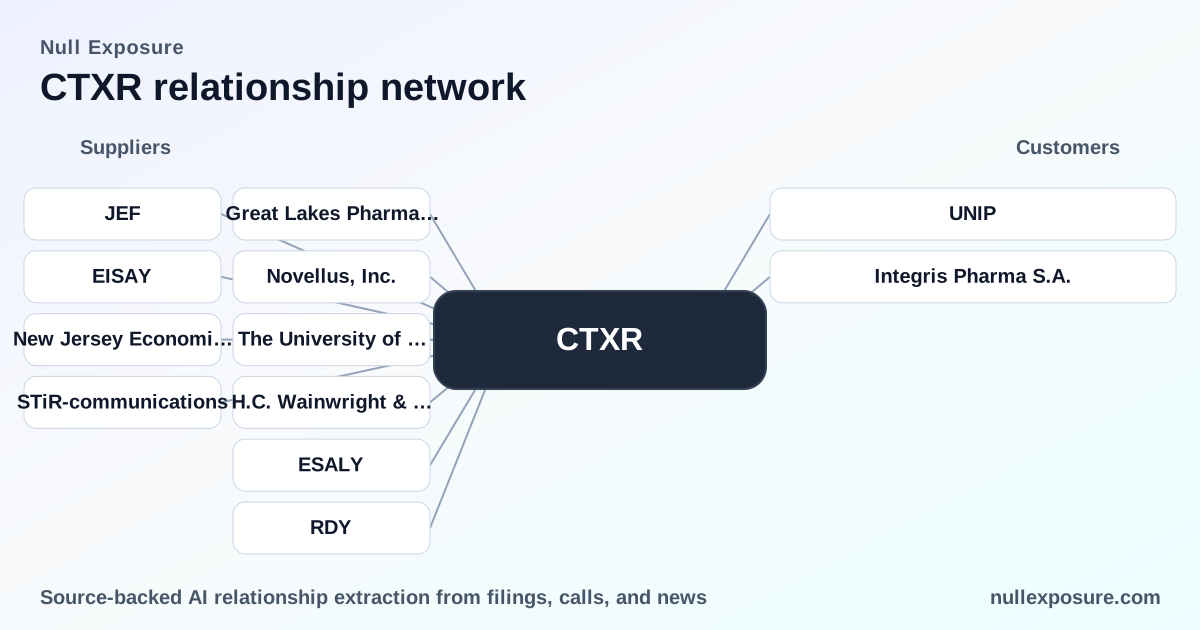
CTXR (Citius Pharmaceuticals): supplier relationships, commercial posture, and risk vectors investors must price
Citius Pharmaceuticals operates as a specialty critical-care pharmaceutical company that monetizes through licensing, product commercialization (principally via its oncology subsidiary), and milestone/contract arrangements with third parties. Revenue drivers are a mix of royalty/license income and nascent product sales (notably LYMPHIR through Citius Oncology), while financing and placement agents are routinely used to shore up working capital. For investors evaluating supplier counterparty risk, the company’s business model is highly third‑party dependent for manufacturing, distribution and commercialization support—this dependency directly affects execution risk and cash requirements. For an investor-focused view of supplier exposure visit https://nullexposure.com/.
Why supplier relationships matter for CTXR’s value chain
CTXR outsources formulation, manufacturing, packaging and many commercialization functions. Minimum purchase commitments and multi‑million dollar payables are material to the balance sheet, and contracts span short and long durations across geographies (including EMEA). The firm’s contracting posture combines long‑term minimum supply commitments with operational flexibility secured by third‑party service providers and placement agents — a structure that preserves capital lightness but concentrates execution risk in a small group of suppliers and advisors.
If you want a concise supplier risk scorecard for portfolio diligence, start here: https://nullexposure.com/.
Relationship-by-relationship readout (plain English summaries)
Below I list each counterparty cited in public disclosures and press coverage, with a one‑to‑two sentence summary and source note.
Great Lakes Pharmaceuticals, Inc. (GLP)
Citius references a product called B‑Lock, a triple combination formulation (trimethoprim, EDTA and ethanol) that is associated with Great Lakes Pharmaceuticals. This indicates a licensing or product-level relationship for an alternate critical‑care therapeutic. According to CTXR’s FY2025 10‑K filing, B‑Lock is identified as a product from Great Lakes Pharmaceuticals. (Source: FY2025 10‑K excerpt.)
Novellus, Inc.
In April 2020 Citius signed an exclusive six‑month option agreement to in‑license a stem‑cell therapy for ARDS from a Novellus subsidiary, showing a prior strategic attempt to broaden the pipeline via external in‑licensing. This deal was described in contemporaneous reporting on the company’s COVID‑19 research collaborations. (Source: BioInformant report, FY2020.)
The University of Texas MD Anderson Cancer Center
Citius licensed Mino‑Lok, an antibiotic lock solution for catheter‑related bloodstream infections, from MD Anderson and is running late‑stage trials as part of commercialization plans. The company’s press release on trial progress names MD Anderson as the licensing source for Mino‑Lok. (Source: PR Newswire, FY2023.)
H.C. Wainwright & Co.
H.C. Wainwright serves as exclusive placement agent on multiple registered direct and at‑the‑market offerings executed by Citius and Citius Oncology in FY2025, evidencing a repeat financing relationship relied upon to raise equity capital. Multiple press releases and market notices confirm H.C. Wainwright’s role across several concurrent offerings. (Sources: PR Newswire and Yahoo Finance releases, FY2025.)
Eisai
Citius amended a license agreement with Eisai to align payment timing with commercialization plans, and Eisai is listed as a creditor for certain invoices totaling approximately $6.8 million in a FY2026 SEC filing, indicating both licensing and payables exposure. The company disclosed the amendment and the invoiced balance in recent filings and corporate updates. (Sources: FY2025 PR Newswire update and FY2026 10‑Q coverage in TradingView.)
Dr. Reddy’s Laboratories Ltd.
Citius acquired rights to E7777 and related assets from Dr. Reddy’s and recorded a material upfront payment in that transaction; later filings also show an outstanding payable balance of about $18.25 million. The acquisition and the outstanding liability are visible in historical press coverage and the company’s more recent SEC disclosures. (Sources: RTTNews coverage of the 2021 asset sale and FY2026 10‑Q commentary.)
Jefferies LLC
Citius Oncology retained Jefferies as exclusive financial advisor to evaluate strategic alternatives for maximizing shareholder value, signaling a formal process to explore M&A or capital structure options at the subsidiary level. The advisory engagement is disclosed in company business‑update releases in FY2025. (Source: PR Newswire and related FY2025 filings.)
New Jersey Economic Development Authority (NJEDA)
Citius received $3.8 million in non‑dilutive capital via New Jersey’s NOL (tax certificate transfer) program, which provides a liquidity cushion without equity dilution and reduces near‑term cash burn. Local press and regional economic development reporting covered the FY2026 award. (Source: Sahm Capital / NJEDA reporting, FY2026.)
STiR‑communications
STiR‑communications is listed as the media contact for Citius’ positive phase‑2b results for HALO‑LIDO, indicating an external PR/communications relationship supporting clinical commercialization messaging. The PR release lists STiR‑communications as media contact in FY2023. (Source: PR Newswire, FY2023.)
Operating model constraints that shape counterparty risk
CTXR’s public statements and filings expose several cross‑cutting constraints that investors must consider when modeling downside scenarios and funding needs:
-
Contracting posture — guaranteed minimums exist. The company reports minimum purchase commitments that total in the low‑to‑mid‑tens of millions ($16.2M in one agreement and other agreements in the $1M–$10M band), creating fixed cash outflows irrespective of sales timing; these commitments reflect long‑term supply contracts. (Company filing language on purchase commitments, FY2025.)
-
Concentration and criticality — manufacturing and distribution are outsourced. CTXR explicitly relies exclusively on third parties for formulation and manufacturing and has contracted commercialization and distribution with specialized providers; this structure reduces capital intensity but creates a single point of failure if a vendor underperforms or supply chains break. The company names distribution partners in its disclosures (Cardinal Health, Cencora, McKesson) and lists EVERSANA and Innovation Partners as commercialization/service providers. (Company disclosures and press releases.)
-
Geography risk — EMEA manufacturing exposure. One contract manufacturer is located in Italy, introducing shipping, import and geopolitical risks that are harder to insure or rapidly backfill. (FY2025 filing language on foreign contract manufacturer.)
-
Materiality — liabilities and commitments are balance‑sheet relevant. The company reported outstanding liabilities of about $38.4 million and commitments of $22.7 million tied to LYMPHIR licensing, supply and other costs that would materially affect commercialization if disrupted. (FY2025 financial disclosure.)
-
Spend profile — mixed spend bands. Public excerpts indicate both $1m–$10m and $10m–$100m commitment bands, suggesting a mix of medium and large supplier exposures across different assets and contracts. (Commitment excerpts from FY2025.)
Taken together, these constraints imply a high execution leverage: CTXR’s clinical and commercial upside depends heavily on a narrow group of suppliers and advisors, and its funding cadence is intertwined with placement agents and one‑off non‑dilutive programs.
If you want a supplier risk brief for investment committees or vendor diligence teams, use this resource: https://nullexposure.com/.
Investment implications and actions for operators
- Key takeaway: CTXR is a capital‑light developer that is simultaneously capital‑hungry because of minimum purchase commitments and material payables; investor returns will depend on successful commercialization of LYMPHIR and tight vendor management.
- For operators: prioritize contract contingency planning for European manufacturers and accelerate options to reduce concentrated payables.
- For investors: stress‑test forecasts for scenarios where supplier delays or payment shortfalls interrupt commercialization; model financing events given repeated reliance on placement agents.
To evaluate CTXR supplier exposure across your portfolio or to commission a tailored counterparty analysis, visit https://nullexposure.com/ and initiate a data‑driven diligence engagement.
Final note: the company’s public record shows active licensing, financing and advisory relationships that are essential to execution—these are not peripheral partners but structural elements of Citius’ go‑to‑market and funding strategy.