Lionheart Holdings (CUB) — Supplier relationships, operating posture, and what investors should price
Lionheart Holdings operates as a blank-check vehicle: it raised capital through an initial public offering, placed roughly $230 million into a trust account, and currently funds operating and sponsor-related services while seeking a business combination that will create investor value or trigger liquidation. The company does not generate operating revenue today; value is driven by the trust-account balance, counterparty arrangements for legal, accounting and administrative services, and the timing and terms of a successful business combination. For a concise supplier-risk snapshot for diligence and vendor negotiation, review this analysis and visit https://nullexposure.com/ for broader supplier intelligence.
What Lionheart actually pays for and how it monetizes investor capital
Lionheart’s near-term economics are simple and concentrated: investors’ proceeds sit in a trust account and earn interest while the sponsor and affiliates provide office, administrative and professional services that are paid from operating cash. Monetization for public investors occurs only through a successful acquisition (creating an operating company) or liquidation of the trust account. According to the company’s FY2024 10-K, $224 million of IPO proceeds plus $6 million of private placement funds were deposited in the Trust Account, and cash and marketable securities in the Trust Account totaled $236,335,105 against total assets of $237,406,781 (FY2024 filing). That balance is the single most important asset on the balance sheet and determines shareholder recoveries absent a business combination.
- Key structural driver: trust-account concentration — nearly all assets are cash-like and governed by the Investment Management Trust Agreement (FY2024 filings).
- Cost driver: sponsor and related-party service expenses (office, admin, legal and accounting) are disclosed as recurring line items and will cease upon a business combination or liquidation, per the FY2024 statements.
If you want a structured supplier-risk feed on Lionheart and comparable SPACs, see https://nullexposure.com/ for additional vendor maps and contract signals.
Supplier map: active relationships you should know
This supplier audit covers every named counterparty disclosed in the supplier results for CUB. Each relationship summary is concise and tied to the company's public filing.
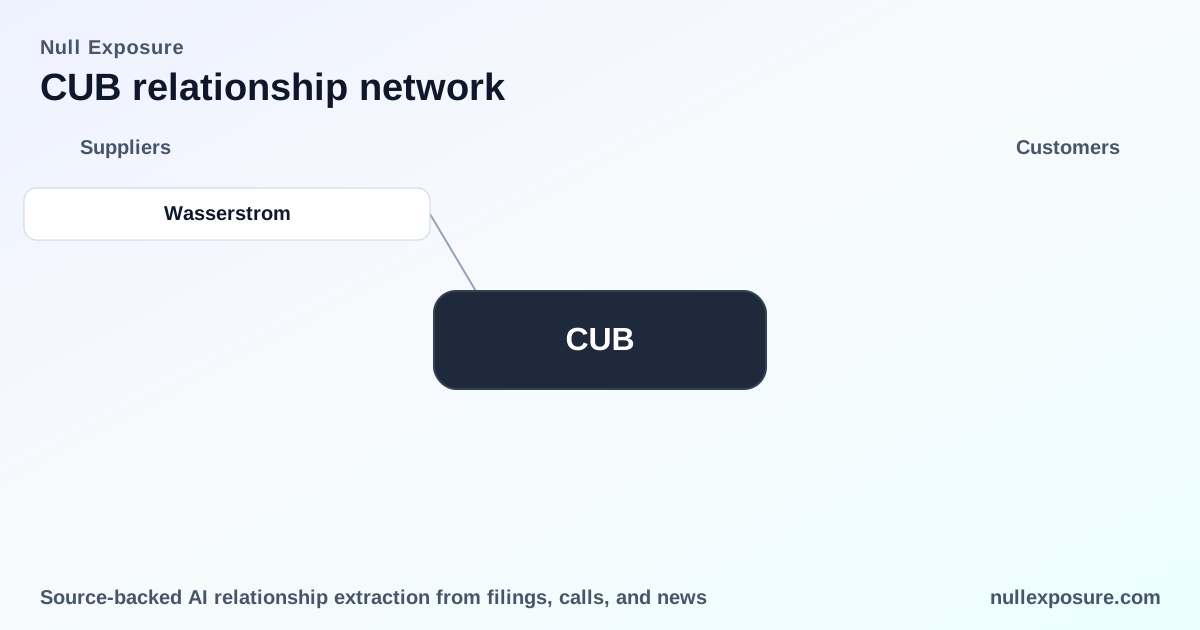
Wasserstrom
Wasserstrom provided corporate legal counsel and billed the company for professional legal services; Lionheart incurred $175,000 of legal fees from Wasserstrom recorded within accrued offering costs as of December 31, 2024. The engagement letter between Lionheart Capital and Wasserstrom is described as indefinite (subject to termination rights), and Wasserstrom may be considered a related party for corporate counsel services. According to the company’s FY2024 Form 10-K (filed for the period ended December 31, 2024), these fees are part of offering and formation costs.
(That completes the relationship list; all disclosed supplier entries in the results are covered above.)
What the contract signals tell investors about operational risk
The extracted contract and constraint signals from the filing reveal a compact operating model with a handful of meaningful characteristics:
- Contracting posture — mixed: framework and short-term elements. The engagement letter with Wasserstrom is structured as a framework (an indefinite engagement subject to standard termination), which implies an on-going advisory posture rather than one-off project billing. Simultaneously, other vendor arrangements — notably monthly sponsor and administrative fees — are explicitly short-term and will stop upon completion of a business combination or liquidation. These two modes mean Lionheart has enduring counsel coverage while carrying discrete, stop-gap operating costs elsewhere (company-level filing language).
- Concentration and criticality — high. Trust-account holdings (~$236 million) dominate the balance sheet and are the critical asset determining investor outcomes; this makes the relationship with trustees, the sponsor and counsel materially important to recovery scenarios (FY2024 reporting shows Trust Account vs Total Assets).
- Spend profile — modest but visible. Legal fees to Wasserstrom are in the mid-six-figure band (about $175,000), placing them in the $100k–$1m spend band for the FY2024 period; other professional services (audit) are separately disclosed in the low six-figure or sub-$100k ranges, indicating the enterprise runs with lean external suppliers while relying on sponsor-provided administrative services.
- Maturity and stage — active but pre-operating. The firm’s relationships are active — auditors and counsel are engaged and performing — yet the company is pre-revenue and pre-acquisition, so vendor criticality is driven by transaction-readiness rather than scale of operations.
These signals form a concise risk map: capital preservation and service continuity are the chief investor concerns; counterparties are important but spend levels are limited and replaceable if needed.
Investment implications and where to focus diligence
For investors evaluating exposure through supplier relationships, prioritize three operational questions:
- Trust-account governance and custodial risk. Confirm trustee arrangements, investment rules, and the haircut/penalty conditions that could erode the $236m trust balance disclosed in FY2024. The trust balance is the core recovery engine.
- Sponsor and related-party fee transparency. Monthly administrative fees (e.g., $15,000 per month for office and administrative services as disclosed) reduce the runway; track ratchets, termination rights and any fee acceleration clauses that could accelerate cash burn on a failure-to-combine outcome.
- Continuity of legal and audit coverage. Counsel (Wasserstrom) and auditors are small absolute-dollar vendors but are operationally critical in diligence, SEC compliance and closing a transaction; ensure no conflict-of-interest arrangements are latent given related-party disclosures in the 10-K.
Key takeaway for investors: Lionheart’s supplier footprint is small, concentrated and primarily transactional — the bigger risks are balance-sheet concentration and sponsor-aligned economics rather than supplier delivery failure.
If you need a deeper vendor-level risk scorecard and contract signal export for comparable SPACs, visit https://nullexposure.com/ to request a tailored report.
Final verdict and next steps
Lionheart Holdings is a classic pre-combination SPAC: asset-backed by a large trust account, operationally light, and reliant on a handful of service providers for legal, audit and administrative functions. Wasserstrom’s engagement is a material supplier relationship in the legal spend band, and the engagement structure is indefinite—supporting continuity through a transaction window.
For active investors and operators negotiating with Lionheart or conducting counterparty diligence, prioritize trust-account mechanics, sponsor fee exposure, and the termination/continuity provisions in counsel and administrative agreements. For a comparative supplier-risk framework and supplier mapping across similar issuers, go to https://nullexposure.com/ and request the vendor intelligence package.