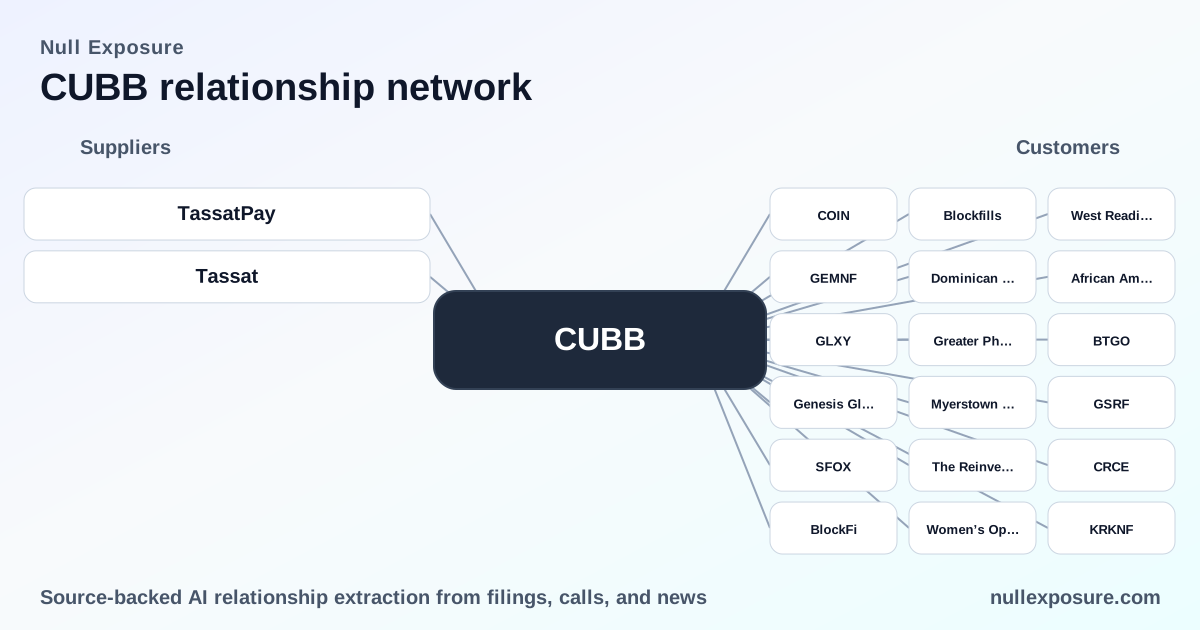
Customers Bancorp (CUBB) — supplier relationships and what they mean for investors
Customers Bancorp operates as a progressive bank holding company that monetizes through net interest margin on lending (commercial real estate, mortgages, and commercial loans), fee income from treasury and payments services, and scale-driven deposit gathering via branch and digital channels. The firm expands its product set and accelerates time-to-market through third-party technology and payments partners while funding growth with a mix that includes long-term Federal Home Loan Bank (FHLB) and Federal Reserve advances. For readers evaluating supplier counterparty risk or partnership value, the payments relationships with Tassat/TassatPay are the most visible external technology tie-ins publicized to date.
Explore deeper vendor mappings and exposure signals at https://nullexposure.com/.
How Customers Bancorp uses suppliers to extend its franchise
Customers Bancorp has structured its operating model to lean on third parties for both product innovation and back-office scale. Company disclosures and program descriptions make three operational characteristics clear:
- Outsourced core technology and processing functions: Customers leases and outsources major functions including data processing, loan servicing, deposit processing and money transfer systems to third-party service providers, which accelerates product rollout but concentrates operational risk with those vendors. (Company filings, FY2024–FY2025 disclosures.)
- Leasing posture for real estate: The bank leases its corporate and branch footprints from third parties rather than owning all real estate, creating predictable occupancy cost profiles but adding a counterparty exposure to landlords. (Customer disclosures on leased corporate and branch properties.)
- Long-term funding elements in the balance sheet: The company uses long-term FHLB and FRB advances as a stable funding sleeve, indicating a deliberate contracting posture for multi-year funding commitments rather than purely short-term wholesale reliance. (Long-term advances disclosures at December 31, 2024 and 2023.)
Collectively, these signals show a partnership-first operating model: Customers Bancorp trades some direct control for speed and capability through external vendors. That posture produces faster product launches plus vendor concentration risk and third-party operational criticality that investors must watch.
Why the Tassat relationships matter to the economic story
Customers has publicly tied its instant-payments ambitions to Tassat’s blockchain-enabled platform. Instant payments are both a product differentiator and a source of deposit stickiness and fee income, so the Tassat relationship is strategically meaningful. If the Tassat integration scales, Customers will convert payments flows into a competitive deposit and fee engine; if the integration encounters operational issues, reputational and revenue impacts follow directly.
For an up-to-date map of supplier dependencies and risk exposure, visit https://nullexposure.com/.
Relationship-by-relationship: the two public supplier links
- TassatPay — Customers Bank launched a "soft launch" of a real-time, blockchain-based payments service powered by TassatPay in mid-October as part of its instant-payments push, showing the bank is live-testing a blockchain rails solution to deliver real-time settlement to clients. According to FinTech Magazine reporting on the announcement in FY2022, Customers began the soft launch of the TassatPay-enabled service. (FinTech Magazine, reporting mid-October / FY2022: fintechmagazine.com article.)
- Tassat — Earlier reporting noted that Customers Bank will utilize the TassatPay platform, confirming the use of Tassat’s technology as the underlying vendor for the instant payments product rather than an in-house rails development. PaymentsJournal documented Customers’ selection of the Tassat platform in FY2021. (PaymentsJournal, FY2021: paymentsjournal.com.)
Operational constraints and what they signal about risk and resilience
Company-level constraint excerpts and program descriptions indicate the following signals for investors evaluating supplier counterparty and operational risk:
- Contracting posture — long-term funding commitments exist. The presence of long-term FHLB and FRB advances indicates deliberate, multi-year funding relationships that stabilize liquidity but also create contractual repayment or covenants exposure. This is a corporate-level funding characteristic, not tied to any specific vendor.
- Service delivery model — substantial outsourcing. Customers explicitly outsources major technology and processing functions; that increases vendor criticality and the need for strong third-party risk management and business continuity programs.
- Relationship maturity and stage — active and operational. The company describes outsourcing as a live element of operations, indicating these supplier links are active components of day-to-day service delivery rather than exploratory pilots.
These constraints are company-level signals that shape how you should underwrite counterparty concentration, downtime risk, and the potential impact to revenue and reputation if a key vendor has an outage.
Investment implications: upside drivers and risk checklist
- Upside drivers: Successful roll-out and scaling of the Tassat/TassatPay integration creates a differentiated instant-payments capability that can increase non-interest fee income and deposit retention while broadening treasury services to commercial clients. That aligns with the bank’s strategy to serve underserved markets via modern digital channels.
- Key risks: Heavy outsourcing increases operational concentration and fourth‑party exposure; leasing strategy exposes the firm to landlord performance; long-term advance usage can amplify interest-rate and covenant sensitivities. Operational and vendor-governance execution is the single most important risk variable.
- What to monitor: vendor SLAs and uptime history, incident disclosures tied to payments processing, evolution of fee-bearing transactions on the Tassat rails, and any regulatory or compliance notices involving third-party payment processors.
If you are mapping supplier concentration or modeling counterparty fallout scenarios, our platform provides structured signals and traceability — start from the homepage: https://nullexposure.com/.
Final read: where to focus diligence
Customers Bancorp’s approach is a deliberate trade-off: external partnerships accelerate product delivery and scale but centralize operational risk with a narrow set of suppliers. For investors and operators, the Tassat/TassatPay linkage is the most visible supplier dependency and should be evaluated for operational performance and revenue conversion potential. Simultaneously, the company-level practice of broad outsourcing and the use of long-term advances require ongoing scrutiny of vendor governance and balance-sheet covenants.
For an actionable supplier-risk brief and continuous supplier exposure monitoring, review the platform at https://nullexposure.com/.