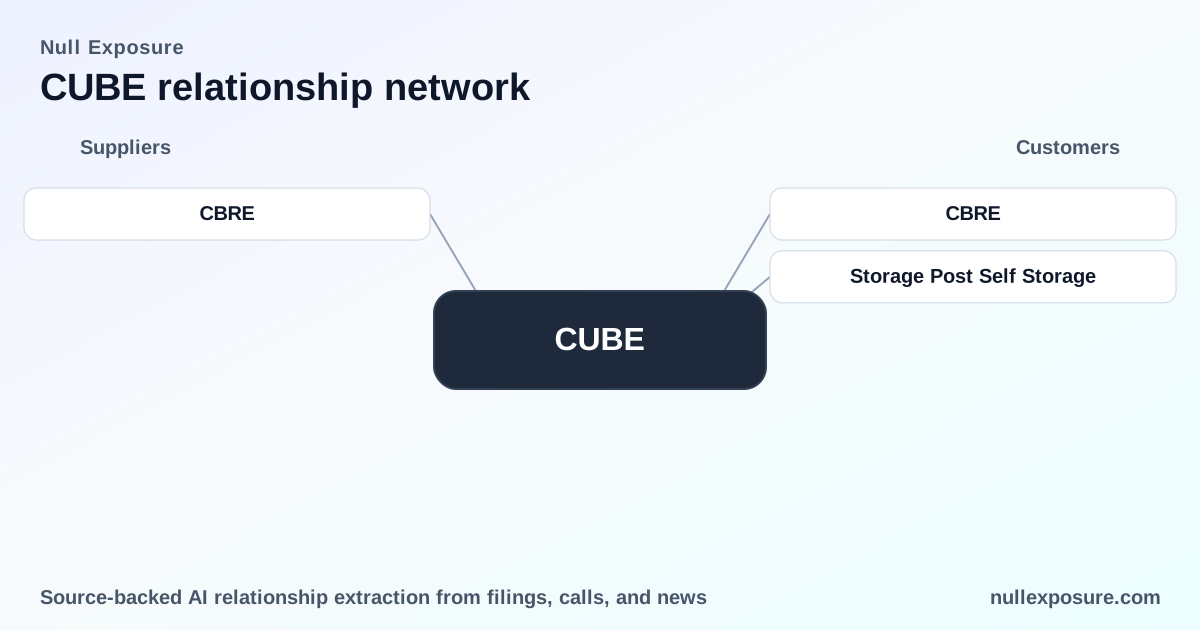
CubeSmart (CUBE): Platform REIT with an operations-first play and partnership leverage
CubeSmart operates as a self-managed, self-administered REIT that monetizes a national self-storage portfolio through rental income, ancillary tenant services, and property-level operating margins; the firm extracts additional value by applying its in-house operating platform to partner capital and joint ventures. Revenue comes from space rental, ancillary fees, and the uplift generated by active asset management; profitability is driven by occupancy, rate progression, and operating leverage across properties. For investors evaluating supplier and capital relationships, CubeSmart’s model blends proprietary operating control with selective external capital partnerships to scale faster without ceding management. Learn more at https://nullexposure.com/.
How CubeSmart actually makes money and why it matters to suppliers
CubeSmart is a mid-cap REIT focused on self-storage assets that combines direct property ownership with internal operations. The company’s reported financials show Revenue (TTM) of $1.1256 billion, EBITDA of $709.5 million, and a market cap near $8.9 billion, indicating a sizeable, cash-generating real estate platform. Price and valuation metrics—EV/EBITDA ~17.3 and Price/Book ~3.23—reflect investor willingness to pay for durable cash flow and operational optionality rather than mere asset appreciation.
- Operating leverage is the core monetization lever: improving occupancy and ancillary revenue lifts margins materially; CubeSmart shows a strong operating margin (TTM 39.5%) and profit margin near 29.6%.
- Self-management reduces vendor dependence on core property operations: CubeSmart’s internal platform makes certain supplier categories (software, specialized services, third-party management) less critical, while concentrating spend in areas such as marketing, renovations, and capital improvements.
- Capital-light scaling through partnerships: CubeSmart deploys its operating platform into ventures with external capital partners to expand footprint without taking on 100% equity exposure.
If you want a comprehensive supplier-risk heatmap tied to CubeSmart’s supplier and capital ecosystem, visit https://nullexposure.com/ for our interactive supplier profiles.
Contracts, spend posture, and what the constraints reveal about procurement
CubeSmart’s corporate signals point to a mid-to-high single-vendor spend band for certain categories and an operational contracting posture that emphasizes internal execution with select external partners.
- Company-level disclosure shows advertising and marketing costs of $26.0 million in 2024 (down from $24.5m in 2023 and $22.4m in 2022) recorded within property operating expenses, placing marketing in a $10m–$100m spend band for supplier evaluation and negotiation. According to the company’s consolidated statements of operations for the years ended December 31, 2024/2023/2022, those figures are explicit.
- Contracting posture: being self-managed, CubeSmart retains core operational responsibilities and thus contracts externally for non-core services that scale—marketing, technology platforms, and JV capital—rather than outsourcing day-to-day property management.
- Supplier concentration and criticality: marketing and capital partners are material but not singularly dominant; the existence of strategic ventures reduces immediate balance sheet capital needs but increases importance of partner alignment and governance.
- Maturity and predictability: CubeSmart’s portfolio generates stable, recurring cash flows; suppliers to the business should expect steady, predictable demand for advertising, renovation, and capital upgrades, and episodic needs tied to new joint ventures or portfolio repositioning.
Supplier and capital partner relationships: the one recorded partnership
CBRE Investment Management — a capital and oversight partner
CubeSmart has entered a venture with CBRE Investment Management that positions CubeSmart to deploy its operating platform across a broader portfolio while CBRE provides capital and investment oversight. According to a Simply Wall St report dated March 9, 2026, the venture explicitly aims to enhance property performance by combining CubeSmart’s operational capabilities with CBRE’s capital management. (Source: Simply Wall St news item, March 9, 2026 — https://simplywall.st/stocks/us/real-estate/nyse-cube/cubesmart/news/how-a-us250-million-self-storage-venture-at-cubesmart-cube-h)
This relationship is the only supplier/partner link identified in the reviewed results; it is structured as a venture that leverages CubeSmart’s operating platform rather than a pure vendor contract.
What the CBRE relationship implies for vendor strategy and investor risk
The venture with CBRE Investment Management is strategically important on three axes:
- Capital efficiency: CBRE supplies third-party capital that speeds expansion without CubeSmart fully financing every acquisition or conversion, improving ROIC and preserving balance sheet flexibility.
- Operational extension: CubeSmart’s platform will be applied to assets outside its owned portfolio, increasing the addressable scope for its in-house services (marketing, tenant operations, technology), which in turn raises demand for selected suppliers that integrate with CubeSmart’s platform.
- Governance and oversight: CBRE’s role in investment oversight increases scrutiny and institutional rigor for asset-level decisions, which aligns incentives but also imposes tighter performance deliverables on operating teams and suppliers.
Investor takeaway: the CBRE tie-up is a growth multiplier and a supplier-demand signal—expect higher, more predictable spend in marketing, refurbishment, and operating-platform integrations as the partnership scales.
If you want deeper, transaction-level intelligence and a supplier alignment checklist for CubeSmart and its partners, see our coverage at https://nullexposure.com/.
Operational risks and constraints investors must weigh
- Marketing and customer-acquisition spend is material: marketing spend in the tens of millions annually is recorded as property operating expense, which compresses margin volatility if occupancy weakens. This spend band makes marketing vendors both strategically important and economically actionable.
- High institutional ownership (99.25%) increases governance stability but reduces retail liquidity-driven repricing; shareholder bases largely institutionalize expectations around predictable dividends and disciplined capital allocation.
- Concentration of operational control: self-management means CubeSmart assumes operational risk internally; supplier relationships are transactional and performance-based rather than mission-critical runaway dependencies—except for capital partners like CBRE where alignment, not price, is decisive.
- Valuation sensitivity: trading at mid-to-high multiples (Forward P/E ~23.5, EV/EBITDA ~17.3) puts a premium on execution; missed occupancy or ancillary targets will be punished more than for lower-multiple peers.
Bottom line: an operations-first REIT where select suppliers matter
CubeSmart is a platform REIT that monetizes through owned property cash flows and by exporting its operating expertise into joint ventures with capital partners such as CBRE Investment Management. The vendor landscape for CubeSmart is characterized by predictable, mid-sized spend on marketing and property services, and by episodic increases in supplier demand tied to partnership-driven portfolio expansion. For investors and operators evaluating supplier relationships, the priorities are clear: partner alignment, scalable operating integrations, and disciplined performance metrics.
For transaction-level supplier intelligence, scoring, and contract playbooks tailored to CubeSmart relationships, visit https://nullexposure.com/.
Next actions for investors:
- Review CubeSmart’s latest filings for occupancy and ancillary revenue trends and reconcile against marketing spend trajectories disclosed in the consolidated statements.
- Map potential vendors into categories: recurring property ops, marketing/customer-acquisition, and platform integration—prioritize those that can demonstrate scale and JV experience.
- Monitor announcements for further joint ventures; each new partnership is likely to meaningfully increase supplier demand and change the procurement posture in predictable ways.