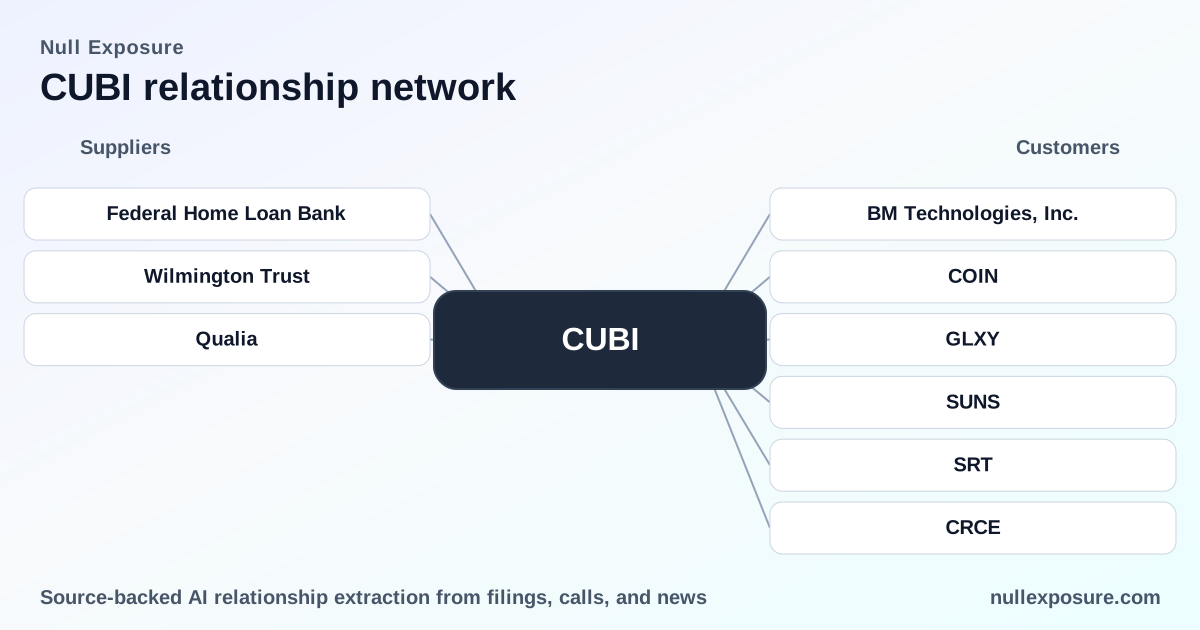
Customers Bancorp (CUBI): supplier relationships that shape funding, mortgage distribution, and tech outsourcing
Customers Bancorp operates as a regional bank holding company that monetizes through interest margin on commercial and consumer loans, wholesale mortgage financing, and fee income tied to servicing and deposit products. The firm supplements balance-sheet lending with secured short-term mortgage funding and strategic third‑party partnerships that extend distribution and technology capability. For investors, supplier relationships are a direct window into CUBI’s funding flexibility, capital structure choices, and go‑to‑market reach. Read more supplier intelligence at https://nullexposure.com/.
The partners that matter right now
Federal Home Loan Bank (FHLB)
Customers Bancorp discloses that changes to or termination of borrowings from the FHLB or correspondent banks would adversely affect profitability and financial condition, indicating FHLB access is a core wholesale funding source. According to the company’s 2024 Form 10‑K (FY2024), FHLB borrowing is material to liquidity planning and interest‑rate management.
Wilmington Trust
Customers Bancorp executed a Second Supplemental Indenture with Wilmington Trust to issue $100 million of 6.875% fixed‑to‑floating subordinated notes due 2036, reflecting an active use of subordinated debt to manage regulatory capital and funding mix. TradingView reported this issuance on March 9, 2026, describing the terms and counterparty role of Wilmington Trust in the indenture.
Qualia
Customers Bank has joined Qualia’s Bank Partner Network, signaling an expansion of mortgage origination distribution through a digital title/closing platform partnership that can feed mortgage flow and ancillary fee income. Multiple news reports in March 2026 (Finviz syndications) documented Customers Bank’s entry into Qualia’s network, positioning the bank closer to originators and closing platforms.
How these relationships reveal CUBI’s operating posture
The disclosed supplier interactions and constraint excerpts collectively describe an operating model that balances stable credit capacity with flexible short‑term execution:
- Contracting posture and maturity: The company runs a mix of long‑term contractual exposure (multi‑year agreements referenced for transition, licensing, and deposit servicing) alongside short‑term repurchase-style mortgage financing. The 10‑K notes one‑to‑ten year agreements tied to divestiture activities and long‑term FHLB/FRB advances, which supports predictable service and capital access.
- Funding concentration and criticality: The presence of substantial FHLB and Federal Reserve borrowing capacity is a structural source of liquidity; the 10‑K warns that loss of these channels would materially affect operations. The company reports very large maximum borrowing capacities with FHLB and FRB, reflecting high criticality of these counterparties for working capital and loan warehousing.
- Outsourcing reliance and service risk: Customers Bancorp outsources major technology and business process functions — data processing, loan and deposit servicing, money transfer systems — implying operational dependency on third‑party vendors for day‑to‑day bank operations.
- Capital management via subordinated debt: The $100 million subordinated notes placed through Wilmington Trust are a sign of active balance‑sheet and capital management that modifies leverage and regulatory capital ratios without diluting shareholders.
These are company‑level signals: the 10‑K excerpts reference long‑term agreements with BM Technologies and long‑term FHLB/FRB advances, and the company explicitly states that technology and processing functions are outsourced.
Discover more relationship-level insight and supplier risk scoring at https://nullexposure.com/.
Relationship-level takeaways and investor implications
- FHLB — Funding lifeline, high operational leverage. The FHLB relationship is structurally critical: the 10‑K cautions that changes or termination of FHLB borrowings would negatively impact profitability and financial condition, making FHLB access a material concentration and liquidity risk (Customers Bancorp 2024 10‑K, FY2024).
- Wilmington Trust — Capital markets conduit for subordinated issuance. The Wilmington Trust indenture and $100 million subordinated notes issuance show CUBI using the capital markets to shore up regulatory capital and optimize its funding curve; the fixed‑to‑floating 6.875% notes due 2036 are a deliberate, long‑dated financing move (TradingView report, March 9, 2026; FY2025 filing context).
- Qualia — Distribution partnership aimed at mortgage flow expansion. Joining Qualia’s Bank Partner Network positions Customers Bank to capture more mortgage referral and closing volume through a modern title/closing platform, enhancing fee income and origination pipelines without direct retail expansion (Finviz coverage, March 2026; FY2025–FY2026 news).
Key risks for operators and investors
- Concentration risk in wholesale funding. The company’s reliance on FHLB/FRB capacity—documented as large maximum borrowing lines—creates single‑channel liquidity vulnerability during stress events.
- Operational dependency on outsourced vendors. Outsourcing core processing and servicing functions increases vendor risk and potential continuity exposure if a major provider fails or contracts shift.
- Interest‑rate and capital structure sensitivity. Use of subordinated notes and fixed‑to‑floating structures changes interest expense dynamics and tail‑risk under rising rate scenarios; these moves are positive for capital but raise fixed‑cost obligations.
- Channel execution risk. Partnerships like Qualia improve reach but require integration and consistent execution to translate into sustainable mortgage flow and fees.
What investors should watch next
Monitor three vectors for clear signals of supplier risk and strategic progress:
- Any change in disclosed FHLB/FRB borrowing levels or maximum capacity in upcoming filings or earnings calls.
- Follow‑through on the subordinated note program: investor reception, use of proceeds, and impact on regulatory capital metrics.
- Performance metrics from the Qualia partnership: referral volumes, pull‑through rates, and net servicing or origination fee capture.
For a more detailed supplier risk breakdown and ongoing alerts tied to CUBI counterparties, visit https://nullexposure.com/.
Conclusion — practical verdict
Customers Bancorp runs a hybrid funding and distribution model: dependent on secured wholesale funding (FHLB/FRB), active in capital markets (subordinated notes via Wilmington Trust), and expanding mortgage distribution through fintech partnerships (Qualia) while outsourcing key operational functions. The net effect is a bank that leverages external counterparties for scale and capital efficiency, but that also carries identifiable concentration and vendor risks that warrant active monitoring. For investors and operators evaluating exposure, the supplier map is as important as the loan book when judging resilience and runway.
Explore supplier-level intelligence and actionable alerts at https://nullexposure.com/.