Curative Biotechnology (CUBT): Licensing-led development with NIH-origin assets at the core
Curative Biotechnology is a development-stage biotech that acquires exclusive licenses to government-originated intellectual property and intends to monetize those assets through clinical development, out-licenses, and eventual product commercialization. The company’s operating cashflows are currently negligible; value is concentrated in a small number of licensed technologies sourced from U.S. government institutes and commercial development of two early pipeline programs.
For a quick view of supplier intelligence and relationship mapping, visit Null Exposure.
Why the licensing relationships define the business model
Curative’s balance sheet and revenue profile show a classic early-stage licensing company: tiny current revenue ($132k TTM) and negative EBITDA (-$1.95M), paired with exclusive licensing arrangements that constitute the firm’s primary intellectual property position. These licenses are the company’s economic engine; they are both the main asset and the main operational dependency.
Company-level constraints and operating signals investors should internalize:
- Contracting posture — license-centric: Curative structures its tech ownership through exclusive licenses from U.S. government research institutes, positioning the company as a license-holder that must execute clinical and regulatory steps to realize value.
- Concentration risk — few core assets: Given the small revenue base and the nature of the disclosed relationships, the company’s valuation and upside are concentrated in a handful of licensed programs rather than a diversified product portfolio.
- Criticality — IP is mission-critical: The licensed technologies are central to the pipeline; losing a license or failing to meet milestones would materially damage prospects.
- Maturity — development-stage with financing needs: Market capitalization (~$7.4M) and cash-flow metrics indicate ongoing capital dependence for R&D and commercialization; historical bridge financing has been used to fund early progression (see relationship history below).
- Governance and investor composition: Institutional ownership is effectively zero and insider ownership is minimal, implying limited institutional oversight and potential dilution risk as the company funds development (Shares outstanding exceed 1.07 billion).
All of these signals amplify a simple investment proposition: value is binary and execution-dependent—successful clinical development and partner deals create outsized returns; failed trials or licensing setbacks destroy value.
For deeper supplier mapping and tracker tools, visit Null Exposure.
What the public relationship records report — one-by-one review
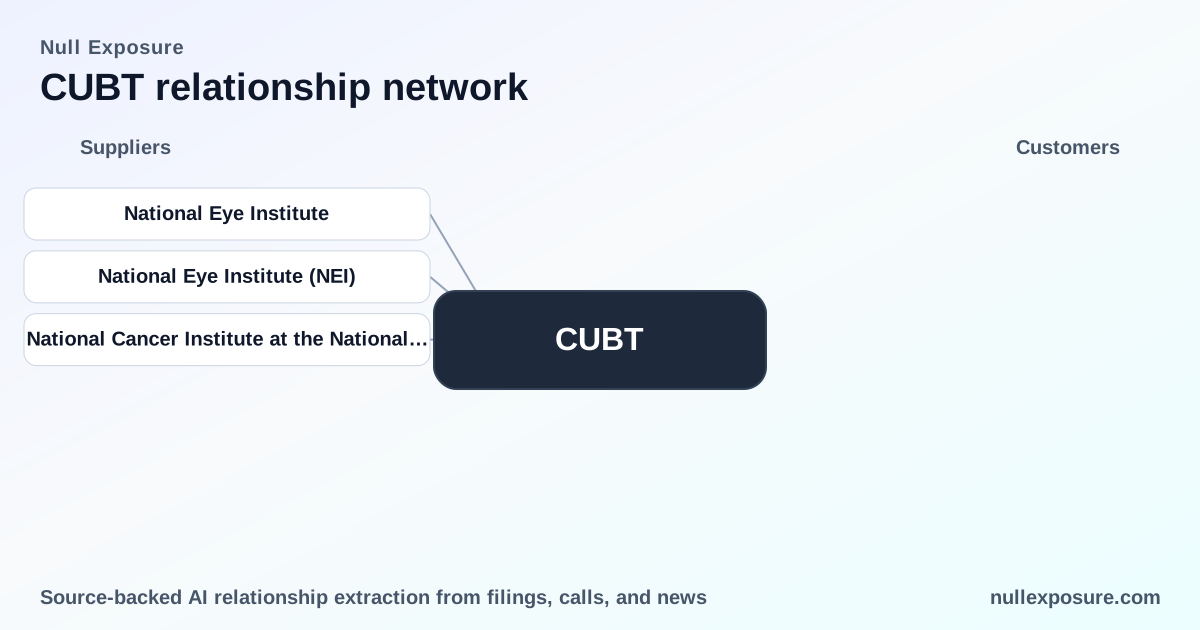
National Eye Institute
Curative is the exclusive worldwide licensee of a technology developed at the National Eye Institute, according to a company announcement published on Yahoo Finance in March 2026; that press release emphasized the patent allowance and the exclusive licensing posture with the NEI. (Source: Yahoo Finance news release, Mar 9, 2026).
National Eye Institute (NEI) — parallel press coverage
A GlobeNewswire/ManilaTimes distribution in January 2026 repeats that Curative holds exclusive worldwide rights under a patent license agreement with the NEI (part of NIH), underscoring the same licensing arrangement reported elsewhere and the strategic centrality of NEI-origin IP to the company’s pipeline. (Source: GlobeNewswire / ManilaTimes release, Jan 23, 2026).
National Cancer Institute at the National Institutes of Health
In a 2020 GlobeNewswire release tied to a corporate name change and bridge financing, Curative disclosed in-licensing of two development assets from the National Cancer Institute, including a monoclonal antibody drug conjugate platform for glioblastoma and an immunotherapy candidate (IMT504) with broad therapeutic interest; that release tied these in-licensing steps to early-stage financing and rebranding activity. (Source: GlobeNewswire press release, Nov 23, 2020).
What these relationships mean for operators and investors
These three records tell a coherent corporate story: Curative sources preclinical/early clinical IP from NIH-affiliated institutes and builds development programs around exclusive licenses. For investors and supplier managers, the implications are operational and financial.
Key operational and commercial consequences:
- Supply and partner negotiations will revolve around intellectual property stewardship and milestone compliance. License agreements typically include diligence milestones, royalty terms, and reversion risks; failure to meet contractual obligations can trigger loss of rights.
- Counterparty concentration increases execution risk. With a handful of government-instituted sources underpinning the pipeline, Curative’s supplier and partner network is narrow by design; that structure simplifies management but increases single-point-of-failure risk.
- Capital intensity and dilution pressure are certain. The company’s small market cap and negative operating metrics mean recurring capital raises are necessary to fund trials and commercialization activities, which has historically included bridge financing (2020) and will likely continue until significant partnering or product revenue arrives.
- Strategic value to partners is binary but substantive. For larger biopharma partners, Curative’s NIH-derived licenses can be attractive bolt-on technologies, giving the company leverage in out-licensing negotiations if early efficacy signals justify greater investment.
Operational teams should structure supplier contracts to protect milestone clarity, IP assignment integrity, and cooperative data-sharing with the credentialed government institutes that originated the technology.
Investment implications — higher risk, asymmetric payoff
Investors evaluating CUBT must weigh a set of concentrated risks against the potential for outsized returns if any licensed program achieves clinical success or a strategic partnership:
- Upside: Exclusive access to NIH-origin IP can be commercially valuable and attractive to acquirers or co-development partners.
- Downside: The company is development-stage with negligible current revenue, negative profitability, limited institutional ownership, and a very large share count that increases dilution risk.
Operationally oriented investors should monitor: progress on license-mandated milestones, clinical readouts or IND activity, cash runway and financing events, and any partnership or out-license transactions that convert intangible IP into monetizable revenue streams.
For tracking supplier and partner signals over time, see the full supplier intelligence hub at Null Exposure.
Final takeaways for investors and operators
- Curative is a license-driven biotech where NIH-origin IP is the company’s asset base and the primary driver of future value.
- Execution on clinical development and capitalization strategy determines whether the licensed assets translate into shareholder value.
- Concentration of IP sources increases both short-term fragility and long-term strategic clarity: partners will evaluate Curative based on specific program milestones rather than diversified sales performance.
For ongoing supplier relationship monitoring and concise intelligence on small-cap biotechs, visit Null Exposure.