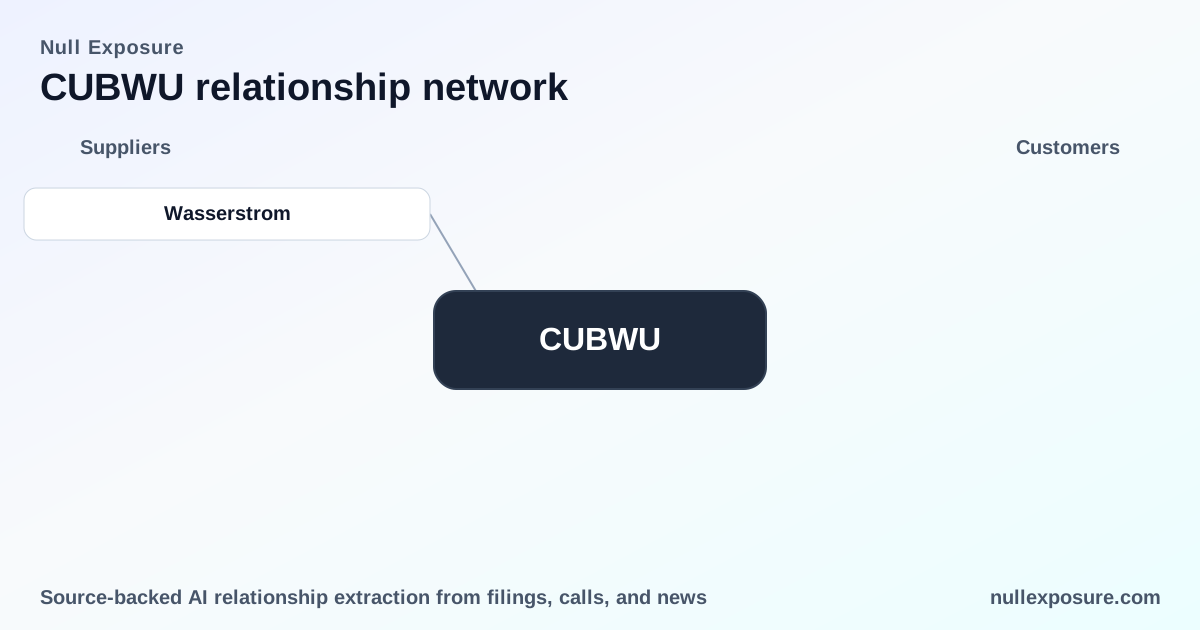
Lionheart Holdings Unit (CUBWU) — supplier relationships that matter to investors
Thesis: Lionheart Holdings Unit operates as a SPAC that monetizes by assembling public capital, holding proceeds in a trust account, and enabling a business combination where sponsor and underwriting economics convert into realized fees; its near-term supplier profile is light, dominated by short-term service providers and one disclosed legal services supplier for offering-related work. For investors and operators evaluating counterparty risk, the economics are straightforward: large custody balances and deferred underwriting economics drive the material cash flow events, while routine operating spend is small but concentrated around a handful of service providers. Learn more about how we map supplier risk at Null Exposure: https://nullexposure.com/.
Where the money sits and how suppliers are used
Lionheart is a classic SPAC in formation. The company placed $230,000,000 in a trust account (comprised of $224,000,000 from the IPO and $6,000,000 from the private placement) and holds marketable securities in the trust (approximately $236,335,105, including about $6,335,105 of interest income). These balances establish the firm’s primary economic leverage: underwriting discounts, deferred fees, and distribution of trust proceeds on consummation of a business combination. According to the company’s FY2024 Form 10-K, underwriters received a $4,000,000 cash underwriting discount at closing and are entitled to a deferred underwriting discount aggregating $9,800,000 upon completion of a business combination.
Operational supplier spend is small in absolute terms. Lionheart contracted with its sponsor for office, utilities, and administrative services at $15,000 per month, incurring $95,000 of such fees from inception through December 31, 2024. These are recorded as general and administrative and formation costs in the 10-K.
- Contracting posture: short-term, month-to-month service agreements for office and administrative support. Evidence of short-term custody and instrument maturities also supports a short-term contractual posture for financial holdings.
- Concentration: high financial concentration in the trust account (hundreds of millions) but low supplier concentration in operating spend—a small set of vendors service formation activities.
- Criticality: trust account relationships (trustee, underwriters) are critical to value realization; operating suppliers are non-critical to market value but necessary for readiness to complete a combination.
- Maturity: the entity is in formation/early operational phase with no operating revenue and limited supplier history.
These characteristics translate into an operating model where custody, legal, and underwriting counterparties generate the largest contingent payables, while everyday supplier risk is bounded and addressable.
What Lionheart paid Wasserstrom — a concise read
Wasserstrom provided legal services related to the offering. As of December 31, 2024, Lionheart had incurred $175,000 of legal fees from Wasserstrom, of which $50,000 was paid on June 25, 2024 and the $125,000 balance is recorded as deferred legal fees due at the time of the business combination, per the company’s FY2024 Form 10-K filing. This places Wasserstrom in the $100k–$1m spend band for offering-related services and classifies it as a short-term service provider tied to the IPO process.
Source: Lionheart Holdings Unit Form 10-K, FY2024 (disclosed legal fees from Wasserstrom as of December 31, 2024).
All disclosed supplier relationships (complete coverage)
- Wasserstrom — Legal services for the offering; $175,000 of fees recorded as of December 31, 2024 with $50,000 paid and $125,000 deferred to the business-combination closing, per the FY2024 10-K.
Source: Lionheart Holdings Unit Form 10-K, FY2024.
(There are no other supplier relationships disclosed in the supplied results for the supplier scope.)
Operational implications investors and operators should prioritize
Lionheart’s supplier footprint communicates several actionable points for procurement, treasury, and investor diligence:
- Trust and custody are the true counterparty concentration. The trustee and the underwriters will dictate the timing and quantum of deferred economics; the 10-K documents both the trust funding and the deferred underwriting fee mechanics that convert into material cash flows on a successful business combination.
- Legal and formation vendors are transactional and short-term, but they carry timing risk. Wasserstrom’s deferred legal fee illustrates a common SPAC structure: a portion of offering-related legal costs are deferred until closing—this creates contingent liabilities that reduce net proceeds available to targets at the time of combination.
- Operating spend is modest but should be contractually constrained. Sponsor administration services totaled $95,000 through FY2024 under a monthly arrangement; operators should enforce clear caps and transparent invoicing to avoid sponsor cost creep.
- Negotiation levers exist around deferred economics. Because deferred underwriting discounts and contingent legal fees represent sizable slices of the post-combination economics, investors should scrutinize underwriting agreements and legal engagement letters ahead of any vote.
Source context: company disclosures in the FY2024 Form 10-K detailing trust amounts, sponsor service arrangements, underwriting discounts, and offering-related legal fees.
If you need a deeper supplier risk map for SPACs or a tailored due-diligence checklist for target diligence, start here: https://nullexposure.com/.
Practical risk checklist for next-stage diligence
- Verify trustee custody arrangements and restrictions on trust investments; confirm maturities and interest accrual mechanics.
- Confirm the scope, timing, and payment triggers for deferred legal and underwriting fees and model their impact on merger proceeds.
- Ensure sponsor administrative fees are contractually limited and transparently reported each quarter.
- Evaluate whether any single service provider (legal, trustee, underwriter) introduces single-point failure risk to transaction timing or regulatory performance.
Bottom line: what this means for investors
Lionheart presents a classic SPAC supplier profile: abundant liquidity sitting in a trust account that creates the bulk of the economic leverage, small, short-term supplier relationships for formation tasks, and a handful of deferred obligations that will crystallize at business combination. Wasserstrom is a transactional legal counterparty with a modest deferred liability and does not represent a structural supplier concentration risk on its own. The material risks for investors are transactional timing, underwriting economics, and the adequacy of legal and administrative controls as the SPAC moves toward a combination.
For analysts building counterparty risk models or procurement teams preparing vendor playbooks for SPACs, the next step is to map deferred-fee triggers and reconcile them to expected transaction proceeds — Null Exposure can help with that analysis: https://nullexposure.com/.