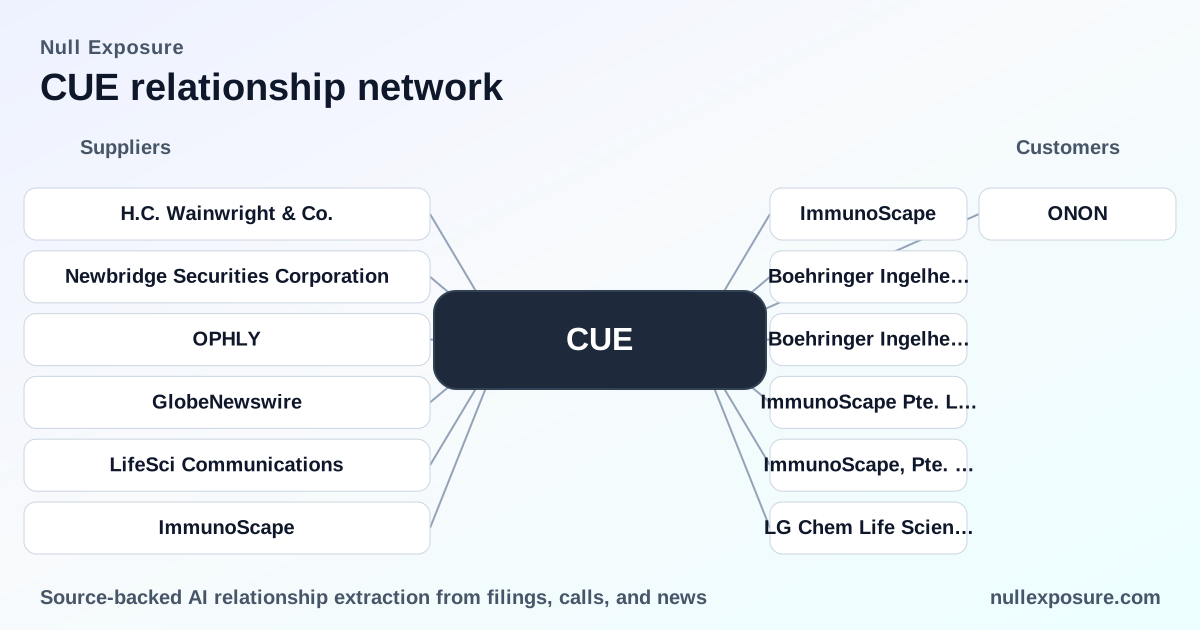
Cue Biopharma (CUE): Supplier Relationships and Contracting Risks for Investors
Cue Biopharma operates as a clinical-stage immunotherapy company that develops selective biologics and advances them through clinical partnerships and capital markets. The company monetizes primarily through collaboration agreements, licensing milestones and, when required, equity raises to fund operations — most recently through an underwritten public offering process — while outsourcing manufacturing and many trial execution functions to third parties. For investors assessing counterparty risk, the supplier footprint is small, concentrated, and functionally critical to near-term clinical progress and regulatory timelines. Learn more about supplier risk and relationship mapping at https://nullexposure.com/.
The operating model in plain terms: outsourced execution, partner-driven value
Cue’s operating posture is highly outsourced. Public disclosures state the company relies completely on third parties for manufacturing of clinical drug supplies and uses third-party CROs to run its trials, controlling only discrete elements of execution. This creates a supplier model where operational continuity depends on a network of contract manufacturers and service providers rather than in-house production. Cue supplements clinical relationships with third-party cybersecurity and data protection experts, indicating a reliance on external vendors for operational risk mitigation as well.
- Contracting posture: predominantly vendor-centric — Cue buys manufacturing and clinical execution rather than self-performing.
- Concentration: the firm runs with a limited set of specialized suppliers and partners, raising single-vendor criticality for drug supply and trial delivery.
- Criticality: suppliers are mission-critical — drug product availability and CRO performance directly drive clinical timelines and licensing value.
- Maturity: company-level maturity is typical of clinical-stage biotech — limited revenue, negative EBITDA, and reliance on capital markets for funding.
These signals recommend that credit and operations teams treat manufacturing and CRO relationships as top-tier counterparty risks for valuation and continuity planning. For a deeper supplier-risk map and partner heatmaps, visit https://nullexposure.com/.
Who Cue works with — counterparties and what they do
Below are every supplier or partner relationship flagged in the source material, with a concise, investor-facing description and the original source for verification.
-
H.C. Wainwright & Co. — Book-running manager for a public offering. According to the offering announcement distributed in March 2026, H.C. Wainwright & Co. is acting as sole book-running manager on Cue’s underwritten public offering of common stock and warrants, evidencing a primary capital markets relationship to meet near-term funding needs. (QuiverQuant/GlobeNewswire, March 2026)
-
Newbridge Securities Corporation — Co-manager on the same offering. The same March 2026 announcement lists Newbridge Securities as a co-manager, indicating Cue is using a syndicate model with regional/sector specialist support for distribution. (QuiverQuant/GlobeNewswire, March 2026)
-
Ono Pharmaceutical (OPHLY) — Clinical collaboration partner for CUE-401. In Cue’s 2024 second-quarter earnings discussion, management referenced CUE-401 as being developed in collaboration with Ono Pharmaceutical, signaling an active R&D partnership that could be material to Cue’s clinical pathway and regional development plans. (Cue 2024 Q2 earnings call transcript)
-
GlobeNewswire — Press distribution channel used for corporate communications. The underwritten offering and related investor communications were distributed via GlobeNewswire, and the QuiverQuant aggregation notes an AI-generated summary of the GlobeNewswire release, underlining GlobeNewswire’s role in disclosure distribution. (QuiverQuant/GlobeNewswire, March 2026)
-
LifeSci Communications — Media relations/contact for corporate announcements. The offering press materials reference LifeSci Communications as a media contact, indicating reliance on an external PR firm to manage investor and media outreach during financing and corporate news cycles. (QuiverQuant press aggregation, March 2026)
-
ImmunoScape — Scientific/strategic collaborator referenced in hiring coverage. A March 2026 news piece highlighted that Cue’s development plans and hires were discussed in the context of maintaining its collaboration with ImmunoScape, showing that this external scientific relationship factors into program continuity and expertise access. (Yahoo Finance, March 2026)
What these relationships imply about execution risk and funding
Cue’s supplier list is compact but strategically significant: investment banks (H.C. Wainwright, Newbridge) handle near-term capital, public relations specialists and press distributors (LifeSci, GlobeNewswire) manage disclosure, while clinical and scientific progress depends on partners (Ono, ImmunoScape) and third-party manufacturers/CROs referenced in company disclosures. The presence of an active underwritten offering is a direct on-ramp to capital but also a signal of persistent funding needs consistent with a clinical-stage biotech profile and the negative EBITDA disclosed in FY2025.
Key implications for investors:
- Funding and liquidity are active drivers of valuation. The March 2026 underwritten offering shows Cue is accessing equity markets to fund operations; underwriting structure and manager selection materially affect execution risk.
- Operational continuity is supplier-dependent. Public filings state Cue relies entirely on third-party manufacturing and CROs; a manufacturing interruption or CRO failure would directly delay clinical readouts and licensing opportunities.
- Communications and market perception are externally managed. Use of LifeSci and GlobeNewswire centralizes disclosure channels; any breakdown in transparency or messaging could amplify market volatility around clinical or financing events.
For a granular supplier-risk assessment tied to contract terms and service-level exposures, visit https://nullexposure.com/ for our analytical tools and counterparty scoring.
Investor checklist — what to monitor next
Watch the following near-term items to gauge supplier and partner risk exposure:
- Confirmation of manufacturing agreements and contingency plans for clinical supply; supplier redundancy is essential given the stated reliance on third parties.
- Progress and milestone payments under the Ono collaboration and any contractual announcements with ImmunoScape that secure data rights or development obligations.
- Execution of the underwritten offering: pricing, allotment, and use-of-proceeds statements will affect burn runway and dilution.
- Public communications cadence and any corrections or additions to press releases distributed via GlobeNewswire and managed by LifeSci.
Bottom line and next steps
Cue operates a partnership-first, outsourced execution model that efficiently conserves cash but concentrates operational risk in a small set of suppliers and collaborators. Investors should treat manufacturing and CRO arrangements as first-order risk factors and monitor capital markets activity — particularly the March 2026 underwritten offering — for its impact on runway and dilution. For ongoing tracking of supplier exposure and relationship health across biotech and life sciences firms, explore our supplier-risk tools and briefings at https://nullexposure.com/.