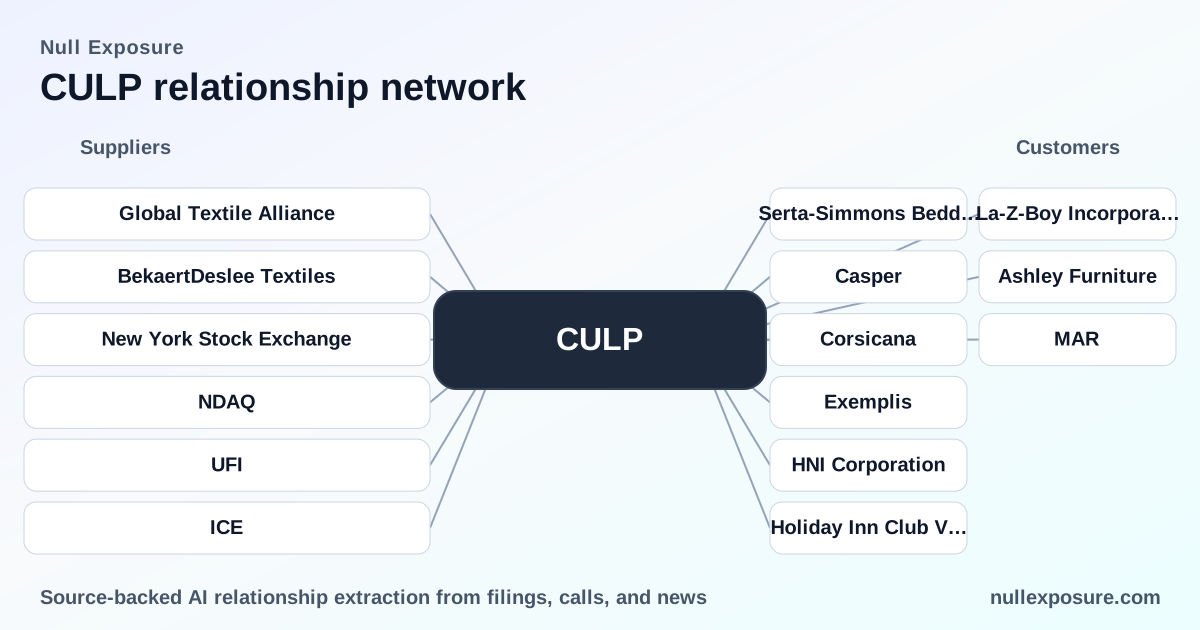
Culp, Inc. — Supplier relationships, constraints, and what investors should know
Culp, Inc. manufactures mattress fabrics, sewn covers and cut-and-sew kits for bedding and upholstery, monetizing through B2B sales to mattress and furniture manufacturers across North America and internationally. Revenue is driven by fabric and sewn-cover supply contracts, a strategic mix of in‑house production and outsourced sourcing, and margin leverage tied to raw material and labor efficiency. For investors evaluating supplier risk, Culp blends long-tenured sourcing in specialty woven fabrics with short‑term working capital arrangements that shift payment risk into the supply chain finance ecosystem. Explore supplier intelligence on NullExposure.
Quick read: the commercial model in one line
Culp sells finished textile components to OEMs and retailers, consolidating manufacturing where economical while redirecting non‑core weaving to long-term sourcing partners and using supply‑chain financing to smooth cash flows.
How the relationships stack up (each relationship in the public record)
Global Textile Alliance — direct competitor in mattress fabrics
Culp lists Global Textile Alliance as one of its principal mattress fabric and mattress cover competitors in its FY2025 Form 10‑K, signaling overlapping product sets and channel exposure to the same OEM customers. According to the FY2025 10‑K, this is a competitively relevant peer for fabric and cover production.
BekaertDeslee Textiles — competitive peer in covers and fabrics
BekaertDeslee Textiles is named alongside other fabric and mattress-cover producers as a principal competitor in Culp’s FY2025 10‑K, underscoring pricing and product innovation pressure in the mattress supplies market. The FY2025 10‑K highlights its presence in the same product categories.
New York Stock Exchange — legacy exchange relationship
Culp announced the voluntary transfer of its listing from the New York Stock Exchange, thanking the NYSE for a multi‑decade partnership in a March 2026 release; coverage framed this as a transition rather than a regulatory issue. A Baystreet report from March 2026 relayed management’s public remarks thanking the NYSE for the partnership over three decades.
Nasdaq (NDAQ) — new listing destination and platform partner
Management confirmed that Culp will join the Nasdaq Capital Market to leverage Nasdaq’s trading and corporate solutions following recent restructuring and integration initiatives, positioning the exchange change as part of a corporate transformation. Baystreet and Yahoo Finance coverage in March 2026 quoted CEO Iv Culp on the strategic rationale for moving to Nasdaq.
Unifi Inc. (UFI) — product partnership on cooling and sustainability
Culp partnered with Unifi to introduce a “Chillsense” mattress fabric powered by Repreve, demonstrating co‑innovation with fiber producers to capture sustainability and performance demand; Textile World covered this collaboration in June 2021. The 2021 Textile World article documents the product development partnership between Culp and Unifi.
(Note: multiple news items report the same NYSE/Nasdaq developments in March 2026; the summaries above reference those distinct media accounts.)
What the public constraints reveal about Culp’s supplier posture
The corporate disclosures and constraint excerpts indicate a mixed contracting posture:
- Short‑term payment arrangements are active. Suppliers entered supply‑chain financing arrangements in April 2025 totaling RMB20.0 million (approximately $2.8 million USD) with expirations through April 2026, and those suppliers assigned receivables to the Agricultural Bank of China under reverse factoring. This is evidence that Culp leverages trade payables and reverse-factoring structures to manage cash conversion while suppliers accept financed receivables.
- Strategic long‑term sourcing exists in parallel. In FY2025 the board directed a shift of certain weaving operations to a strategic sourcing model, and the company reports that the majority of its woven jacquard (damask) fabrics are sourced from a long‑tenured, strategic supplier in Turkey — a signal of supplier concentration for a critical product line.
- Buyer posture and procurement control. The reverse‑factoring arrangement and supply‑chain financing were executed “based on the company’s request,” which indicates Culp exercises buyer leverage in structuring supplier payment terms.
- Relationship maturity is mixed but anchored by legacy partners. The company explicitly describes long‑tenured suppliers for key fabrics, reflecting mature, entrenched relationships for differentiated inputs, alongside shorter‑term financing arrangements for working capital flexibility.
Together these signals describe a company that balances concentration in specialty woven supply with tactical short‑term financing to stabilize working capital.
Investor implications: risks, opportunities, and operating levers
- Concentration risk in specialty fabrics is meaningful. Reliance on a long‑tenured Turkish supplier for jacquard fabrics creates single‑source risk for a critical, higher‑margin product line. Loss or disruption would force operational relocation or inventory drawdown.
- Supplier financing mitigates supplier liquidity but shifts credit exposure. The April 2025 reverse-factoring program improves supplier cash flows but effectively converts trade credit into bank‑backed receivables; investors should treat working capital metrics and off‑balance financing disclosures as active levers management uses to stabilize operations.
- Competitive set pressures margins. Publicly named competitors — Global Textile Alliance and BekaertDeslee — reinforce a market where product differentiation (cooling fabrics, sustainability claims) and cost control matter. The Unifi partnership signals management’s strategy to drive product differentiation through fiber and performance alliances.
- Listing move is operationally framed. The transfer from NYSE to Nasdaq, covered in March 2026 media, is presented as tactical support for corporate transformation rather than a distress signal; treat this as an administrative change tied to restructuring progress.
Explore detailed supplier and risk analytics on NullExposure.
Actionable checklist for investors and operators
- Monitor inventory and days‑payable trends to detect increased reliance on supply‑chain financing and to quantify bank‑backed receivables tied to reverse factoring.
- Assess alternative sourcing for jacquard fabrics and the supplier’s capacity and geographic concentration to price disruption scenarios.
- Track product partnerships (for example, the Unifi collaboration) as indicators of margin expansion and differentiation potential.
- Watch management commentary around the Nasdaq move for hints on governance, shareholder base changes, and liquidity impacts.
Bottom line and next steps
Culp runs a hybrid supplier model: entrenched strategic suppliers for specialty woven goods and short‑term financing mechanisms to manage working capital. That combination delivers product continuity and temporary liquidity relief but introduces concentration and credit‑structure considerations investors must price into valuation and operational due diligence. For focused supplier intelligence and to map these exposures across counterparties and contracts, visit the NullExposure homepage and start a targeted review. Visit NullExposure.
Carefully review Culp’s FY2025 10‑K and the March 2026 exchange‑listing disclosures for the primary source language behind the supplier financing and strategic‑sourcing shifts before making allocation decisions.