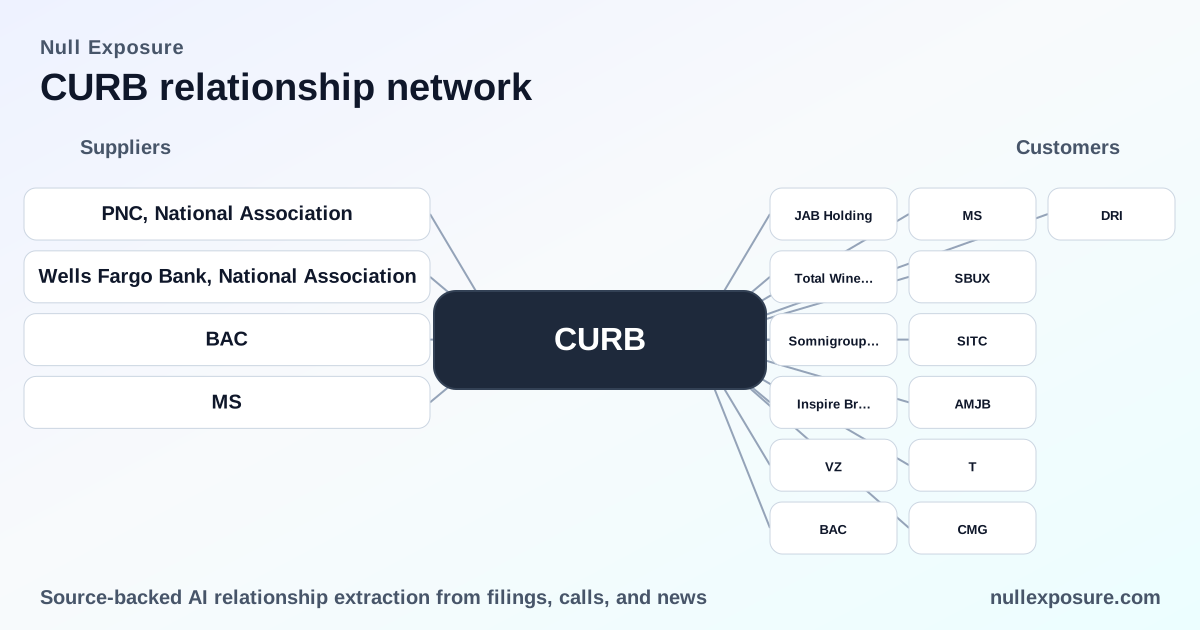
Curbline Properties (CURB) — Supplier relationships and capital-partner landscape
Curbline Properties is a retail-focused REIT that monetizes through property ownership, leasing and selective development activity, supported by capital markets access and syndicated lending. The company funds growth via a mix of unsecured term debt, a revolving credit facility established at spin-off, and periodic equity issuances; service relationships supply critical back-office functions under fee arrangements. For investors evaluating supplier and capital counterparty risk, the combined picture is a capital-light operating posture supported by large financial institutions and outsourced services, with direct implications for liquidity, dilution and operational concentration. Learn more about how supplier exposures affect risk and valuation at https://nullexposure.com/.
Why these relationships matter: capital partners plus outsourced services define risk
Curbline’s counterparties split into two practical buckets: capital providers (banks and underwriters), and service providers (outsourced IT and shared services). The capital partners control near-term liquidity and optionality; the service providers shape ongoing operating costs and operational continuity.
Two disclosure-driven signals matter for modeling counterparty risk and operational leverage:
- A filing excerpt shows the Operating Partnership pays SITE Centers a usage-based fee equal to 2.0% of the Company’s Gross Revenue under a Shared Services Agreement. This is a named contractual relationship that is usage-based and recurring, creating a revenue-linked cost that scales with topline and is likely material to operating cashflow when revenues expand.
- Company disclosures also identify outsourced technology and back-office services—payroll, HR, electronic communications, financial reporting and certain finance functions—that are provided by a third party, which positions Curbline in a service-provider contracting posture: dependency on external IT/provider continuity for critical functions.
Taken together, these signals indicate variable-cost operating exposure (usage-based fees) plus dependency on third-party service continuity, which increases the importance of counterparty operational stability even when debt is unsecured.
The counterparties you need to know
PNC, National Association
On July 15, 2025, Curbline and its Operating Partnership executed a term loan with a syndicate of lenders and PNC, National Association acting as administrative agent for an unsecured $150.0 million term loan. This is direct evidence of PNC’s role in Curbline’s near-term secured (unsecured in this case) financing stack and liquidity profile, increasing the bank’s influence over covenant monitoring and refinance windows. According to the FY2025 Form 10‑K, the term loan was documented on that date.
Wells Fargo Bank, National Association
In connection with Curbline’s October 1, 2024 spin-off, the company and its Operating Partnership entered into a credit agreement administered by Wells Fargo Bank, National Association and a lender syndicate; this facility established the company’s post-spin funding backbone. The FY2025 Form 10‑K records Wells Fargo as the administrative agent for the 2024 credit agreement that underpins day‑to‑day liquidity management following the corporate reorganization.
BofA Securities, Inc.
On February 10, 2026, Curbline and its operating partnership signed an underwriting agreement with BofA Securities, Inc. (joint with Morgan Stanley) to execute a forward equity offering for 8.0 million common shares, plus a 1.2 million-share option for underwriters. This places BofA in a lead capital markets role and signals a near-term dilution pathway tied to growth financing. A Globe and Mail press release summarizing the underwriting arrangement reported the February 10, 2026 transaction.
Morgan Stanley & Co. LLC
Morgan Stanley joined BofA as a co-underwriter on the forward equity offering announced February 10, 2026, serving as a primary distribution partner for the incremental equity issuance and associated over-allotment option; that role gives Morgan Stanley practical influence over execution timing and pricing dynamics. The underwriting engagement was documented in the same February 2026 press release coverage.
What these relationships imply for investors and operators
- Capital access is diversified but market-facing. Curbline uses both syndicated bank facilities (Wells Fargo, PNC) and investment bank distribution (BofA, Morgan Stanley)—a conventional REIT structure that preserves flexibility but ties funding capacity to capital-market windows. The February 2026 forward sale is direct evidence management is prepared to use equity to fund growth rather than extend secured real estate leverage alone.
- Operational dependence on third parties is explicit and measurable. The SITE Centers 2.0% gross revenue fee introduces a scalable operating cost and is a direct contractual drag on NOI expansion; outsourced IT and finance functions concentrate operational risk outside corporate walls. Both factors increase the importance of counterparty credit and service continuity in downside scenarios.
- Credit posture is unsecured and syndicated. The $150 million term loan is unsecured and administered by PNC, implying lenders’ exposure is to enterprise value rather than specific collateral, while the Wells Fargo credit agreement provides a post-spin liquidity backbone; covenant structure and maturity ladders will determine refinance and liquidity risk.
- Dilution is an explicit tool for growth financing. The forward offering with BofA and Morgan Stanley demonstrates management’s willingness to use equity issuance as a primary lever—a capital-markets-driven approach that reduces near-term leverage at the expense of dilution, and which underwriters will price to investor appetite.
A practical investor signal: institutional ownership is concentrated (institutions hold approximately 98.6% of free float), which improves liquidity in block trades but concentrates shareholder sensitivity to execution and dilution decisions.
If you want a structured supplier- and counterparty-risk view tied to capital forecasting, explore our analysis and monitoring tools at https://nullexposure.com/ for continuous updates and scenario modeling.
Risk checklist for due diligence
- Counterparty concentration: key services and shared‑services fee (SITE Centers) expose Curbline to outsourcer performance and commercial terms that scale with revenue.
- Market sensitivity: forward equity issuance ties cash needs to public market reception and underwriter execution.
- Refinancing windows: unsecured term debt and the credit agreement are bank-led commitments; covenant and maturity detail should be reviewed in the 10‑K.
- Operational continuity: outsourced IT and finance functions are critical; vendor replacement costs and transition risk are non-trivial.
Bottom line for investors and operators
Curbline’s supplier profile combines traditional bank syndication and investment‑bank distribution with outsourcer-driven operating dependency. That mix gives management flexibility to fund growth but places a premium on underwriter execution, bank relationships, and the stability of service providers. Key near-term monitoring items are the forward offering execution, the $150 million PNC-administered term loan, the Wells Fargo credit agreement provisions, and the commercial terms of shared services with SITE Centers.
For a deeper counterparty exposure map and live tracking of Curbline’s supplier and capital relationships, visit https://nullexposure.com/ — our platform consolidates filings and market signals into actionable intelligence for investors and operators.