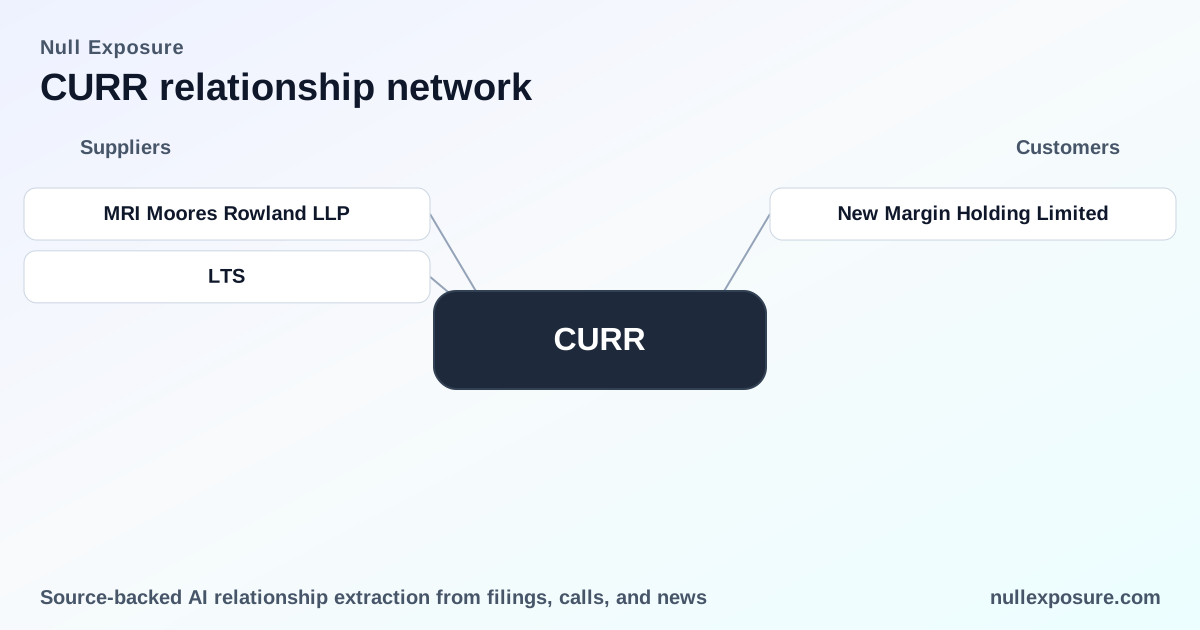
Supplier relationships and counterparty posture for Currenc Group (CURR)
Currenc Group operates as a technology company in the software-application space and generates revenue through product and service offerings tied to its platform and transactional flows; the company’s financial advisor and auditor relationships, plus explicit reliance on third‑party infrastructure and payment gateways, shape both its near‑term funding path and operational risk profile. Investors should treat CURR as a capital‑intensive growth operation that monetizes platform activity while depending materially on external service providers for payments and data hosting. For a quick view of other supplier and governance signals, visit https://nullexposure.com/.
The investment thesis in one line
Currenc Group sells software-driven services that produced roughly $40.2 million in trailing revenue and relies on external financial and audit partners for capital access and governance; the supplier footprint is small, concentrated, and operationally critical, which places outsized importance on the handful of named counterparties and the company’s contracting posture.
What the supplier signals reveal about operating model and risk
Currenc declares reliance on third parties for networks, banks, payment processors, payment gateways and data centers. That language is a company‑level signal that describes how the business runs: core transaction flows and data hosting are outsourced, not insourced. From a deal and risk perspective this produces several structural characteristics:
- Contracting posture: the company operates with a vendor‑dependent posture—agreements with payment processors and data center providers are functionally critical rather than peripheral. This implies shorter supplier switching windows but higher operational risk if a key provider changes terms.
- Concentration: the visible supplier universe in public disclosures is small, which raises counterparty concentration risk; a disruption to a single provider would have immediate operational impact.
- Criticality: suppliers handle payments and hosted data, two functions that are mission‑critical to revenue capture and compliance, so counterparties are high‑severity controls from a vendor‑risk standpoint.
- Maturity: auditor ratification and use of established capital markets advisors indicate corporate governance is being coordinated through traditional professional relationships, consistent with a company moving from early‑stage financing into broader market access.
These signals are not tied to any single named relationship; they are a company‑level indicator of how Currenc contracts for essential services.
Visit https://nullexposure.com/ for curated intelligence on supplier concentration and governance signals.
Who Currenc contracts with — the named relationships
The public record for the supplier scope is concise. Below are the relationships surfaced in filings and press notices; each entry includes a plain‑English summary and the source cited.
-
MRI Moores Rowland LLP (press release, FY2026): Investors ratified MRI Moores Rowland LLP as the independent auditor for the fiscal year ending December 31, 2025 and re‑elected director Eric Weinstein at the 2026 shareholder meeting. According to The Globe and Mail press release dated March 9, 2026, the vote confirms continuity of external audit oversight for the coming reporting cycle (https://www.theglobeandmail.com/investing/markets/stocks/CURR/pressreleases/492433/currenc-group-shareholders-approve-us546-million-debt-for-equity-swap-and-2025-equity-plan/).
-
MRI Moores Rowland LLP (EGM announcement, FY2026): The company’s February extraordinary general meeting materials again reference the ratification of MRI Moores Rowland LLP as auditor for 2025, underlining the same auditor appointment in the context of approving a major debt‑to‑equity swap and incentive plan. A Globe and Mail press notice from March 2026 details the EGM agenda and auditor ratification (https://www.theglobeandmail.com/investing/markets/stocks/CURR/pressreleases/37099532/currenc-group-calls-february-egm-to-approve-major-debt-to-equity-swap-and-new-incentive-plan/).
-
Ladenburg Thalmann & Co. Inc. (capital markets advisor, FY2025): Ladenburg Thalmann served as sole financial advisor to Currenc in connection with a convertible note financing of up to $33 million, positioning them as the company’s chosen investment banking partner for that transaction. Investing News reported the engagement in a March 2026 item describing the financing and Ladenburg’s advisory role (https://investingnews.com/currenc-group-announces-up-to-33-million-convertible-note-financing/).
What these relationships imply for investors
-
Audit continuity is established. The ratification of MRI Moores Rowland LLP for the 2025 audit year signals management’s intent to maintain consistent external controls and financial reporting through material corporate actions such as a debt‑to‑equity swap and incentive plan. That continuity is an important governance cue for investors given the company’s negative profitability and the structural change announced at the EGM.
-
Capital markets access is active and advisor‑driven. Engaging Ladenburg Thalmann as sole financial advisor for a convertible note financing signals that Currenc uses experienced boutique capital markets partners to structure bridge and growth capital. This relationship is transactional but strategically important because capital availability is a gating factor for execution given current negative EBITDA.
-
Operational vendor dependence is the core non‑financial risk. Company disclosures list payment gateways, banks and data centers as third‑party dependencies; this creates an operational profile where small supplier counts and mission‑critical services elevate single‑counterparty impact. Operational resilience is therefore as material to valuation as headline capital events.
Key risks and monitoring checklist for investors
- Monitor auditor independence and audit findings during the 2025 financial statement cycle now under MRI Moores Rowland’s oversight.
- Track follow‑through on the $33M convertible financing execution and any expanded mandate with Ladenburg Thalmann, since capital structure changes will affect dilution and liquidity.
- Review contract tenure and termination clauses with payment processors and data centers to quantify supplier switching costs and continuity risk.
- Keep an eye on governance outcomes from the debt‑to‑equity swap and incentive plan that were approved at the EGM; these are likely to alter insider economics and could affect future supplier negotiations.
For deeper supplier concentration analysis and cross‑reference capability, see the supplier intelligence hub at https://nullexposure.com/.
Bottom line
Currenc Group’s disclosed supplier footprint is small but strategically consequential: audit and capital‑markets relationships provide governance and funding continuity while third‑party payment and hosting providers represent the largest operational vulnerability. Investors evaluating CURR should weigh capital execution against supplier concentration and prioritize monitoring audit outcomes, financing deliverables, and contract terms with payment and hosting vendors. For hands‑on supplier risk intelligence and alerts tied to these same counterparties, visit https://nullexposure.com/ and review the full supplier profiles.