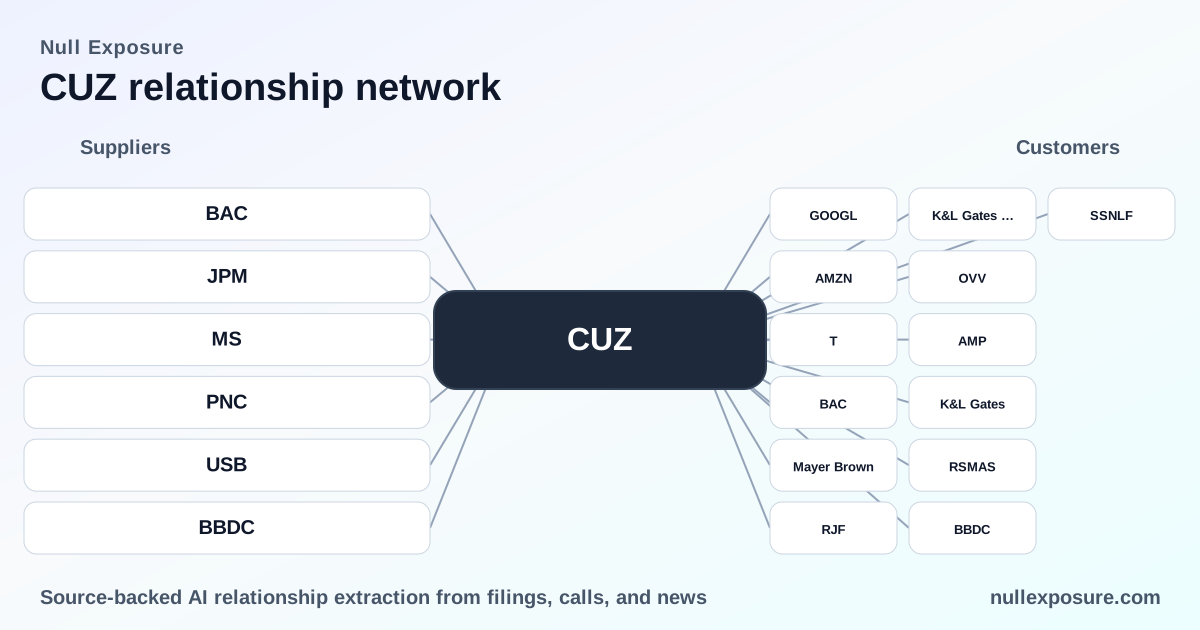
Cousins Properties (CUZ) — supplier relationships and what they mean for investors
Cousins Properties is a self-managed, fully integrated office REIT that generates income by owning, developing and operating office assets and monetizing through lease income, property dispositions and selective capital markets issuances. The company funds growth with a mix of operating cash flow and capital markets activity—public notes and asset sales underpin liquidity for development and tenant improvements—and supplier relationships reflect that capital-centric operating model. For investors assessing counterparties and operational risk, the relevant signal is clear: Cousins runs long-duration financing programs and large capital commitments, which make capital markets and trustee relationships strategically important.
Explore more supplier intelligence at https://nullexposure.com/ for portfolio-specific diligence.
Quick operating snapshot for context
Cousins has roughly $3.79 billion market capitalization and reported $985.7 million revenue (TTM) with EBITDA of $632.0 million, giving an EV/EBITDA of 11.71. The company carries long-term unsecured notes and ongoing development and tenant-improvement commitments; those financial characteristics drive its supplier posture: capital providers and trustees are critical suppliers, and large single-transaction counterparty engagements are standard.
What the supplier relationships show — who matters and why
Below I cover every supplier relationship captured in the available results and summarize what each connection means in plain English, with source context.
BofA Securities — underwriting partner on $500M notes
Cousins engaged BofA Securities as one of the underwriters on a $500 million senior unsecured notes issuance tied to financing activity announced in early 2026. TradingView reported the underwriting agreement dated February 10, 2026 that listed BofA alongside other major banks. (TradingView, March 9, 2026)
J.P. Morgan Securities — senior underwriter role
J.P. Morgan Securities served as a lead underwriter on the same $500 million notes issuance, helping place the securities into the market and syndicate the sale to institutional investors. The underwriting pact was reported on February 10, 2026 and summarized in a TradingView item on March 9, 2026. (TradingView, March 9, 2026)
Morgan Stanley & Co. — underwriting syndicate member
Morgan Stanley & Co. participated as a syndicate member on the underwriting agreement for the $500 million senior unsecured notes, providing distribution and capital markets execution capacity for the deal. This activity was captured in the same TradingView coverage dated March 9, 2026. (TradingView, March 9, 2026)
PNC Capital Markets — placement and distribution support
PNC Capital Markets joined the underwriting group to facilitate the notes sale, giving Cousins additional distribution channels to institutional investors. TradingView’s March 9, 2026 article lists PNC in the underwriting pact announced February 10, 2026. (TradingView, March 9, 2026)
U.S. Bank Trust Company — trustee for the notes
U.S. Bank Trust Company acts as trustee for the issuance, a standard but operationally important role that administers the indenture and protects bondholder rights. TradingView’s coverage of the financing notes identifies U.S. Bank Trust Company as trustee in the transaction documentation. (TradingView, March 9, 2026)
Barings — asset counterparty on a major disposition
Cousins acquired 300 South Tryon in Uptown Charlotte from Barings for $317.5 million as part of portfolio repositioning and growth in targeted markets. REBusiness Online reported the sale and noted Barings as the seller in the transaction announced in early March 2026. (REBusiness Online, March 9, 2026)
Operating model constraints and what they imply for supplier risk
The disclosed constraints signal two company-level characteristics that shape supplier relationships and negotiating posture:
-
Long-term capital contracting posture. Cousins carries multi-year unsecured notes and issued $500 million in senior unsecured notes (5.250% coupons that mature in 2030 for a tranche referenced as issued in June 2025), demonstrating a preference for long-dated capital and institutional underwriters. This is a company-level signal that capital markets and trustees are strategic, long-term suppliers rather than episodic vendors.
-
High single-event capital intensity. The firm reported $172.9 million of unfunded tenant improvements and development costs as of December 31, 2025, placing capital expenditure commitments squarely in the $100M+ band. That scale of commitments translates into sustained reliance on development contractors, financing counterparties and asset-sale counterparties such as Barings.
These constraints imply a contracting posture that is credit- and capital-market dependent, concentrated around a handful of major banks and trustees, and mature in tenor—factors that elevate the criticality of underwriting and trustee relationships for ongoing operations.
Investment implications: risk, concentration and opportunity
-
Concentration of capital counterparties increases operational dependency. Cousins’ use of a small group of major banks (BofA, J.P. Morgan, Morgan Stanley, PNC) to place large public notes creates an operational and reputational hinge: market disruption or a counterparty underwriting constraint could raise refinancing costs or narrow distribution channels. Underwriting concentration is a material supplier risk.
-
Trustee relationships are low-friction but legally critical. U.S. Bank Trust Company’s trustee role is administrative but central for bondholder protections; continuity of trustee services supports investor confidence in the notes market.
-
Asset-level counterparties are transactional but economically meaningful. The Barings sale for $317.5 million demonstrates how asset dispositions are used to refresh the balance sheet and fund development, meaning asset buyers/sellers are functionally important suppliers when portfolio rebalancing is active.
-
Cash flow profile demands flexible capital access. With nearly $1.0 billion revenue and significant unfunded development costs, Cousins requires consistent capital markets access to execute growth and tenant-improvement programs; its supplier ecosystem is therefore weighted heavily toward banks and institutional buyers.
What investors should watch next
- Monitor syndicated underwriting activity and any changes in the composition of lead managers; a shift away from the current bank group would be meaningful for distribution capacity.
- Track disposals or major asset acquisitions that alter funding needs; counterparties like Barings show the REIT uses institutional buyers to rebalance capital.
- Review future trustee notices and indenture amendments for covenants tied to the 2030 maturities; these affect creditor/contractor treatment in stressed scenarios.
Explore bespoke counterparty analysis and curated supplier risk summaries at https://nullexposure.com/ to support portfolio-level decisions.
Bottom line and recommended actions
Cousins runs a capital-intensive, long-tenor financing model that relies on major investment banks for underwriting and institutional counterparties for transactions; these relationships are operationally critical and concentrated. For investors and operators, the priority is to treat underwriting and trustee counterparties as ongoing service providers whose capacity and stability directly affect refinancing risk and execution of development spend. Assess exposure to underwriting concentration, monitor maturities clustered around 2030, and validate counterparty continuity when underwriting syndicates change.
For deeper supplier-level due diligence and continuous monitoring, visit https://nullexposure.com/ — the next level of counterparty insight for portfolio managers and corporate operators.