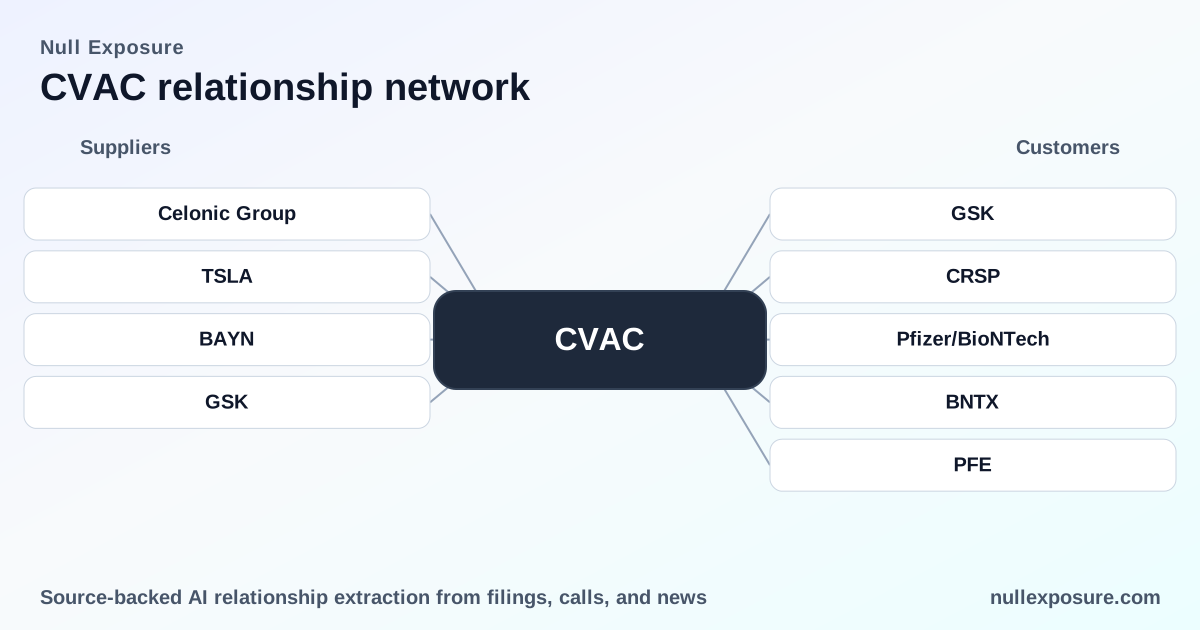
CureVac NV (CVAC): Supplier relationships that shape manufacturing scale and commercial optionality
CureVac NV is a clinical-stage mRNA therapeutics company that develops vaccine and therapeutic candidates and monetizes through strategic partnerships, manufacturing agreements and future product sales and licensing. The firm leverages external production capacity and collaboration revenue to scale development and distribution, with commercial upside tied to successful clinical progression and partner-led manufacturing commitments. Investors evaluating supplier exposure should focus on how CureVac outsources critical manufacturing capacity, relies on strategic pharma partners for scale and regulatory reach, and maintains a modest institutional ownership profile that concentrates governance risk.
For a concise supplier-risk view and deeper supplier discovery, visit https://nullexposure.com/.
How CureVac’s operating model turns science into revenue
CureVac’s business model centers on proprietary mRNA platforms commercialized through collaborations and contract manufacturing. The company converts scientific IP into cash flow primarily via partnership deals and outsourced production, rather than a vertically integrated manufacturing footprint. Financials through the latest quarter (2025-09-30) show Revenue TTM of $70.7M and Gross Profit of $66.0M, indicating that current commercial receipts and cost structure are meaningful but remain small relative to a $1.05B market capitalization. Profitability metrics (Trailing P/E 6.96, Operating Margin TTM 5.73%) signal an unusual combination of clinical-stage growth optionality with nascent positive operating results.
Key operational characteristics:
- Contracting posture: Reliance on external contract manufacturers and strategic pharmaceutical partners to scale production and distribution. This reduces fixed-capex burdens but creates operational dependency.
- Concentration: Low institutional ownership (about 10.4%) and minimal insider shareholdings (0.095%) concentrate investor influence outside major funds, which can amplify governance and strategic risk during partnership negotiations.
- Criticality of suppliers: Manufacturing partners are mission-critical — disruptions in production capacity directly constrain clinical timelines and commercial supply.
- Maturity: CureVac remains a clinical-stage, partnership-driven company; revenue and profitability exist but are relatively small compared with the enterprise valuation, so commercial milestones and partner execution are the primary value drivers.
For supplier diligence and monitoring playbooks, start at https://nullexposure.com/.
What’s on the record: the supplier and partner roster
Below are the supplier and partner relationships that appear in public reporting and trade coverage. Each entry is a concise, plain-English summary with a source reference.
Celonic Group
CureVac entered a production partnership with Celonic Group to manufacture doses of its COVID-19 vaccine candidate CVnCoV, establishing external capacity to produce at commercial scale. According to European Pharmaceutical Review coverage in FY2021, Celonic was tasked with producing up to 100 million doses for CureVac’s program. (European Pharmaceutical Review, FY2021)
Tesla Inc.
CureVac was linked to Tesla through a collaboration on a vaccine "printer" technology, with public discussion spurred by commentary from Elon Musk that highlighted progress toward regulatory submissions. Fortune reported this linkage and the public commentary in FY2021, underscoring a nontraditional manufacturing partner entry point. (Fortune, FY2021)
Bayer AG
CureVac established partnerships with Bayer to accelerate production and broader commercialization planning for its vaccine efforts, reflecting strategic alignment with big-pharma manufacturing and distribution capabilities. Fortune’s FY2021 reporting noted Bayer as a production and scale partner in CureVac’s pandemic response planning. (Fortune, FY2021)
GlaxoSmithKline Plc (GSK)
CureVac forged a strategic collaboration with GlaxoSmithKline aimed at enhancing production scale and developing next-generation vaccine candidates for variant coverage, leveraging GSK’s global footprint. Fortune identified GSK among CureVac’s key partners in FY2021 coverage of manufacturing and acceleration efforts. (Fortune, FY2021)
What these relationships imply for investors
The set of public relationships illustrates a deliberate model: CureVac transfers substantial manufacturing risk to external partners while keeping platform R&D and IP in-house. This reduces capital expenditure but increases counterparty exposure. The partner mix spans contract manufacturing specialists (Celonic), big-pharma scale (Bayer, GSK) and nontraditional technology players (Tesla), which diversifies operational risk across different supplier types.
Operational implications:
- Scale can be executed quickly when manufacturing partners are engaged, lowering time-to-market for emergency vaccines or partner-led launches.
- Counterparty concentration is moderate: while multiple partners exist, production of any single product could still hinge on a small number of critical CMO facilities.
- Governance and commercial leverage are asymmetric: with low institutional ownership, strategic decisions on partner selection and contract terms can pivot quickly under management influence.
Operational and commercial risks to monitor
- Manufacturing dependency: Outsourced production makes CureVac vulnerable to disruptions at partner sites and to capacity allocation decisions by partners prioritizing their own programs.
- Execution over promise: Partnerships with pharma giants and technology companies provide capability but require flawless coordination across regulatory, quality and distribution functions.
- Valuation sensitivity: Current revenue and profitability are modest relative to market capitalization; major value inflection points are tied to clinical outcomes and partner-dependent commercial launches (latest quarter 2025-09-30 financials).
Final take: what to watch next
For suppliers and operators evaluating CureVac as a counterparty, the priority is proof of reliable, contractually binding manufacturing capacity and clear governance over IP and supply allocation. For investors, monitor partner performance updates, any expansion of manufacturing agreements, and quarterly financials that reflect collaboration revenue and margin trends.
If you want a focused supply-chain and counterparty risk briefing on CureVac or comparable biotech suppliers, start here: https://nullexposure.com/.
Investors should track near-term clinical readouts, partner contract disclosures and manufacturing confirmations as the primary catalysts that will determine whether CureVac’s externalized production model converts into durable commercial revenue. For more supplier intelligence and portfolio-level exposure analysis, visit https://nullexposure.com/.