CVB Financial (CVBF): Who supplies the bank and what it means for investors
CVB Financial Corporation operates as a regional bank headquartered in Ontario, California, generating revenue primarily from interest income on loans and securities and fee income from deposit and banking services; it monetizes through net interest margin compression/expansion, scale in deposit gathering, and targeted M&A to grow earning assets. For investors, supplier relationships tell you how CVB sources liquidity, external advice and legal coverage, and where operational risk is concentrated. Explore deeper supplier maps and counterparty intelligence at Null Exposure.
Why supplier relationships matter for a regional bank CVB’s balance sheet and operating model depend on three categories of external relationships: funding counterparties, strategic advisors for transactions, and outsourced technology and service providers that run critical systems. Supply-side signals illuminate liquidity posture, legal and transactional readiness, and operational concentration risk—all directly relevant to credit and operational due diligence.
A quick snapshot of what the records show
- CVB maintains short-term contractual liquidity arrangements (overnight fed funds lines) with other major banks, indicating a liquidity management posture that relies in part on short-term bank credit.
- The investment portfolio is heavily skewed to U.S. government and government-sponsored securities, signaling high-quality liquid assets on the balance sheet.
- CVB identifies several critical technology systems as managed by outside vendors, highlighting outsourced operational exposure that is material to ongoing business continuity.
The three supplier relationships investors need to know about
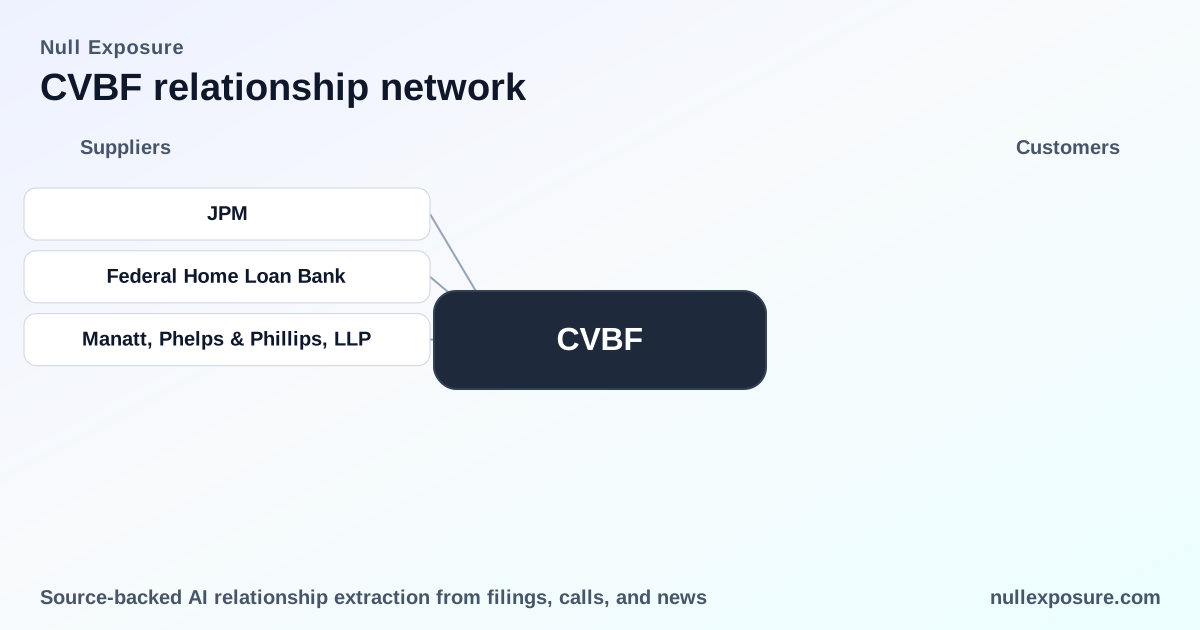
J.P. Morgan — financial advisor role J.P. Morgan acted as a financial advisor in connection with the transaction discussed in CVB’s merger announcement, positioning JPM as the external investment-bank advisor supporting deal strategy and execution (GlobeNewswire, Dec 17, 2025: CVB Financial Corp and Heritage-Commerce Corp Announce Agreement to Merge). This ties CVB to a top-tier advisory relationship during M&A activity, reducing execution risk on the sell-/buy-side advisory front. (Source: GlobeNewswire press release, Dec 17, 2025 — https://www.globenewswire.com/news-release/2025/12/17/3207338/0/en/CVB-Financial-Corp-and-Heritage-Commerce-Corp-Announce-Agreement-to-Merge.html)
Manatt, Phelps & Phillips, LLP — legal counsel on the transaction Manatt served as legal counsel in the same announced transaction, providing transaction and regulatory legal services tied to the merger activity cited in the press release. Having a specialized law firm engaged for transaction counsel is standard for regional-bank M&A and reduces legal execution friction around regulatory filings and integration covenants. (Source: GlobeNewswire press release, Dec 17, 2025 — https://www.globenewswire.com/news-release/2025/12/17/3207338/0/en/CVB-Financial-Corp-and-Heritage-Commerce-Corp-Announce-Agreement-to-Merge.html)
Federal Home Loan Bank (FHLB) — secured advances as borrowings As of December 31, 2025, CVB’s total borrowings included $500 million of Federal Home Loan Bank advances, a material wholesale funding source for the bank’s balance sheet liquidity and term funding strategy (CVB earnings release, Jan 21, 2026). FHLB advances provide predictable, collateralized funding and are a core component of funding diversification for community and regional banks. (Source: CVB Financial earnings release, Jan 21, 2026 — https://www.globenewswire.com/news-release/2026/01/21/3223282/0/en/CVB-Financial-Corp-Reports-Earnings-for-the-Fourth-Quarter-and-the-Year-Ended-2025.html)
What the supplier map implies about CVB’s operating posture CVB combines conservative asset placement with tactical use of wholesale funding and external advisory services. The coverage above and company disclosures support these operating characteristics:
- Contracting posture — short-term liquidity usage: CVB disclosed $305.0 million in fed funds lines available for overnight borrowings (as of Dec 31, 2024), signaling disciplined but active management of day-to-day liquidity through the interbank market rather than exclusive reliance on long-term wholesale funding. This is a company-level signal drawn from CVB’s disclosures.
- Counterparty concentration — government-weighted portfolio: Company filings indicate approximately 90% of the investment securities portfolio at Dec 31, 2024 consists of U.S. government or government-sponsored securities, a deliberate concentration toward high-quality, low-credit-risk securities that support liquidity and regulatory capital profiles.
- Criticality and vendor reliance — outsourced systems: CVB states that a number of its most critical technology systems and applications are provided or managed by outside vendors or service providers, which elevates operational and third-party risk to a company-level strategic consideration rather than isolated vendor-level detail.
- Relationship roles and maturity: The supplier set spans advisory (J.P. Morgan), legal (Manatt) and secured wholesale funding (FHLB)—a conventional mix for a bank executing M&A while managing funding needs; advisory and legal relationships are transactional and project-timed, while FHLB access is ongoing and operational.
Risk and concentration considerations investors should monitor
- Liquidity sensitivity: reliance on overnight fed funds lines and short-term market access makes intraday and quarterly funding conditions a monitoring priority, particularly in stress scenarios.
- Third-party operational risk: outsourcing of critical tech systems is material; failure or cyber-incident at a vendor could yield significant disruptions as CVB itself warns in disclosures.
- Funding mix stability: the FHLB advance is a stable secured source, but concentration in any single wholesale funding program increases replacement risk if access is restricted.
Practical next steps for analysts and operators
- Verify the maturity ladder and roll-forward of fed funds lines and FHLB advances in the latest 10-Q or investor presentation to assess rollover and seasoning risk.
- Review vendor oversight and continuity arrangements in the risk-management disclosures; prioritize vendors identified as “critical” for scenario testing.
- Track transaction counsel and advisory engagement terms for any material contingent liabilities or integration milestones embedded in merger documents.
If you want a deeper supplier-risk breakdown and real-time alerts on counterparty changes, start here: Null Exposure homepage.
Bottom line CVB’s supplier footprint is conventional for a regional bank executing growth through M&A and relying on a mix of secured wholesale funding and short-term bank credit. The dominant company-level signals—heavy government-backed securities, short-term liquidity lines, and critical outsourced systems—paint a picture of conservative asset placement but concentrated operational dependencies. For buy-side diligence and operational risk management, focus on funding maturity, vendor continuity plans, and the specifics of any transaction-related advisor or counsel engagements.
Need a supplier-focused briefing tailored to your investment thesis or underwriting checklist? Contact us or begin exploring supplier intelligence at Null Exposure.