Churchill Capital Corp VII (CVII): What suppliers tell investors about a SPAC’s operational posture
Churchill Capital Corp VII is a blank-check company that raises capital through an IPO to complete a business combination; it monetizes by deploying its trust-held proceeds into a target and through the sponsor/shareholder economics that activate once a merger closes. As a public shell, CVII’s value proposition is execution of a deal rather than recurring operating revenue, and its supplier relationships are therefore concentrated, highly investor-facing, and oriented around shareholder servicing and governance. For buy-side and operator diligence, the supplier roster confirms that CVII runs a conventional SPAC operating model with established third-party providers handling transfer, redemption and proxy functions. For more supplier intelligence and relationship mapping, visit https://nullexposure.com/.
Snapshot: a SPAC with standard public‑market plumbing
Churchill Capital Corp VII is listed on NASDAQ as a special-purpose acquisition vehicle. The registered address and public filings show no operating revenue and little operating leverage outside the SPAC trust; equity economics are driven by sponsor upside and the success of a future business combination. Market-cap at the latest reporting reflects the public float and trust dynamics rather than an operating business. The public disclosures reviewed here focus squarely on investor servicing — transfer agent and proxy solicitation — which are the core vendor engagements for a SPAC in the pre-combination phase.
Who Churchill VII hires to run shareholder mechanics — and why it matters
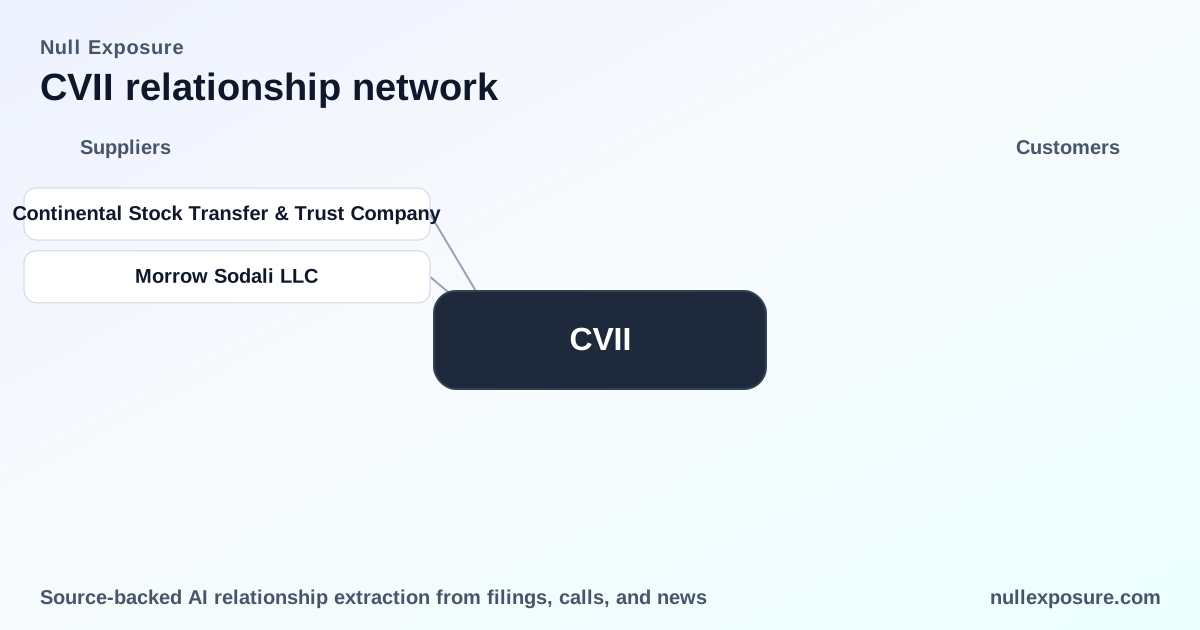
CVII’s supplier relationships are narrowly tailored to the SPAC lifecycle: transfer agents and proxy solicitors manage redemptions, voting and communications with public investors. These roles are operationally critical because redemption deadlines, proxy voting and timely communications materially affect deal completion and sponsor economics. The following relationships were disclosed in Churchill VII’s investor communications and are the only supplier entries identified in the public release reviewed.
Continental Stock Transfer & Trust Company — transfer agent and redemption point
Continental Stock Transfer & Trust Company is named as the contact for shareholders seeking to redeem shares, with a full mailing address and a designated SPAC Redemption Team email provided in Churchill VII’s public redemption notice. This confirms Continental’s role as the transfer agent and operational hub for processing redemption requests and maintaining shareholder records. (PR Newswire release: “Redemption deadline for Churchill VII stockholders extended until August 9, 2024.” https://www.prnewswire.com/news-releases/redemption-deadline-for-churchill-vii-stockholders-extended-until-august-9-2024-302214244.html)
Morrow Sodali LLC — proxy solicitor and shareholder communications advisor
Morrow Sodali LLC is listed as Churchill VII’s proxy solicitor and a contact point for shareholders who need assistance voting or requesting materials, with dedicated phone numbers and an email address provided. This designates Morrow Sodali as the vendor responsible for proxy distribution, solicitation and voting logistics, a function that directly impacts meeting outcomes and the SPAC’s ability to consummate its business combination. (PR Newswire release: “Redemption deadline for Churchill VII stockholders extended until August 9, 2024.” https://www.prnewswire.com/news-releases/redemption-deadline-for-churchill-vii-stockholders-extended-until-august-9-2024-302214244.html)
What these relationships reveal about CVII’s operational characteristics
- Concentration and criticality: The supplier roster is intentionally narrow. For a SPAC, the transfer agent and proxy solicitor are among the most critical third parties because they directly enable redemptions, voting, and shareholder communications — the mechanics that determine whether a deal closes and what residual cash returns to public holders.
- Maturity of vendor selection: Both Continental and Morrow Sodali are established, national providers commonly used by SPACs and public companies, indicating standard vendor selection rather than bespoke or boutique arrangements. That suggests CVII prioritized reliability and market-tested operational execution.
- Contracting posture: A SPAC’s contracting posture is typically short-term and transaction-focused; vendors are engaged to support discrete corporate events (redemption windows and meetings). Expect standard service agreements focused on regulatory compliance, recordkeeping accuracy and rapid turnaround for shareholder instructions.
- Operational footprint and cost profile: The absence of operating revenue and the presence of investor-service vendors indicate a low recurring cost base outside event-driven fees, which preserves trust assets but concentrates transaction risk on event timing and shareholder behavior.
If you want deeper supplier-level intelligence and continuity mapping for SPACs and public shells, explore our resources at https://nullexposure.com/.
Investor implications and risk signals
- Governance and execution risk are front and center. Because CVII’s core workstream is completing a business combination, the efficiency and reliability of its transfer agent and proxy solicitor materially affect timelines, redemptions and ultimate deal economics.
- Reputational and operational dependency is elevated. Using recognized suppliers reduces counterparty risk, but any operational lapse in redemption processing or proxy solicitation would have outsized impact on deal outcomes and investor returns.
- Limited diversification of vendor functions. The narrow supplier list reflects the SPAC lifecycle. Investors should monitor filings for additional supplier engagements (legal, financial advisors, de-SPAC lenders) as those providers change the risk profile and cost structure.
Constraints and company-level signals to factor into diligence
There are no explicit contractual constraints disclosed in the supplier release reviewed. At the company level, however, the following signals are evident and should inform counterparty diligence and stress-testing:
- Transaction-centric contracting: Agreements are likely scoped to discrete events (meeting dates, redemption windows), implying limited long-term vendor commitments but heightened short-term operational exposure.
- High criticality, low redundancy: Critical processes (redemptions, proxy distribution) appear to rely on a single provider per function, which is appropriate for efficiency but increases single-point-of-failure risk.
- Predictable maturity mix: Vendors are established incumbents, signaling standard compliance and reporting capabilities rather than innovative or untested servicing models.
Bottom line and recommended next steps
Churchill Capital Corp VII operates as a conventional SPAC with a lean, investor-facing supplier footprint focused on transfer and proxy services. For investors evaluating CVII counterparty risk, focus on operational reliability of the transfer agent and proxy solicitor, monitor shareholder meeting notices and redemption metrics, and review any subsequent filings for added advisors or financing counterparties that would change the profile.
If you require a supplier-risk briefing or ongoing monitoring for CVII and similar SPACs, review our research offerings at https://nullexposure.com/ — we map supplier relationships and event-driven counterparty exposures for public shells and acquisition vehicles.
Final action items for diligence:
- Confirm service agreements and SLAs with Continental and Morrow Sodali in SEC filings or proxy materials.
- Track redemption tallies and meeting outcomes; these are the operational events that convert trust assets into deal flow or return capital.
- Watch for additional supplier disclosures (investment bankers, legal counsel, financing counterparties) that will redefine execution risk as a business combination progresses.
For bespoke supplier intelligence and alerts on CVII, visit https://nullexposure.com/ and request a tailored report.