Cadrenal Therapeutics (CVKD): Supplier relationships reshape a clinical-stage value story
Cadrenal Therapeutics operates as a clinical-stage biopharmaceutical company focused on renal disease and an expanding anticoagulation pipeline built through targeted asset acquisitions and external partnerships. The company monetizes by advancing clinical assets toward licensing or commercialization, using equity raises (including at‑the‑market offerings) to fund development, and relying on third‑party manufacturing and service providers to execute trials and eventual supply. Investors should value CVKD as an asset‑acquisition and development play whose near‑term returns depend on clinical readouts and the company’s ability to manage third‑party supplier risk. For more context on supplier exposures, visit https://nullexposure.com/.
Why suppliers matter for this stage of the story
Cadrenal is not a vertically integrated manufacturer or commercial seller; it sources critical activities from contract manufacturers, CROs, and distribution partners. That structure compresses fixed costs and accelerates program expansion via acquisitions, but it also concentrates operational risk in external providers. Control over timelines, quality and regulatory compliance lives largely outside CVKD’s four walls, so investor returns hinge on supplier execution and the company’s competency at integrating acquired programs.
Portfolio expansion through acquisitions — what investors should track
Cadrenal has expanded its anticoagulation portfolio in two strategic moves in 2025–2026 that change the supplier and program map for the company.
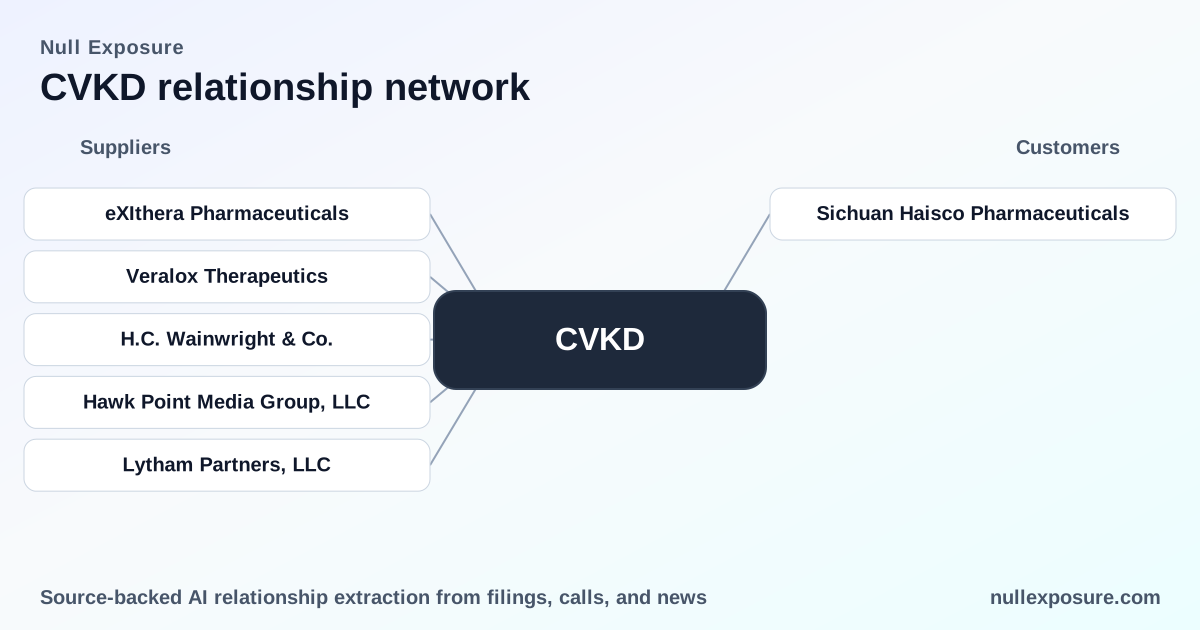
eXIthera Pharmaceuticals — Factor XIa program added
Cadrenal acquired a portfolio of Factor XIa inhibitors from eXIthera, including frunexian, in September 2025 as part of a push to broaden anticoagulation offerings. According to Cadrenal’s September 15, 2025 press release, the transaction added both intravenous and oral investigational candidates to the company’s pipeline and materially expanded its development responsibilities and supplier footprint. (Source: GlobeNewswire / Cadrenal press release, Sept 15, 2025.)
Veralox Therapeutics — VLX‑1005 and 12‑LOX assets transferred
Cadrenal completed the acquisition of VLX‑1005 and related 12‑lipoxygenase (12‑LOX) assets from Veralox in December 2025, a move the company described as a first‑in‑class addition for patients with heparin‑induced thrombocytopenia. Public releases confirm program ownership transferred to Cadrenal and that the Phase 2 study closed following handover in December 2025. (Source: GlobeNewswire & company releases, Dec 11, 2025; Feb 24, 2026 clinical update.)
H.C. Wainwright & Co. — equity distribution and ATM sales agent
Cadrenal continues to use H.C. Wainwright & Co. as sales agent under its at‑the‑market equity program; the company filed a prospectus supplement to extend capacity for additional common stock sales. That relationship is the primary channel for incremental financing via share issuance. (Source: TradingView / Globe and Mail coverage of the SEC prospectus supplement filing, FY2025.)
Hawk Point Media Group, LLC — retained for investor and digital communications
Cadrenal engaged Hawk Point Media Group through an IR intermediary to support press releases, editorial insights, and digital media production—an outsourced investor communications arrangement that increases external control of market messaging. (Source: AccessNewswire press releases announcing the retention, FY2025.)
Lytham Partners, LLC — investor relations contact
Lytham Partners is listed in investor communications as a contact for investor inquiries, with a named managing partner and contact details in recent press material; this signals an active use of boutique investor relations and capital markets outreach. (Source: GlobeNewswire Q1/Q3 2025–2026 investor notices, FY2026.)
(Each relationship above is explicit in Cadrenal press materials and market reporting; sources are company press releases and coverage between September 2025 and February 2026.)
What the supplier constraints tell us about operational risk
Cadrenal’s public disclosures and the cited reporting produce a consistent operating model signal:
- Outsourced manufacturing is critical: Cadrenal relies on contract development and manufacturing organizations (CDMOs) for production; any prolonged CDMO disruption would force alternate arrangements and increase costs. This is a company‑level constraint, not assigned to any named supplier unless specifically stated in filings.
- Clinical program execution depends on third‑party services: The company will rely on CROs, clinical investigators and contract labs to run trials, which makes trial timelines and data integrity contingent on external performance.
- Limited internal commercial infrastructure: Cadrenal lacks broad distribution, sales, and support capabilities and plans to use third‑party distribution partners, which will delay or limit revenue capture during commercialization.
- Concentration and criticality are elevated at this stage: With multiple recently acquired programs, a small number of suppliers will have outsized influence on timelines and regulatory outcomes.
- Maturity profile remains early‑stage: Negative EBITDA and zero revenue TTM reflect clinical‑stage economics; supplier relationships are therefore foundational to de‑risking programs for future partners or acquirers.
These constraints together indicate that execution risk sits squarely in supplier management — selecting, auditing and retaining CDMOs and CROs is a primary driver of value or downside.
Practical takeaways for investors and operators
- Catalyst schedule: Monitor clinical readouts for the VLX‑1005 and Factor XIa programs and the cadence of any further acquisition announcements; these are the near‑term value drivers.
- Financing cadence: Watch ATM deployment with H.C. Wainwright for dilution signals and cash‑management strategy. (See https://nullexposure.com/ for a supply‑risk screening framework.)
- Supplier diligence: For operators, establish redundancy plans with alternate CDMOs and CROs and prioritize data integrity controls during integrations. For investors, prioritize transparency around supplier contracts and regulatory inspection history.
The investment conclusion — where value and risk intersect
Cadrenal’s growth thesis is clear and actionable: scale through asset acquisitions and de‑risk programs via clinical advancement toward licensing or commercialization. Value creation is conditional on third‑party supplier execution and efficient capital raises. The company’s relationships with eXIthera and Veralox materially improve its anticoagulation footprint, while H.C. Wainwright, Hawk Point and Lytham Partners formalize its financing and market communications strategy. Investors should underwrite both the upside from clinical progress and the operational risk embedded in outsourced manufacturing and services. For a concise supplier‑risk checklist tailored to biotech acquirers and investors, visit https://nullexposure.com/.
If you evaluate supplier exposure across small biotech portfolios, use the report framework at https://nullexposure.com/ to map concentration and criticality into valuation scenarios.