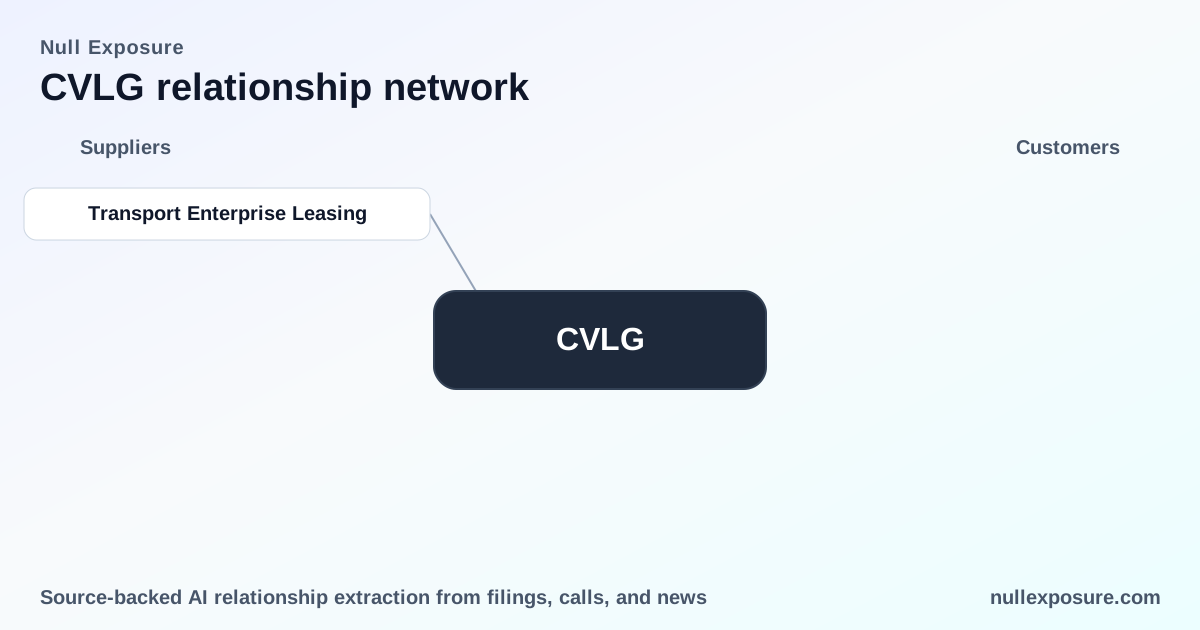
Covenant Logistics Group (CVLG): Supplier relationships that move the business
Covenant Logistics Group operates as a U.S. transportation and logistics company that monetizes through freight transportation, managed freight services, brokerage, and equipment leasing via affiliated channels. The firm generates revenue both from asset-based trucking operations and from providing capacity and logistics services that outsource carriage to third parties; Covenant also recognizes equity income from a near‑50% investment in a leasing affiliate that supports revenue equipment sales and leases. Investors should treat Covenant’s supplier posture as a hybrid model—asset-backed cash flows supplemented by service-provider relationships and an income stream from an affiliated leasing entity (Revenue TTM ≈ $1.164B; EBITDA ≈ $116M).
For a concise view of supplier exposures, see https://nullexposure.com/.
The single recurring supplier relationship you need to track: Transport Enterprise Leasing (TEL)
-
Covenant reports a 49% equity-method investment in Transport Enterprise Leasing that contributed pre‑tax net income of $3.1 million (approximately $0.09 per share) in the fourth quarter reported alongside FY2026 results. This shows direct economic exposure to TEL’s leasing performance and a measurable contribution to Covenant’s reported earnings (reported March 2026 via the company’s fourth-quarter financial release distributed on QuiverQuant).
According to Covenant’s FY2026 report published March 2026, the equity-method return from TEL was $3.1 million in the quarter (QuiverQuant, March 9, 2026). -
Earlier company communications describe TEL as an affiliate that provides revenue equipment sales and leasing services to the trucking industry, establishing the operational role TEL plays in Covenant’s equipment strategy and supply chain. That affiliate description was reiterated in a corporate press release covering Covenant’s 2025 dividend declaration (The Globe and Mail press release, March 2026).
How Covenant’s supplier relationships shape the operating model
Covenant’s supplier stance is not a simple vendor list; it is a set of operating trade-offs:
- Contracting posture — Covenant uses multi-year finance and operating leases (approximately 48 to 84 months) to secure revenue equipment, which signals a preference for long-term capital commitments over spot procurement and points to predictable fleet availability and scheduled capital outflows.
- Concentration and criticality — The company identifies dependence on certain third-party services and a single vendor for several IT functions, which elevates operational concentration risk and underscores the importance of vendor stability to billing, dispatch, and revenue capture.
- Role of suppliers — In the Managed Freight and brokerage segments Covenant relies on third‑party carriers as service providers, where Covenant sells logistics management and capacity rather than owning all transport assets; this increases variable cost exposure but limits fixed-asset capital intensity.
- Relationship maturity and visibility — Lease right‑of‑use assets are reported on the balance sheet, indicating active and material supplier arrangements already embedded in Covenant’s capital structure.
These are company-level signals drawn from Covenant’s disclosures and should guide how investors assess supplier counterparty risk and cash‑flow timing.
What this means for cash flow, margins, and operational risk
- Lease commitments smooth equipment procurement but require capital discipline. Long-term leases stabilize fleet access and support revenue continuity, while also creating predictable cash outlays and balance-sheet lease liabilities.
- The TEL equity stake converts leasing economics into an earnings line, demonstrated by the $3.1 million pre-tax contribution; this converts equipment finance performance into non-operating income rather than pure operating margin expansion.
- Managed Freight reliance on third-party capacity makes margins sensitive to vendor pricing and capacity tightness. If third‑party costs rise, Covenant’s ability to pass through costs or protect margins will determine short-term earnings resilience.
- IT vendor concentration is an operational risk that is functionally critical—disruption to dispatch, load planning, or billing platforms would directly impair revenue capture and customer service.
Bold takeaway: Covenant’s supplier architecture balances asset-backed stability with service-provider flexibility, but it concentrates risk in a handful of long-term vendor relationships and a single critical IT provider.
For deeper supplier intelligence and quantitative exposure mapping, visit https://nullexposure.com/ to review structured relationship signals and disclosures.
Financial context that elevates supplier importance
Covenant’s valuation and performance metrics frame supplier implications:
- Market capitalization is roughly $626.6M with Revenue TTM ≈ $1.164B and EBITDA ≈ $116M; EV/EBITDA is ~8.7, suggesting the market prices some operational leverage into the stock.
- Trailing PE is high (156x) while Forward PE is materially lower (≈14.7x), reflecting low trailing EPS and improving forward profitability expectations; supplier cost inflation or equipment shortages would directly affect that forward earnings profile.
- Institutional ownership (~69%) and insider ownership (~26%) indicate investor attention and alignment, making supplier disruptions more likely to attract active scrutiny from stakeholders.
Monitoring checklist for operators and investors
Watch these discrete signals each quarter:
- TEL performance and equity-method income — track whether the affiliate’s leasing margins expand or contract relative to the $3.1M quarterly contribution reported in Q4 FY2026.
- Lease maturity and refinancing schedule — concentrate on the 48–84 month lease terms to understand upcoming cash needs or rollover risk.
- Capacity pricing and third‑party carrier costs — Managed Freight margins are exposed to spot and contracted carrier rates.
- IT vendor stability — any vendor incident or migration initiative has direct operational and revenue implications.
- Supply constraints in manufacturing (tractors/trailers) — component shortages lift capital and operating costs across the sector and extend lead times.
Mid-article resource: to compare Covenant’s supplier exposures with peers and view raw relationship signals, visit https://nullexposure.com/.
Closing: the investor verdict
Covenant Logistics runs a hybrid supplier model that blends owned and leased assets, third-party capacity, and an earnings contribution from an affiliated leasing business. That structure creates both stability (through leases and asset-backed revenue) and sensitivity (through third-party carrier costs and vendor concentration). For investors and operators, the priority is monitoring TEL’s contribution, lease roll schedules, and IT/vendor concentration—these are the levers that will drive Covenant’s ability to convert revenue into durable earnings.
For a structured, relationship‑level view and disclosures that support investment and operational decision-making, start at https://nullexposure.com/.