Commvault (CVLT) — Supplier Relationships and Contracting Signals Investors Should Know
Commvault is a software-first provider of data protection and information management that monetizes through subscriptions, SaaS offerings, maintenance on perpetual licenses, and professional services. The company’s financial profile today is driven by subscription growth and cloud-resilience product expansion while management uses buybacks and conservative guidance to manage investor expectations. This supplier snapshot focuses on the specific third-party relationships and contracting signals that shape Commvault’s technology roadmap, cost base, and operational risk profile. For a deeper supplier-risk view, visit https://nullexposure.com/.
Two active supplier relationships that change how Commvault sells and defends data
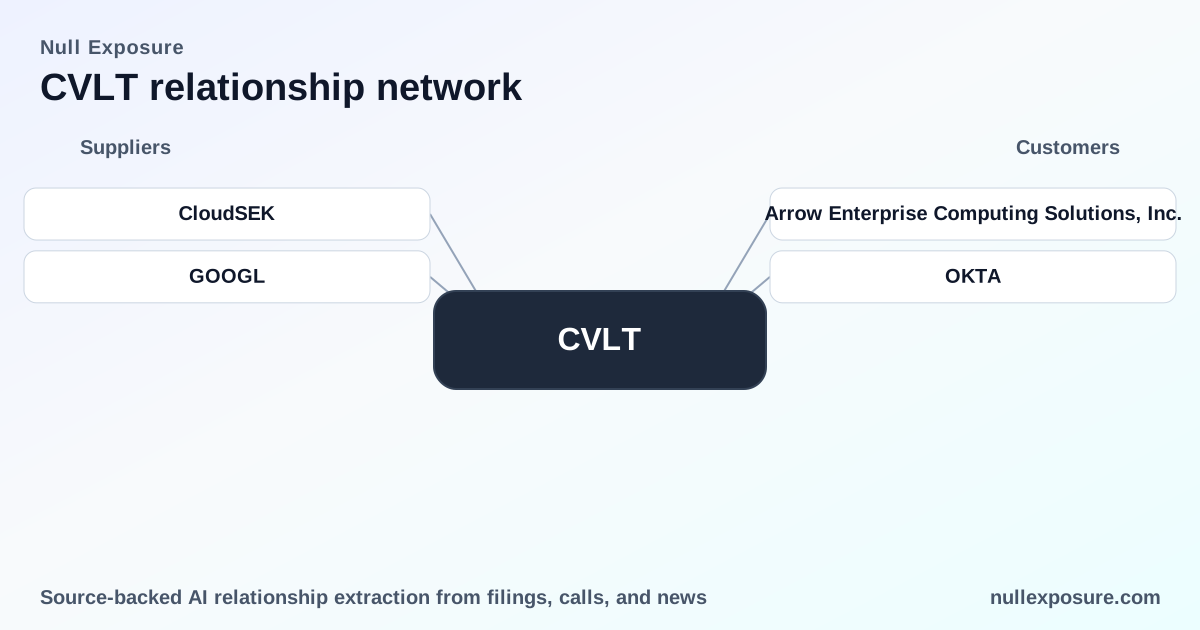
The supplier map returned for Commvault contains two notable partners: a security intelligence provider and a hyperscaler. Both relationships are strategic rather than purely transactional — they extend product capabilities and distribution reach rather than represent large, fixed cost commitments. Separately, company-level contracting evidence shows limited non-cancellable third-party commitments, which frames the firm’s procurement posture as flexible and lightly committed. For full platform access and tracking, see https://nullexposure.com/.
CloudSEK — dark‑web credential intelligence integrated into identity protection
Commvault has integrated CloudSEK’s dark-web credential intelligence into its Active Directory tooling to surface exposed accounts earlier in identity attacks, improving early detection of credential compromise. According to an Intellectia.ai news item (reported March 9, 2026 / FY2026), this integration embeds real‑time credential threat intelligence into Commvault’s identity-protection workflow, reducing the window of exposure for customers. (Source: Intellectia.ai, March 2026)
Implication: security integrations like this are feature-leveraging partnerships that enhance product differentiation without large incremental capital commitment.
Google Cloud — expanded collaboration to support cloud resilience and SaaS momentum
Commvault has expanded its collaboration with Google Cloud to support cloud resilience offerings and accelerate its SaaS and subscription push, a point highlighted in investor coverage alongside buyback and guidance dynamics. A Sahm Capital piece (January 29, 2026) described the expanded collaboration as part of Commvault’s cloud data story, linking the partnership to ongoing subscription momentum and new cloud resilience products. (Source: Sahm Capital, January 29, 2026)
Implication: a hyperscaler partnership materially amplifies go-to-market reach and operational delivery for cloud-native SaaS, which accelerates recurring revenue growth while anchoring enterprise customers to integrated cloud workflows.
What the aggregate contracting signals reveal about procurement, concentration, and criticality
Commvault’s public filing-level evidence shows total non-cancellable purchase commitments of $107,494 as of March 31, 2025, which places company-level third‑party commitments in the $100k–$1M band. This is a meaningful procurement signal:
- Contracting posture: The low absolute level of non-cancellable commitments indicates a flexible, transaction-oriented procurement model rather than heavy lock-in to large suppliers; Commvault retains the ability to pivot vendors or shift cloud vendors without onerous sunk purchase obligations.
- Concentration: Supplier concentration is low by dollar commitments; strategic concentration is higher by function — a small number of platform partners (e.g., Google Cloud, security vendors) carry outsized product and GTM importance.
- Criticality: Data protection and resilience are mission-critical for customers; therefore, even modest supplier spend can have outsized operational importance. The CloudSEK tie-in and Google Cloud collaboration are functionally critical integrations for security and delivery.
- Maturity: The relationships are enterprise-grade and complementary to core product lines, indicating a mature partnership approach focused on capability extend rather than procurement leverage.
This company-level signal does not assign those purchase commitments to any named supplier; it should be read as a corporate procurement posture rather than a vendor-specific exposure. For ongoing monitoring of contract-level changes, check https://nullexposure.com/.
How investors and operators should interpret these relationships
- Revenue leverage: The Google Cloud collaboration is the most direct lever for accelerating recurring revenue by embedding Commvault in hyperscaler-native workflows and channel motions. Monitor incremental SaaS bookings and joint GTM announcements for quantifiable lift.
- Product differentiation: Security integrations like the CloudSEK relationship are high-impact feature plays that increase win-rate in security-conscious accounts without the need for heavy upfront capex.
- Operational risk: Low non-cancellable commitments reduce financial lock-in risk, but the functional criticality of a few partners implies operational dependency rather than contractual exposure; diligence should focus on service-level integration points and co-engineering roadmaps.
- Governance and vendor maturity: Evaluate SLAs, joint incident-response commitments with hyperscalers, and roadmap alignment for identity and resilience features; these determine how partnership benefits translate into customer retention.
Practical next steps for diligence and monitoring
- Track quarter-over-quarter SaaS/subscription growth and any quantitative disclosures tied to the Google Cloud collaboration to measure commercial impact.
- Validate integration depth for security partners like CloudSEK — confirm whether intelligence is passive feed integration or bi-directional enforcement for automated remediation.
- Monitor future filings for any change in purchase commitments or disclosures that would move supplier spend outside the $100k–$1M band.
- Assess contract terms around SLAs, escalation pathways, and co-support with hyperscalers to understand operational risk during incidents.
Bold takeaways: Commvault’s supplier posture balances flexibility with strategic partnerships; the company uses partnerships to extend product capability and cloud distribution without building large non-cancellable vendor liabilities.
For a consolidated view of supplier exposure and to set up alerts on material changes, visit https://nullexposure.com/.
Commvault’s supplier landscape is compact but strategically dense: hyperscaler ties drive revenue distribution; security integrations drive product differentiation; low purchase commitments preserve operational flexibility. Investors should prioritize monitoring hyperscaler-driven SaaS metrics and the operational terms that underwrite those partnerships. For ongoing supplier surveillance and to explore deeper relationship mapping, go to https://nullexposure.com/.