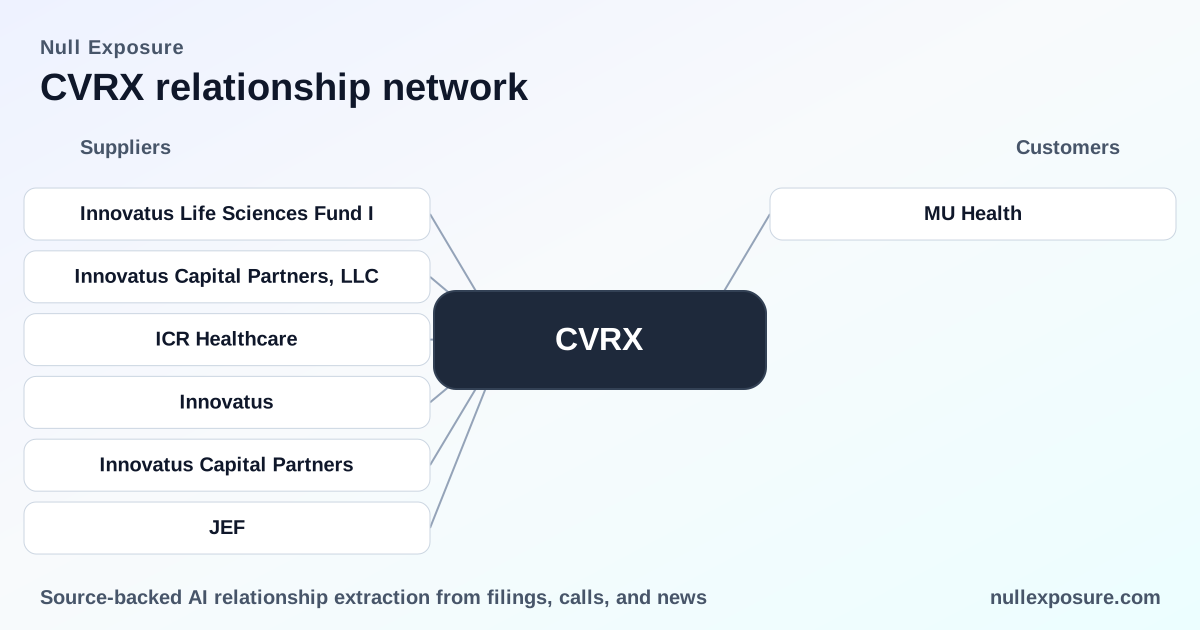
CVRx Inc (CVRX): Supplier and capital-partner map that underwrites the next runway
CVRx develops implantable devices to treat hypertension and heart failure and monetizes through device sales, clinical programs and structured financing that backs clinical scale-up. The company sells Barostim implants and funds commercialization and trials with a mix of debt (innovatus-led term facility), optional equity via an at‑the‑market program, and active investor relations. For investors evaluating supplier relationships, the practical takeaway is simple: CVRx’s operational risk is driven by a concentrated third‑party manufacturing posture while its near‑term liquidity profile is underwritten by Innovatus and optional Jefferies equity capacity.
Explore vendor exposure and counterparty signals in more depth at https://nullexposure.com/.
Why these relationships matter to investors now
CVRx’s partner map breaks into two clear buckets that together define execution risk: financing counterparties that determine runway and capital flexibility, and outsourced manufacturing/supplier risk that controls product availability and revenue realization. The Innovatus‑led loan amendments materially expand committed borrowing capacity and extend interest‑only periods, improving liquidity conditional on milestones. At the same time, public filings flag dependence on a small number of suppliers and third‑party manufacturers with significant lead times, which makes revenue growth vulnerable to supply disruption.
- Financing stance: CVRx has negotiated milestone‑contingent covenant relief and extended maturity options, demonstrating a contracting posture that prioritizes liquidity preservation over immediate deleveraging.
- Supply concentration: Company disclosures identify reliance on a limited pool of component suppliers and third‑party manufacturers, elevating procurement and lead‑time risk.
- Commercial maturity: The firm is still loss‑making on the income statement but progressing revenue; capital partners and equity programs are designed to bridge commercialization and clinical scaling.
If you want a quick cross‑check of counterparties and their documented roles, see the full relationship log below and learn more about supplier concentration at https://nullexposure.com/.
Every referenced counterparty, one‑by‑one
Innovatus Life Sciences Fund I
TradingView reported on March 9, 2026 that CVRx executed a loan agreement amendment involving Innovatus Life Sciences Fund I and other lenders, reflecting a financing relationship used to extend borrowing capacity. This amendment is cited as part of the broader Innovatus facility that supports near‑term liquidity.
Source: TradingView news item, March 9, 2026.
Innovatus Capital Partners, LLC (affiliate)
CVRx disclosed on January 9, 2026 that it amended its term loan agreement with an affiliate of Innovatus Capital Partners, LLC to increase the facility by $50 million to up to $100 million, contingent on achieving defined milestones. This formal amendment is part of CVRx’s FY2026 financial plan to extend runway and support clinical and commercial activities.
Source: Company press release reported on GlobeNewswire, January 12, 2026 (FY2026 filing context).
ICR Healthcare (investor relations)
Multiple investor communications for FY2026 list ICR Healthcare (contacts Mark Klausner and Mike Vallie) as CVRx’s investor relations provider, indicating an engaged IR presence to manage messaging around trials, financing and commercial milestones. ICR’s listing on press releases signals active market outreach during the BENEFIT‑HF trial launch and quarterly reporting.
Source: GlobeNewswire press releases, January 2026.
Innovatus (media shorthand reporting)
Press coverage summarized the Innovatus‑led amendment on January 9, 2026, noting that CVRx doubled potential borrowings to $100 million, extended interest‑only payments for up to five years subject to milestones, and pushed maturity to May 2031, with a $10 million new draw leaving $60 million outstanding. The coverage crystallizes the commercial effect of the Innovatus arrangement on CVRx’s liquidity profile.
Source: The Globe and Mail press release coverage, January 2026.
Innovatus Capital Partners (SEC/10‑K context)
TradingView’s coverage of the company’s SEC 10‑K reported the same Innovatus loan terms in the context of FY2026 reporting, underscoring that the $100 million cap is milestone‑conditioned and is recorded in company filings as a key component of capital strategy.
Source: TradingView summary of SEC 10‑K disclosures, FY2026.
Jefferies LLC (equity distribution partner)
CVRx entered into an Open Market Sale Agreement with Jefferies LLC on January 12, 2026, establishing an at‑the‑market (ATM) program to offer and sell up to $50 million of common stock. Jefferies will act as sales agent on commercially reasonable efforts, with CVRx not obligated to sell shares, preserving optionality to convert equity capacity to cash if needed.
Source: Globe and Mail press release coverage and TradingView reporting, January 2026.
Jefferies LLC (ATM program details)
TradingView also noted the initiation of the ATM offering with Jefferies, specifying the commercial terms (up to $50 million, commission of up to 3%), and the intended use of proceeds for working capital and general corporate purposes, reinforcing that this is a non‑binding equity backstop.
Source: TradingView news item, FY2026.
ICR Healthcare (repeat press mentions)
Additional FY2026 press releases and event notices (conference calls and trial announcements) reiterate ICR Healthcare as the investor relations contact, confirming continuity in CVRx’s market communications during a period of financing and clinical milestones.
Source: GlobeNewswire and SahmCapital press notices, January 2026.
Operating constraints and what they tell investors
Company disclosures include two company‑level constraints that define operational risk:
- Materiality / concentration: CVRx reports that "many components are from a limited number of suppliers" and that dependence on third‑party manufacturers exposes the firm to greater lead times. This is a company‑level signal that supplier concentration is material to revenue timing and scaling.
- Relationship role / outsourced manufacturing: The company uses components and subassemblies manufactured by third parties with significant lead times, which positions third‑party manufacturers as critical suppliers rather than interchangeable vendors.
Taken together, these constraints imply a contracting posture that increasingly relies on capital partners rather than vertical integration to manage growth, elevating the criticality of supplier reliability while the firm remains in a scaling phase.
Investment implications — runway, dilution and supplier risk
- Runway improved but milestone‑conditioned: The Innovatus amendment meaningfully increases potential liquidity and delays principal pressure via extended interest‑only periods, but the incremental capacity is contingent on milestones that investors should monitor closely (trial enrollment, regulatory progress, or revenue targets).
- Optional equity reduces short‑term distress but risks dilution: The Jefferies ATM provides a ready channel for equity raises without a large pre‑committed offering; use of that capacity will dilute shareholders if drawn.
- Operational execution depends on a handful of external manufacturers: Supply concentration is the single most actionable operational risk — delayed components translate into delayed implants and deferred revenue recognition.
Actionable items for investors: watch Innovatus milestone triggers and draws, monitor ATM executions through Jefferies for signs of dilution, and track supplier lead‑time disclosures in quarterly filings and conference calls. For deeper visibility into supplier concentration and counterparty exposure, visit https://nullexposure.com/.
Final take
CVRx’s partner footprint shows a company buying liquidity and investor attention while it outsources production to a limited set of suppliers. That combination reduces near‑term solvency risk but increases execution risk: financing gives the company time, suppliers determine whether time converts into durable revenue. Monitor milestone progress, ATM use, and supplier lead‑time updates as the three most predictive signals for valuation re‑rating. For continuous counterparty monitoring and supplier exposure insights, go to https://nullexposure.com/.