CVS Health: supplier relationships that shape operational leverage and execution risk
CVS Health monetizes through a diversified healthcare stack: retail pharmacy sales, a large pharmacy benefits manager (Caremark), and insurance via Aetna, plus related services. Revenue accrues from point-of-sale retail margins, PBM spread and administration fees, and insurance premiums—while profitability depends on scale, supplier terms for drugs and services, and the ability to extract recurring revenue from platform initiatives such as digital health and cloud-enabled analytics.
If you are evaluating CVS as a counterparty or assessing downstream supplier opportunity, focus on how CVS contracts, where supplier concentration exists, and which external platforms it integrates for clinical and IT workflows. For a concise view of third‑party exposure and supplier signals, visit https://nullexposure.com/ for structured supplier intelligence.
Why supplier relationships matter for CVS investors and operators
CVS is not a traditional retailer: its supplier choices affect clinical throughput, formulary economics, and the customer journey across millions of prescriptions and millions of plan members. A single technical integration that speeds prior authorization or a cloud partner that hosts analytics can materially influence cost of care and margin capture. Investors should therefore value both operational resilience (inventory and distribution relationships) and strategic optionality (cloud/AI partners that drive recurring services).
What CVS’s recent supplier signals show
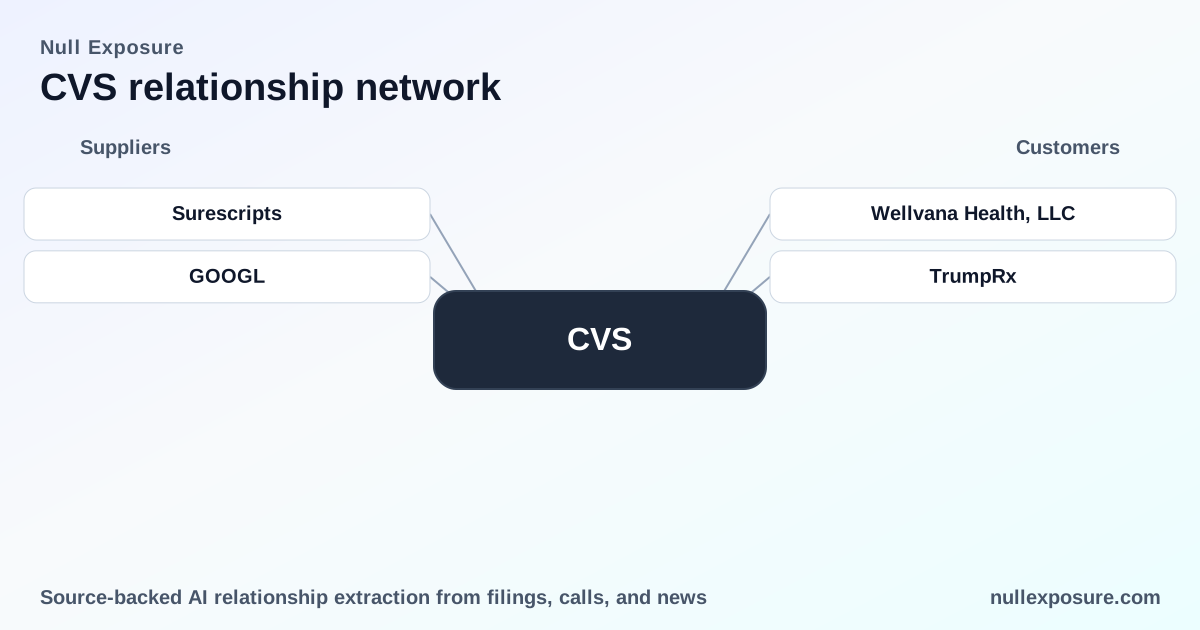
Below I list every supplier relationship surfaced in the source material and give a plain-English summary with the originating reference.
-
Surescripts — CVS Caremark is using Surescripts Touchless Prior Authorization for select specialty drugs to accelerate approvals and reduce manual prior‑authorization workflows. This integration shortens time-to-therapy and lowers administrative cost for specialty prescriptions. According to a CVS Health press release in March 2026, the implementation targets faster patient access for specialty medications. (CVS Health news release, March 2026)
-
Google Cloud — Market commentary in March 2026 reported a large commercial win: CVS will deploy an AI-enabled health platform on Google Cloud, signaling material cloud/AI adoption and a potential shift to recurring cloud and AI services that support enterprise analytics and clinical automation. (MarketBeat coverage, March 2026)
-
Google Cloud (duplicate mention) — A second MarketBeat instant-alert reiterated the same point: CVS’s agreement validates enterprise demand for recurring cloud/AI revenue and supports Google Cloud’s growth narrative driven by AI-enabled healthcare platforms. This is a repeat market signal from March 2026 confirming investor and media attention on the deal. (MarketBeat coverage, March 2026)
How these relationships translate into strategic value
-
Surescripts integration is operationally tactical but high-return: automating prior authorization for specialty drugs reduces friction in dispensing high-cost therapies and protects formulary uptake and adherence rates. For investors, that translates into improved pharmacy throughput and lower non‑labor admin costs.
-
Google Cloud is strategic and revenue‑enabling: a major cloud partnership signals a push to embed AI into care delivery and member services, creating new recurring IT spend for CVS while enabling product differentiation for Caremark/Aetna services.
Both relationships combine operational efficiency (Surescripts) with platform enablement (Google Cloud) — a desirable mix for a company that needs to squeeze margin from high-volume retail pharmacy while scaling analytics-led care management.
Operating model and contracting posture — what the constraints tell us
CVS’s supplier posture is a mix of long-term financial commitments and short-term operational flexibility:
-
The company maintains multi-year unsecured revolving credit facilities and has issued long-dated senior notes, which indicate access to long-term capital and financial commitments that underwrite strategic, multi-year supplier and IT investments. (Company filings and debt disclosures, 2024)
-
CVS also uses short-term facilities: a 364-day $3.0 billion term loan and commercial paper usage, and it explicitly states that certain supplier agreements are short-term and cancellable, giving management flexibility to reprice or re-source operational suppliers. (Company filings, 2024)
At the company level, CVS reports that competitive sources are readily available for most retail products, signaling low supplier concentration in consumer goods. The firm also points to dependence on prescription drug manufacturers and third parties for certain PBM and delivery operations, showing mixed criticality: commodity retail goods are replaceable, while prescription supply chains and clinical services require deeper, more strategic relationships. (Company risk disclosures)
Collectively these signals show a vendor strategy that balances low-concentration, cancellable retail suppliers with targeted, higher‑criticality partnerships in clinical, PBM, and IT services.
Risk and opportunity implications for investors and supplier partners
-
Risk: execution and single-vendor reliance in tech integrations. A major cloud deployment concentrates operational risk with a few hyperscalers; outages or contractual disputes would disrupt analytics and patient-facing services. Investors should model service continuity and contractual SLAs into downside scenarios.
-
Opportunity: recurring revenue and margin expansion via platform services. Cloud and AI integrations create opportunities for CVS to monetize services beyond traditional PBM fees—analytics, provider decision support, and embedded care management can increase lifetime value per member.
-
Operational resilience: replaceability of retail suppliers reduces inventory risk, but dependency on drug manufacturers remains a vector for pricing pressure and supply disruption. CVS’s mix of short-term cancellable agreements and long-term financing suggests management preserves flexibility to renegotiate or rebalance supplier mixes.
For supplier strategists: align value propositions to reduce operational friction (e.g., prior authorization automation) or to leverage platform extension (cloud, AI). For investors: focus on execution metrics — rollout cadence for automated workflows, cloud migration milestones, and measurable reductions in administrative costs.
If you want a detailed supplier exposure map for CVS and comparable peers, visit https://nullexposure.com/ and request a tailored analysis.
Bottom line and recommended actions
CVS is executing a dual-track supplier strategy: operational automations that trim cost and strategic cloud partnerships that enable new recurring services. For investors, that dichotomy is beneficial—short-term margin gains from automation combined with the long-term optionality of a cloud-enabled care platform.
- Track milestone disclosures on the Google Cloud deployment and measurable KPIs from Surescripts integrations (time-to-approval, fill-through rates).
- Stress-test downside scenarios for cloud dependency and pharmaceutical supply shocks.
For a structured supplier-risk assessment and to monitor CVS’s partner rollouts in real time, go to https://nullexposure.com/.