CVSA: Supplier Disclosure That Changes the Playbook
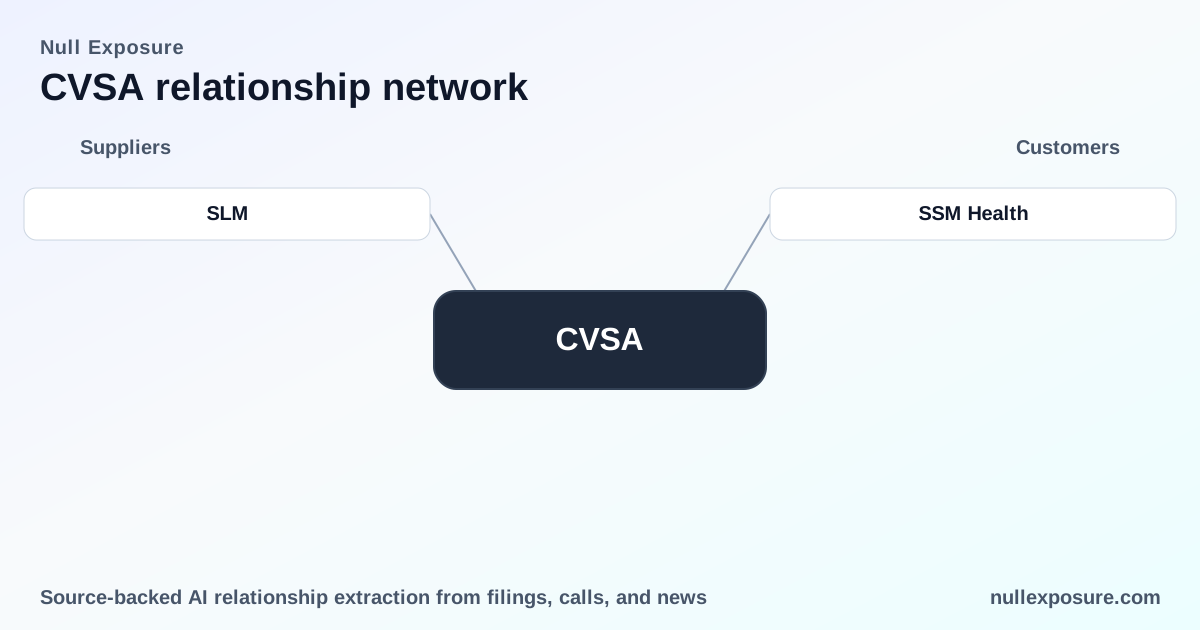
CVSA monetizes by contracting with financial services counterparties and institutional buyers as a supplier, generating revenue through negotiated agreements, letters of intent, and ongoing commercial relationships that translate into service fees and licensed product flows. The company’s recent public remarks show an expansion of commercial ties in the student-lending ecosystem, which has direct implications for revenue mix, counterparty risk, and go-to-market distribution. Investors should evaluate these supplier relationships for concentration, contractual terms, and the practical runway from letter of intent to definitive agreement.
Explore CVSA coverage and supplier signal tracking at https://nullexposure.com/.
What the headline disclosure was — and why it matters to investors
CVSA announced a letter of intent with Sallie Mae, a prominent and established player in student lending. That single-line disclosure is strategic: LOIs signal commercial intent without delivering full contractual detail, and for a supplier like CVSA the conversion of an LOI into a revenue-generating contract is the value inflection investors watch. This disclosure upgrades Sallie Mae from a prospective partner to a formal target for commercial engagement. According to CVSA’s Q4 2025 earnings call, the company described the Sallie Mae arrangement explicitly as a newly announced letter of intent (reported March 7, 2026).
Single-relationship walkthrough: what the record shows
Sallie Mae — A long-standing leader and innovator in student lending. CVSA disclosed a letter of intent with Sallie Mae during its 2025 Q4 earnings call; the remark was brief but explicit about the LOI relationship and was first reported on March 7, 2026. This is a supplier-level business development aimed at formalizing cooperation in student lending channels (CVSA 2025 Q4 earnings call, disclosure dated Mar 7, 2026).
How to read an LOI disclosure from a supplier standpoint
An LOI from a supplier’s perspective signals several concrete dynamics relevant to investors:
- Commercial advancement without full commitment. An LOI documents intent to transact and often precedes definitive contracting, pilot phases, or negotiated commercial terms.
- Near-term revenue optionality. If CVSA converts the LOI into an executed agreement, the company will likely recognize revenue per the agreed delivery milestones or service schedules.
- Counterparty quality matters. Partnering with an established institution such as Sallie Mae increases the probability of scale and predictable cash flows, while also concentrating counterparty exposure.
These are company-level operating model signals: absence of detailed contractual disclosure in the public remarks leaves the LOI as the primary observable indicator of intent. For deeper diligence, investors should push for the timing, exclusivity, termination provisions, and performance milestones embedded in any definitive documentation.
Read more about supplier flow monitoring and partner tracking at https://nullexposure.com/.
Operating model and business-model characteristics inferred from public signals
From the disclosure set available, derive the following operating and commercial characteristics for CVSA:
- Contracting posture — negotiation-first. The LOI indicates a staged contracting approach: public signaling followed by negotiation toward a definitive agreement.
- Concentration — becoming more focused on large institutional partners. The Sallie Mae connection implies a strategy that prefers a smaller number of large counterparties capable of volume.
- Criticality — partner-grade services. A supplier relationship with a national student-lending leader suggests CVSA delivers services or integrations that are operationally meaningful to large financial institutions.
- Maturity — commercial proof-of-concept in progress. The presence of an LOI rather than a completed contract points to mid-stage commercialization: a transition from business development to contracting.
No explicit constraints or supply-side limitations were present in the reviewed disclosure set; the absence of reported constraints in the source materials is itself a company-level signal that no material supplier-side restrictions were disclosed in the public remarks.
Investment implications: risk and upside
- Upside: Conversion of the Sallie Mae LOI into an executed contract would materially de-risk revenue realization and could serve as a reference account that accelerates additional enterprise sales. An executed deal with a top-tier lender provides validation and channel leverage.
- Risk: LOIs carry execution risk and ambiguous timelines. Concentration risk increases if CVSA substantially ties growth expectations to a small number of large partners. Investors must quantify the probability and timetable of conversion.
- Due diligence priorities: Seek clarity on exclusivity, revenue-sharing mechanics, pilot-to-production timelines, and any supplier performance SLAs that could impose penalties or cap upside.
Quick checklist for investors and operators
- Obtain the LOI or a management-provided summary of economic terms and timelines.
- Confirm whether the relationship includes exclusivity, revenue triggers, or minimum purchase obligations.
- Model scenarios where the LOI converts within 6–12 months versus a stalled negotiation to see valuation sensitivity.
- Monitor public statements and follow-on disclosures from CVSA and Sallie Mae for contract filings or regulatory notices.
Closing recommendation and next steps
The Sallie Mae LOI transforms CVSA’s narrative from exploratory to commercially engaged with a major financial institution. Investors should treat the disclosure as material business development but require contractual evidence and timelines before re-rating the company. For subscription-level monitoring and deeper supplier relationship intelligence, visit https://nullexposure.com/.
Action items:
- Request management to provide a one-page term summary of the LOI and expected conversion milestones.
- Update financial models with scenario paths for LOI conversion and non-conversion.
- Maintain active monitoring of future CVSA public filings and earnings remarks for definitive agreement announcements.
Final note: the dataset contained a single supplier relationship entry — Sallie Mae — and no explicit supplier constraints were recorded in the public excerpts provided (CVSA 2025 Q4 earnings call, reported Mar 7, 2026). For a live, continuing tracking of CVSA supplier signals, visit https://nullexposure.com/.